
How to Use Cleaning Chemicals Safely at Home and Work

Last modified on: 18/08/2026
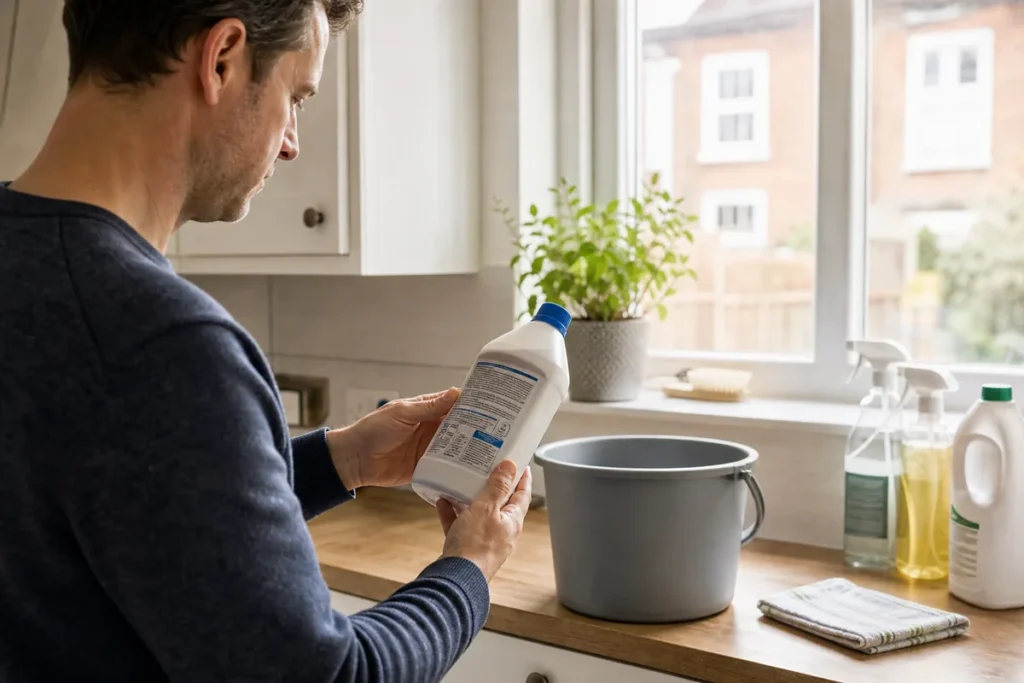
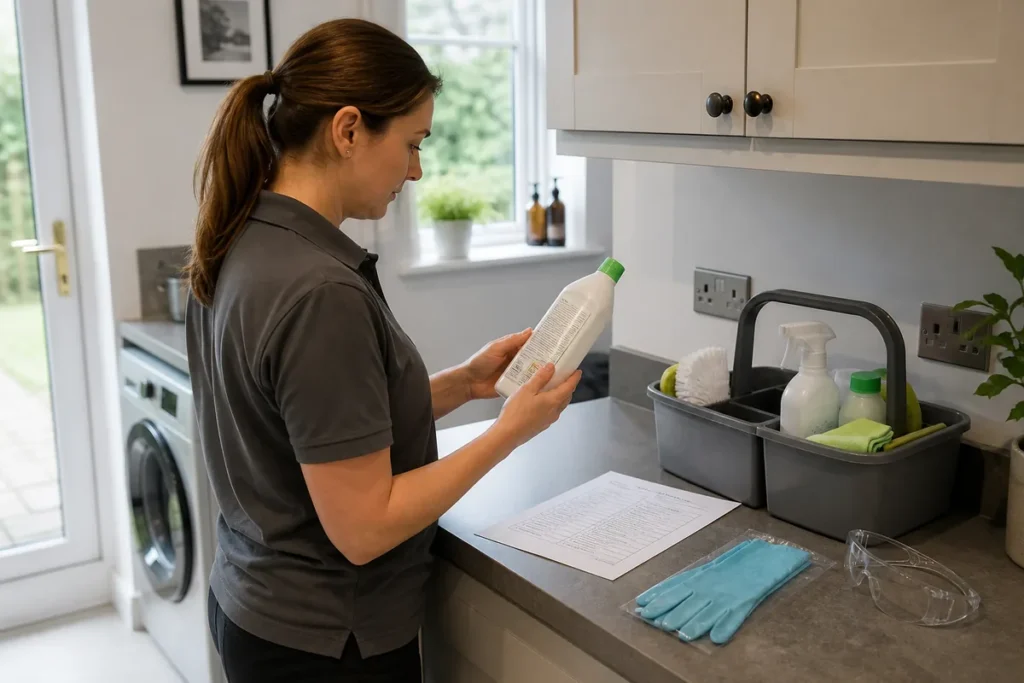
How to use cleaning chemicals safely begins with the complete label, the exact task and one product at a time. Before opening a bottle, confirm what it is for, which surfaces it can touch, whether it needs dilution, what ventilation or protective equipment the manufacturer requires and what to do if exposure occurs.
Household cleaners are not interchangeable, and a familiar smell or colour does not reveal their hazards. The decisions below apply in homes and workplaces, with separate legal contexts for each setting.
Key Takeaways
- Read every part of the label, not only the pictogram.
- Never invent a stronger dose or combine products to save time.
- Match gloves, eye protection and ventilation to the product and task.
- Store chemicals upright, closed, locked away and in their original containers.
- At work, the label and SDS support a COSHH assessment. They do not replace it.
Table of Contents
How to use cleaning chemicals safely starts with the full label
A hazard pictogram is a prompt to keep reading, not a complete set of instructions. Read the full label: hazard statements describe the hazard, and precautionary statements explain safe use and any protective equipment. The directions also settle concentration, application, contact time, rinsing and storage.
| Label element | What it tells you | Decision before use |
|---|---|---|
| Intended use | The named task and compatible surface | Do not use it for a different job because the products look similar |
| Hazard statement | The nature and seriousness of a classified hazard | Decide whether the product is suitable for the setting and user |
| Precautionary statement | Measures for handling, PPE, response, storage or disposal | Put those controls in place before opening the container |
| Dilution and dose | The correct concentration or ready-to-use status | Measure exactly; do not make the solution stronger |
| Contact and rinsing | How long the product stays and whether residue must be removed | Plan the full method before applying it |
| Emergency details | Product-specific action and supplier contact | Keep the label and packaging available throughout the task |
Check product labels for a closer explanation of ingredient lists, claims and warnings. If text is unreadable, the label is detached or the contents are unknown, do not guess. Isolate the container from normal use and contact the supplier or follow an appropriate local disposal route.
Choose the product before preparing the room
Start with the soil and surface. Do not reach for a stronger cleaner by default. A limescale remover, degreaser, disinfectant, oven cleaner and general detergent solve different problems and can damage different finishes. Check sealed stone, metals, painted surfaces, plastics, fabrics and food-contact areas separately. Test where the manufacturer or surface guidance requires it.
Clear away food, utensils, toys and pet items before opening the product. Keep people who are not involved away from the working area. Gather the named applicator, measuring cap and PPE first, so you do not walk through the home with an open container or leave it unattended.
Check the room and the people using it
A product that is suitable for a tiled bathroom may be unsuitable beside unsealed stone, coloured grout, metal fittings or a painted bath panel. Map the route before starting: where will the bottle stand, how will the wet surface be kept out of use, and where will cloths or applicators go afterwards? A label instruction to ventilate the room also needs a real route for air to enter and leave.
Shared and confined spaces need extra planning. Do not begin a strong-smelling or spray-based task in a small WC, cupboard or shower enclosure when the named ventilation cannot be maintained. In a communal kitchen or workplace washroom, prevent another person from touching the treated area, moving the bottle or using a second product before the first method is complete.
Consider the user as well as the surface. A person with asthma, a skin condition, an eye condition or a known sensitivity may need to avoid a product or obtain medical or occupational-health advice. Pregnancy, age or a pet in the home does not create one universal banned-products list. Use the label, individual advice and a lower-exposure method instead of making assumptions from marketing terms such as natural, green or fragrance-free.
Use one product at a time
Do not combine cleaners unless the manufacturer explicitly instructs you to do so. In particular, never mix bleach with an acidic product such as vinegar or a limescale remover, and never mix it with an ammonia-containing cleaner. Current UKHSA guidance explains that bleach with acids can produce chlorine gas and bleach with ammonia-containing products can produce irritating chloramines.
The rule also applies when products are used one after another on the same surface. Do not add a second cleaner to residue from the first. Follow the first label’s removal or rinsing instruction, allow the area to reach the required condition and then decide whether another product is actually needed.
Opening a window does not make an incompatible mixture safe. If products are mixed accidentally and fumes, coughing, eye irritation or breathing difficulty develop, stop, move away from the source and use the emergency route described below. Do not return to investigate the mixture.
You may also enjoy:
Dilute and apply exactly as directed
A ready-to-use spray should not be concentrated. A concentrate should not be estimated by eye. Use the label’s measuring method and prepare only the amount needed. Do not assume that more product cleans faster. Excess can increase exposure, leave residue, damage a finish and create unnecessary waste.
- Follow the order: add product and water in the order printed on the label. There is no universal mixing order for every formulation.
- Control spray: use the named application method. Avoid misting into the air or spraying near faces, food, electrical openings and ventilation intakes.
- Respect contact time: a disinfectant claim depends on the labelled surface, dose and time. Wiping it away immediately may not deliver the claimed result.
- Rinse when required: especially note food-contact, child-accessible and pet-accessible surfaces. Do not add a rinse where the instructions prohibit it.
- Leave no mystery solution: never store a home-diluted mixture unless the product directions explicitly allow it and provide a safe labelled method.
Ventilation is also product- and task-specific. Use the airflow specified by the label and keep extraction routes unobstructed. A strong smell is not a reliable measure of danger, and the absence of smell does not prove that a method is safe.
Choose PPE for the product and task
Not every household cleaner requires a mask, goggles, apron and heavy chemical gloves. Equally, ordinary washing-up gloves are not automatically compatible with every concentrate. Read the precautionary statement and use the type, material and fit it specifies. Check cleaning gloves for fit, condition and compatibility decisions.
Inspect reusable PPE before use. A split glove, loose eye protection or contaminated apron can create a false sense of protection. Remove and clean or dispose of equipment according to its instructions, wash hands after the task and keep contaminated PPE away from clean household items.
Respiratory protection is not a substitute for choosing the right product, controlling exposure or improving the work method. In a workplace, selection, fit and training belong within the employer’s assessment. At home, if a label calls for controls you cannot provide safely, choose a suitable alternative or obtain specialist advice.
Prevent skin and eye contact during the whole task
Exposure often happens around the main cleaning step: opening a stiff cap, measuring concentrate, squeezing a saturated cloth, removing gloves or carrying a wet bottle back to storage. Keep the container below face level, work on a stable surface and avoid touching phones, taps, door handles or your face with contaminated gloves.
Do not reuse a food spoon, cup or kitchen jug for measuring. Use only the cap or tool named for the product, and keep it with the cleaning equipment. If a reusable cloth or applicator has a specific washing or disposal instruction, follow it before the item returns to general household use.
Store products in original closed containers
After use, wipe the outside only where the label permits, close the cap fully and return the product upright to its dedicated storage place. Keep it away from food, drink, medicines, heat and direct sunlight, and separate incompatible products when their instructions require it.
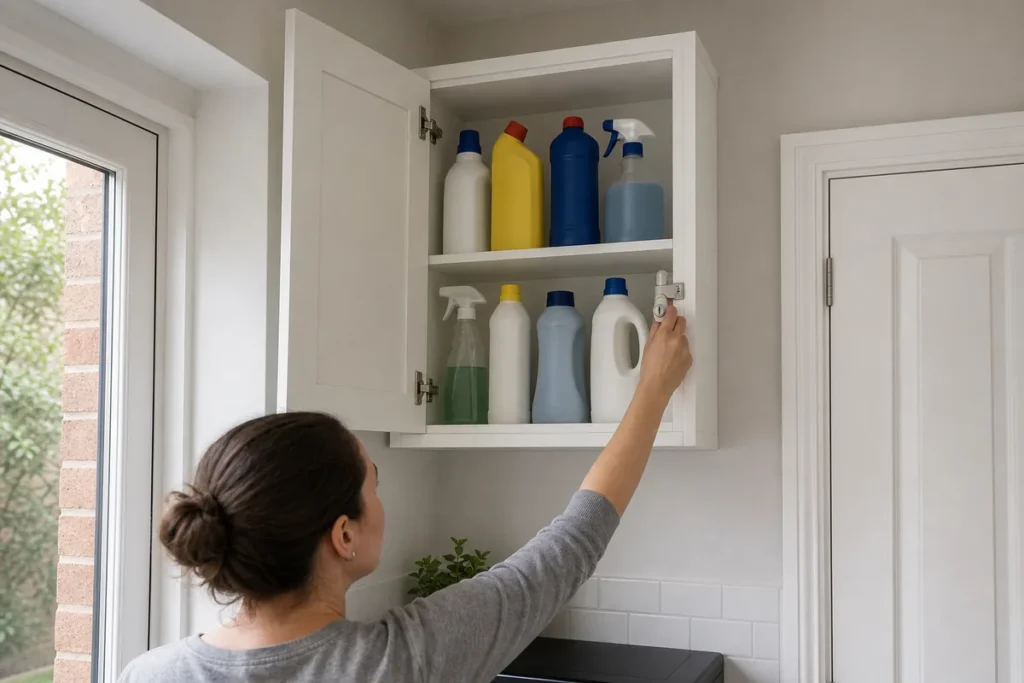
Never decant a cleaner into a drinks bottle, food jar or unlabelled spray bottle. The original container carries the identity, hazard and emergency information that another person may need. Store products out of sight and reach of children, ideally in a locked cupboard. Plan cupboard choice, segregation and damaged packaging with the detailed safe storage instructions.
Separate household instructions from workplace duties
At home, the product label, the task and the user’s circumstances drive the immediate decision. A domestic reader does not need to turn a routine bottle into a workplace training file. Stop if the instructions are missing, unclear or unsuitable for the setting.
At work, HSE guidance says employers must assess chemical risks and implement and maintain effective controls. COSHH covers exposure to substances that can harm health, including products used for general cleaning. That responsibility cannot be delegated to a bottle label alone.
Control exposure before relying on PPE
A workplace assessment starts by asking whether the hazardous product or process is needed at all. A ready-to-use dose-control system, a less hazardous product, a closed dispensing method or a different application tool may reduce exposure more reliably than asking every cleaner to manage an open concentrate. The chosen control must still clean the named surface to the required standard.
The assessment should describe who may be exposed, how often, for how long and by which route. It should cover delivery, storage, dilution, use, spill response and disposal, not only wiping the surface. Employers also need a workable response for damaged packaging, missing labels and symptoms during a shift, plus training that staff can understand and follow.
PPE deals with the remaining exposure after suitable controls have been selected. The equipment must be compatible, available in the right sizes, maintained and replaced when damaged or contaminated. A generic instruction to wear gloves is incomplete when the glove material, breakthrough risk, cuff length and removal method have not been considered for the actual product.
| Information source | Useful for | What it does not replace |
|---|---|---|
| Consumer or supply label | Hazards, precautions and product directions | A work-specific risk assessment |
| Safety data sheet | Hazards, handling, storage and emergency information | COSHH decisions for the actual people, task and site |
| COSHH assessment | Elimination, substitution, controls, training and response | Following the product instructions during the task |
A safety data sheet helps the employer make the assessment. It is not the assessment itself. The employer must consider concentration, frequency, duration, ventilation, vulnerable workers, storage, spills and how the product is actually used. Staff need understandable instructions and the equipment required by the chosen controls.
Know when to stop and seek help
For a small spill covered by the label, isolate the area and follow the named clean-up and disposal method. Do not kneel in the liquid, create airborne spray, use an incompatible absorbent or improvise a neutralising mixture. An unknown product, damaged container, larger spill, persistent fumes or contamination entering a drain, electrical fitting or ventilation system needs the supplier, employer procedure, local authority or an appropriate specialist.
If someone may have swallowed, touched or breathed in something harmful, follow the label and current NHS guidance. Call 999 or go to A&E for suspected harmful exposure or severe symptoms such as major breathing difficulty, loss of consciousness or a seizure. Call NHS 111 if you are unsure whether an exposure is harmful. Keep the packaging available for healthcare staff.
Do not try to make someone vomit and do not give food or drink after suspected poisoning. Leave a fume-filled space. Do not stay to open windows or clean up. Product-specific medical advice overrides generic cleaning guidance.
Dispose of leftovers through the right route
Use the product label and your council’s instructions to decide what belongs in household rubbish, recycling or a special collection. The GOV.UK service routes UK residents to local hazardous-waste arrangements. Do not pour an unknown or unwanted cleaner into a sink, toilet, outside drain or soil.
Keep different leftovers separate in their original closed containers during disposal arrangements. Do not combine small amounts to save space. Broader routines for packaging, food waste and local collection decisions belong under household waste.
How Samyx Cleaning Can Help
SAMYX regular domestic cleaning covers agreed routine cleaning with suitable products and methods for accessible household surfaces. Tell the team about material restrictions, allergies, pets, children and any product the household requires or prohibits before the visit.
The service is not hazardous-material response. Unknown spills, unlabelled mixtures, suspected toxic fumes, sewage, sharps, asbestos, pesticides, industrial chemicals and specialist decontamination need the appropriate emergency, landlord, employer or specialist route. Removing those uncertainties before a booking protects both the household and the cleaner.
Book Regular Domestic Cleaning
Enter your postcode to view our rates and availability in your area.

Frequently asked questions
-
Which cleaning products should never be mixed?
Use one cleaning product at a time unless a manufacturer explicitly instructs otherwise. Never mix bleach with acidic products, including vinegar and many limescale removers, or with ammonia-containing cleaners. Do not add a second product to residue from the first.
-
Do hazard pictograms tell me everything I need to know?
No. A pictogram is only one part of the label. Read the hazard statements, precautionary statements, intended use, dilution, contact time, rinsing, storage, disposal and emergency information before using the product.
-
Do household cleaning products need a COSHH assessment?
COSHH is a workplace duty. A person using an ordinary consumer product at home should follow its full label. An employer using cleaning chemicals at work must assess and control exposure for the actual task; a label or safety data sheet helps but does not replace that assessment.
-
What should I do after possible chemical exposure?
Stop the task, move away from the source when needed and follow the product label. Use the current NHS route: call 999 or go to A&E for suspected harmful exposure or severe symptoms, and call NHS 111 if you are unsure whether the exposure is harmful. Keep the packaging available and do not induce vomiting or give food or drink after suspected poisoning.
Safety note: These steps support routine household and workplace cleaning decisions. They are not a substitute for the product label, supplier instructions, a workplace COSHH assessment, medical advice or specialist incident response. If exposure, symptoms, fire, fumes or an unknown spill creates immediate danger, leave the area and use the appropriate emergency service.
Author: Svetlana Georgieva (Clara)
Hi, I’m Svetlana Georgieva, but you can call me Clara. As the co-founder and heart behind Samyx Cleaning, I’m devoted to sharing the art of a clean space. Let’s journey into a cleaner, more joyful life together with tips from London's cleaning experts.

Discover more of our cleaning secrets: