
PPE for Domestic Cleaning: A Task-Based UK Guide

Last modified on: 18/08/2026
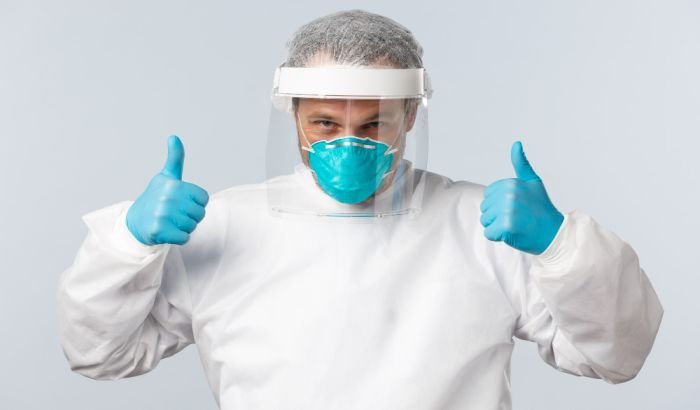
PPE for domestic cleaning should match the task, product, exposure route, working time and person wearing it. Routine dusting, wet bathroom cleaning and use of a corrosive oven product do not create the same risks, so they should not trigger the same equipment list.
The first decision is whether exposure can be prevented through a safer product, better tool or different method. Personal protective equipment deals with the risk that remains. It does not make an unsafe mixture, unknown spill or unsuitable task safe.
Key Takeaways
- Choose PPE from the task, not from a universal list.
- Control splashes, dust and contact before relying on PPE.
- Match glove material and eye protection to the product.
- Inspect, clean, store and replace equipment as instructed.
- Stop when ordinary domestic cleaning becomes specialist work.
Table of Contents
PPE for domestic cleaning starts with the task
A cleaner needs to know what may reach the skin, eyes or lungs and whether there is a slip, puncture or impact risk. Product marketing and bottle colour are not enough. Read the complete label, use the workplace assessment where applicable and consider how the product will actually be measured, applied and removed.
| Domestic task | Main exposure question | PPE decision | Stop or escalate when |
|---|---|---|---|
| Dry dusting and vacuuming | Can dust be captured without making it airborne? | Normal work clothing and suitable closed footwear may be enough; add task-specific protection only when the assessment requires it | Suspected asbestos, hazardous dust, infestation residue or heavy unknown contamination is present |
| Routine wet cleaning | Will hands be wet repeatedly or contact detergent? | Product-compatible gloves may be needed; use an apron or work clothing where splashes or soiling are foreseeable | The product label cannot be read or the surface and chemical are incompatible |
| Bathroom descaling | Could an acidic product splash skin or eyes? | Follow the label for compatible gloves and eye protection; control the dose and application first | Bleach residue, an unknown previous product or inadequate ventilation creates an unsafe situation |
| Oven or strong degreaser use | Is the product corrosive, irritating or aerosolised? | Use only the label and assessment requirements for gloves, clothing and eye protection | The task needs a mixture, improvised dilution, confined-space use or controls that cannot be provided |
| High-touch surface cleaning | Is cleaning enough, or is a specific disinfectant process required? | Select PPE for the actual product and exposure, not for the word disinfection alone | The setting has an outbreak, clinical requirement or bodily-fluid contamination outside the agreed scope |
| Waste handling | Could the bag contain sharp, leaking or unknown material? | Use task-suitable gloves and closed footwear only for ordinary known household waste | A sharp, chemical leak, clinical waste or unidentified item is found |
The same room may need different decisions at different stages. Gloves selected for a diluted detergent may not be suitable for a concentrated descaler. Eye protection may be reasonable during dosing of a splash-risk product and unnecessary during later dry polishing. Review the decision when the product, method or environment changes.
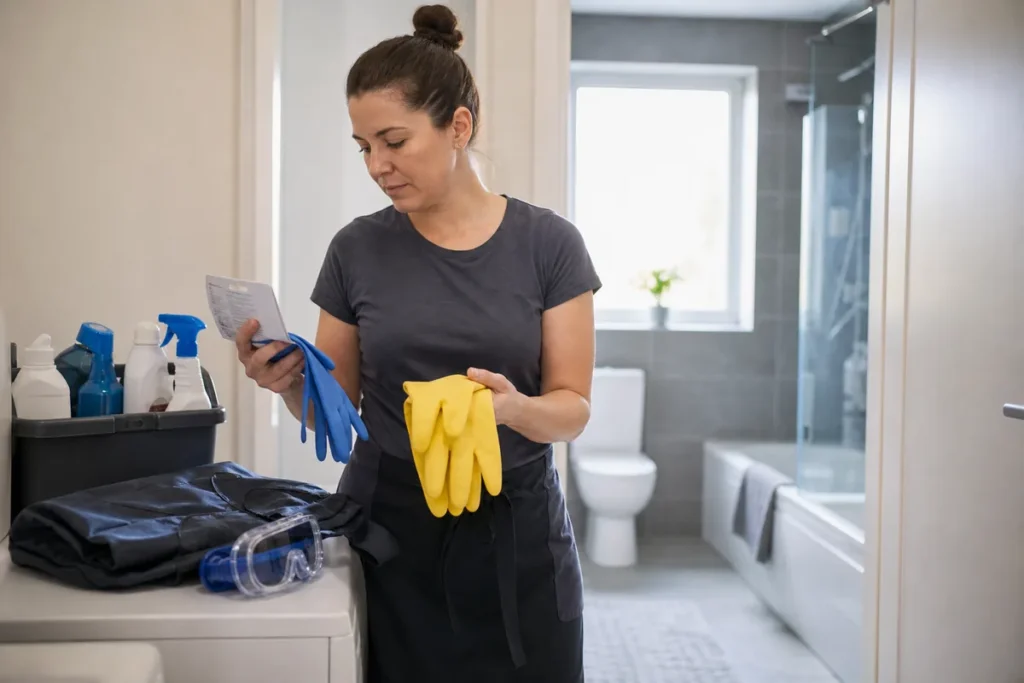
Control exposure before relying on PPE
Current HSE PPE guidance places personal equipment after other measures that can control exposure. PPE protects only the wearer when it is correctly worn. If it fails, is removed early or is wrong for the substance, the barrier disappears.
- Remove the need: do not disinfect a surface when ordinary cleaning meets the task.
- Choose a safer method: use a ready-to-use or controlled-dose product where it provides the required result with less handling.
- Control the application: apply to a cloth when the label permits instead of spraying into the breathing zone.
- Separate the area: keep other people, food, pets and unrelated equipment away from the active task.
- Provide airflow: meet the label or assessment requirement without treating an open window as permission for a prohibited use.
The HSE’s cleaner advice notes that controls depend on the task and may combine good technique, safe storage, hand care, ventilation and, for some work, gloves, aprons or eye protection. Wider decisions about high-touch surfaces should settle cleaning versus disinfection before stronger chemistry or extra PPE is introduced.
You may also enjoy:

Choose cleaning gloves by substance and contact
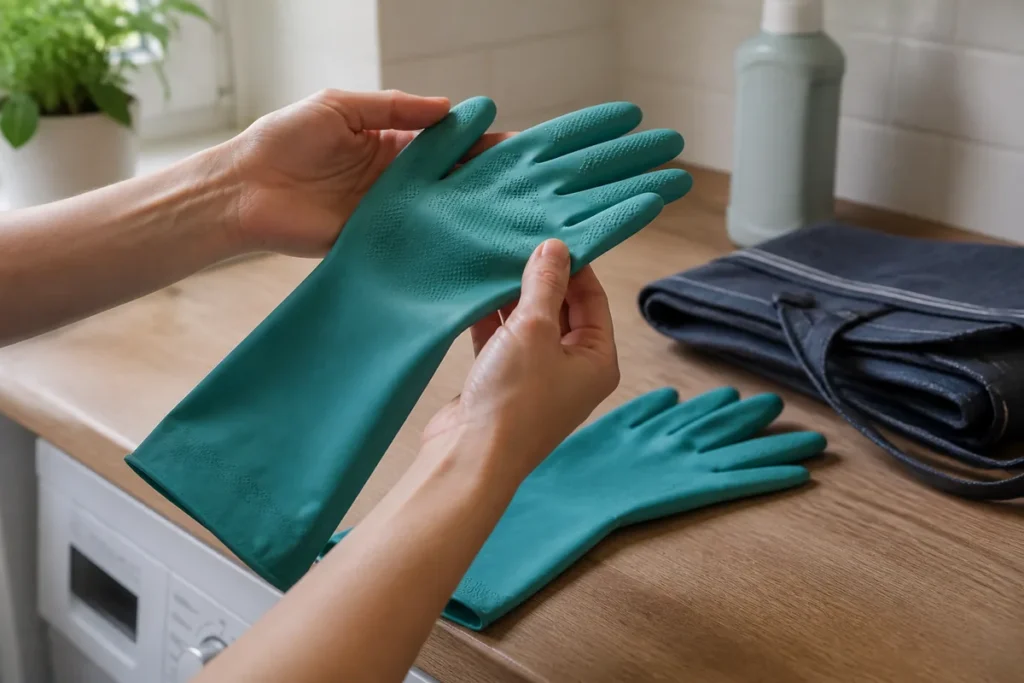
No glove material protects against every product or for an unlimited time. The HSE glove checks start with the substance, other hand hazards, type and duration of contact, wearer and task. Product labels, safety data sheets and glove-manufacturer compatibility data should agree with the final selection.
Reusable household gloves can be practical for repeated wet work when their material is compatible and they remain intact. Single-use gloves may suit a short defined task; thin material is not automatically chemical-resistant. Natural rubber latex can also create allergy concerns, so employers need a reason for the chosen material instead of relying on habit or colour code.
Fit affects protection and control. A glove that is too tight can tire the hand; one that is too loose can reduce grip and dexterity. Cuff length should match the likely splash or immersion depth. A textured surface may help with wet tools; grip does not prove chemical compatibility. Read more about fit, condition and household handling on our cleaning gloves page.
Check gloves before and after use
- Inspect fingers, seams, palm and cuffs for splits, swelling, stiffness, stickiness or loss of shape.
- Keep the inside clean and dry; a contaminated lining can expose the skin during the next task.
- Remove gloves without touching the contaminated outer surface with bare skin.
- Clean reusable gloves only by the manufacturer’s method and replace them when protection or hygiene cannot be restored.
- Wash and dry hands after removal, then report persistent redness, cracking, itching or other skin symptoms through the appropriate health route.
Aprons, work clothing, footwear and eye protection
An apron or protective work layer is useful when the assessment identifies splashes, repeated wet contact or contamination of normal clothing. The material must match the substance and task. A disposable apron is not automatically better than a washable one, and neither belongs in food or rest areas when contaminated.
Work clothing needs a defined laundering and storage route. Do not shake contaminated items, combine them casually with household laundry or return a damp apron to the clean kit. Remove heavily contaminated clothing according to the product or incident procedure instead of carrying the contamination through the property.
Footwear should suit the floor, liquid, movement and duration of work. Closed footwear with stable grip may help during routine domestic cleaning. A slip-resistant sole cannot compensate for trailing cables, wet-floor access or poor spill control. Footwear that becomes soaked, contaminated, split or smooth underfoot needs attention before the next task.
Eye protection is chosen for the type and direction of splash, mist, dust or impact. Ordinary prescription glasses are not automatically protective eyewear. Safety spectacles, goggles and face shields protect differently, and a face shield may leave gaps around the face. Use the product and equipment instructions to select equipment that fits the wearer and works with any other PPE.
Masks and respirators are not interchangeable
A face covering, a loose disposable mask and respiratory protective equipment do not provide the same function. Routine domestic cleaning does not create a universal need for a respirator. Dust and mist should first be controlled at source through the right product, tool, application and ventilation.
If a workplace assessment still requires RPE, the employer must select equipment for the contaminant, concentration, task and wearer. Current HSE RPE information covers selection, face-fit testing, correct use and maintenance. Tight-fitting equipment depends on an effective seal, so facial hair, other PPE and face shape can affect protection.
RPE must not be used as permission to mix products, enter a room with unexplained fumes or tackle suspected asbestos, hazardous mould disturbance or an unknown airborne contaminant. Leave the area and use the correct emergency, employer or specialist route.
Fit, compatibility and maintenance decide whether PPE works
Each item must fit the wearer and work with the others. Goggles can disturb a respirator seal, thick gloves can reduce safe grip, and an apron can create entanglement or heat stress during the wrong task. Trial the complete set through the real movement required, not solely in a standing position.
| Check | Before use | After use | Replace or stop when |
|---|---|---|---|
| Gloves | Correct material, size, cuff and intact surface | Remove safely; clean and dry reusable pairs as instructed | Split, swollen, sticky, stiff, contaminated inside or beyond permitted use |
| Apron or clothing | Compatible material, coverage and freedom of movement | Segregate, clean or dispose through the defined route | Torn, permeated, heavily contaminated or unable to fasten |
| Eye protection | Correct splash or impact rating, clear lens and stable fit | Clean without scratching; store away from contamination | Cracked, deeply scratched, cloudy or no longer seals as required |
| Footwear | Stable fit, suitable sole and dry interior | Clean contamination and dry fully | Split upper, damaged sole, lost grip or internal contamination |
| RPE | Correct type, fit check and compatible equipment | Follow the maintenance, filter and storage programme | Failed check, damaged seal, saturated filter or unknown exposure |
Do not invent a fixed replacement date for every item. Some equipment is single-use, some has a service life, and some is replaced on condition or manufacturer limits. Record workplace checks where the assessment requires them and make defects easy to report before a cleaner feels pressured to continue.
Employers must provide equipment and training
Where PPE is required for work, the employer is responsible for providing, replacing and paying for it. Selection should involve the cleaner because size, comfort, dexterity and compatibility affect whether equipment can be worn correctly throughout the task.
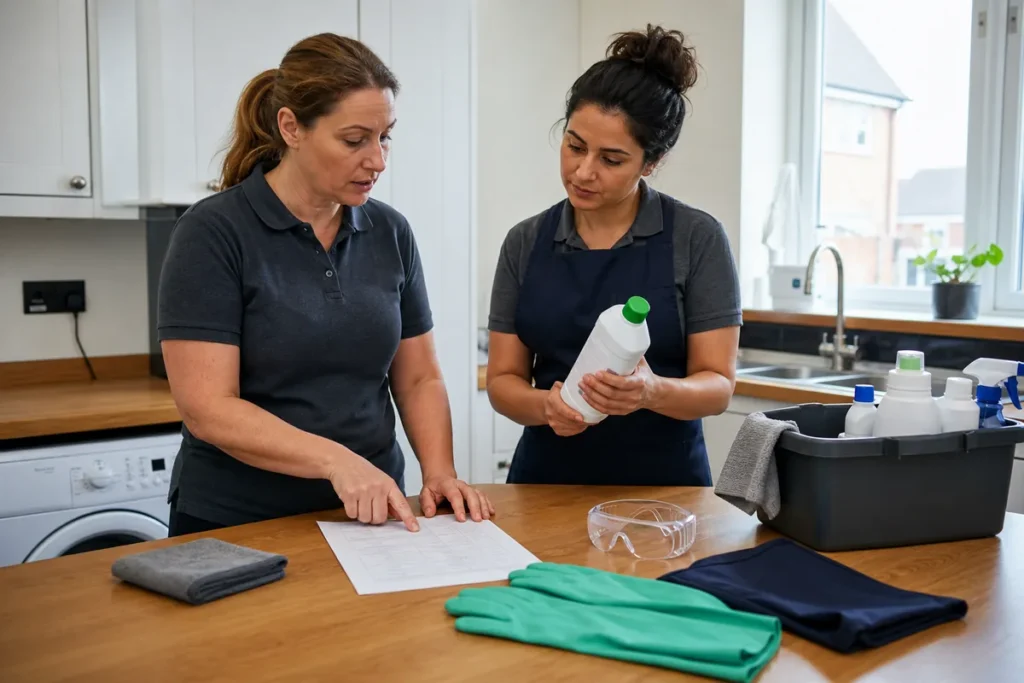
Training should explain the hazard, control method, reason for each item, fitting, pre-use check, removal, cleaning, storage, replacement and defect-reporting route. A worker also needs authority to stop when the product, equipment or site does not match the assessment. A signed sheet without an understandable method is not enough.
Review the decision when a product, concentration, tool, property type or task changes, or when skin symptoms, splashes, near misses and damaged equipment reveal a problem. Household preferences can be discussed. The client should not substitute their own PPE list for the employer’s workplace assessment.
Know when PPE is not the answer
Routine domestic PPE does not create competence, equipment or authorisation for specialist hazards. Stop the task and isolate access where practical if the cleaner finds a needle or other sharp, unknown chemical, suspected asbestos-containing material, sewage, clinical waste, substantial bodily-fluid contamination, extensive mould, pest treatment residue, fire damage or another unassessed substance.
The same boundary applies to unsafe height, exposed wiring, a damaged appliance and a fume-filled room. Gloves do not prevent a fall, goggles do not make live electrical work safe, and a mask does not identify an unknown gas. Use the property owner, employer, emergency service or qualified specialist appropriate to the hazard.
Product selection also remains separate from PPE. Check product safety before introducing stronger chemistry, and use suitable cleaning tools to reduce awkward handling and uncontrolled spray.
How Samyx Cleaning Can Help
SAMYX regular domestic cleaning covers agreed routine cleaning of accessible household surfaces. Product and equipment choices follow the task, surface and service scope, without imposing a fixed costume for every visit.
Tell the team about allergies, sensitivities, pets, children, restricted products, fragile surfaces and any unusual material before the booking. Unknown spills, sharps, sewage, suspected asbestos, extensive mould, pest chemicals, clinical waste, specialist decontamination and unsafe access are outside routine domestic cleaning and need an appropriate route.
Book Regular Domestic Cleaning
Enter your postcode to view our rates and availability in your area.

Frequently asked questions
-
What PPE is normally considered for domestic cleaners?
Common considerations include product-compatible gloves, an apron or work clothing, suitable closed footwear and eye protection where a splash risk remains. A mask, respirator, face shield or coverall is not a universal requirement. The correct selection follows the task, product label, exposure route and workplace assessment.
-
Does a domestic cleaner need to wear a mask?
Not for every task. Dust, spray and vapour should first be controlled through the product, method, tool and ventilation. If a workplace assessment still requires respiratory protective equipment, the employer must select the correct type and provide fit testing, training, checks and maintenance where applicable.
-
When should cleaning gloves be replaced?
Replace single-use gloves after the defined task and never reuse them. Replace reusable gloves when they are split, swollen, sticky, stiff, contaminated inside, no longer fit or have reached a manufacturer limit. The product and glove manufacturers’ compatibility information controls the decision.
-
Who pays for PPE used by a domestic cleaner at work?
When workplace PPE is required, the employer is responsible for providing, replacing and paying for it. The employer must also make sure it is suitable, compatible, correctly fitted and supported by understandable training and maintenance arrangements.
Safety note: These decisions support routine domestic cleaning. They do not replace a product label, safety data sheet, workplace risk or COSHH assessment, equipment instructions, medical advice or specialist hazard procedure. Stop when the substance, exposure or task is unknown or outside the agreed competence and service scope.
Author: Svetlana Georgieva (Clara)
Hi, I’m Svetlana Georgieva, but you can call me Clara. As the co-founder and heart behind Samyx Cleaning, I’m devoted to sharing the art of a clean space. Let’s journey into a cleaner, more joyful life together with tips from London's cleaning experts.

Discover more of our cleaning secrets: