
DIY Cleaning Products Safety: What Never to Mix or Store

Last modified on: 04/08/2026

DIY cleaning products safety begins with a simple question: is this mixture suitable for this exact task, surface and household?
A homemade cleaner can be useful for light soil on a compatible surface. It is not automatically non-toxic, child-safe, pet-safe or more effective than a labelled product. The ingredients, strength, way it is applied, ventilation, storage and possible exposure all matter. The safest routine is often a small, clearly identified batch made for one known job, not a mystery bottle kept under the sink.
Choose the task before choosing the ingredients
- Identify the soil, surface and result you need. Cleaning, descaling and disinfection are different jobs.
- Use one known method at a measured strength. Do not combine cleaners or add an ingredient to a commercial product.
- Work with ventilation, protect skin and eyes as the task requires, and test an inconspicuous area.
- Label any homemade batch, keep it away from children and pets, and never use a food or drink container.
- Use a labelled product when the chemistry, surface, storage life or hygiene requirement is uncertain.
Key takeaways
- Homemade and natural describe where a cleaner came from, not whether it is harmless or right for the job.
- Never mix bleach with vinegar, lemon, citric acid, ammonia or another cleaning product.
- A clear label, preparation date and dedicated container prevent mistaken identity; commercial chemicals stay in their original containers.
- Vinegar and bicarbonate can each have limited uses. Combining them consumes much of the useful acid and alkali.
- For disinfection, unknown materials or a high-risk task, choose a suitable labelled product or specialist guidance.
Table of Contents
Are homemade cleaning products safe?
They can be suitable for a limited job when you know every ingredient, measure it, control exposure and confirm surface compatibility. That is a conditional answer, not a blanket safety claim. White vinegar is acidic. Bicarbonate is alkaline and mildly abrasive. Lemon juice contains acid and may leave organic residue. Even water can damage unsealed timber, electronics or moisture-sensitive finishes.
Risk depends on both hazard and exposure. A substance may irritate skin or eyes, produce vapour, be swallowed, be sprayed into the air or damage a surface. The person using it also matters. A home with a crawling child, a curious pet, asthma, allergies or a vulnerable resident needs tighter controls than a generic recipe usually states.
Marketing language cannot answer those questions. For a commercial cleaner, read the ingredient labels, hazard statements and directions together. For a homemade mixture, you take responsibility for the formula, container, use and storage because there is no finished-product label to do that work.
DIY cleaning products safety by task and surface
Start with the least aggressive method that can remove the soil. Dry dusting, warm water and a suitable microfibre cloth may be enough. If a product is needed, choose it for the contaminant and material, not because the ingredient is popular online.
| Option | Possible household use | Main limit | Safer decision |
|---|---|---|---|
| Warm water and mild detergent | Everyday grease and general soil on washable surfaces | Too much detergent leaves residue; excess water can enter joints or damage sensitive finishes | Use the surface maker’s method and wring the cloth well |
| Diluted white vinegar | Some mineral deposits on acid-resistant surfaces | Acid can etch natural stone and affect grout, metals, seals and finishes | Confirm the material first and follow the maker’s care guide |
| Bicarbonate of soda | Limited deodorising or gentle abrasion on compatible durable surfaces | Particles can scratch polished, coated or delicate finishes | Test a hidden area and avoid hard scrubbing |
| Lemon or citric acid | Selected limescale work on acid-resistant materials | Acid and residue can mark or dull unsuitable surfaces | Use a measured method and rinse only when the surface instructions allow it |
| Labelled cleaner | Defined cleaning or disinfection task | Still requires correct dilution, contact time, ventilation and storage | Choose a product that names the task and surface |

What cleaning products should never be mixed?
Do not mix bleach with acids. Vinegar, lemon juice, citric acid and many toilet or descaling products are acidic. Contact with a bleach product can release harmful chlorine gas. This also means you should not use one after the other on the same wet surface unless the first product has been removed exactly as its label directs.
Do not mix bleach with ammonia. Ammonia may be present in some cleaners, and it can also occur in household contamination. The combination can release harmful vapours. Never try to improve a bleach solution by adding another product.
Do not combine cleaning products. Two individually familiar products can react, increase exposure or cancel the effect you wanted. The HSE safety sheet specifically warns that bleach products mixed with acidic toilet cleaners or ammonia give off harmful gases. The practical household rule is simpler: use one product at a time and follow its label.
If you notice sharp fumes, coughing, eye irritation, breathing difficulty or feel unwell, stop. Leave the area and get fresh air if you can do so without further exposure. Do not add another chemical to neutralise the mixture. The NHS poisoning advice says to get medical advice immediately when someone may have swallowed, touched or breathed in something harmful; use 999 for severe breathing difficulty, collapse or another urgent incident, and NHS 111 when you are unsure.
Prepare one simple cleaner without creating a new risk
- Read before you pour. Check every package and reject a recipe that adds a homemade ingredient to a commercial cleaner.
- Clear the work area. Move food, crockery, children’s items and pet bowls away. Open a window or use the room’s extraction where appropriate.
- Use clean equipment. A measuring jug, spoon or funnel must not carry residue from another cleaner. Never use the equipment again for food.
- Measure a small batch. More ingredient does not mean more cleaning. An over-strong acid, alkali or detergent can damage surfaces and increase exposure.
- Protect against the real route. Wear suitable gloves when skin contact is possible and eye protection where splashing may occur. Avoid making a fine spray that is easy to breathe in.
- Patch test and observe. Stop if colour transfers, gloss changes, coating softens, metal discolours or the surface reacts unexpectedly.
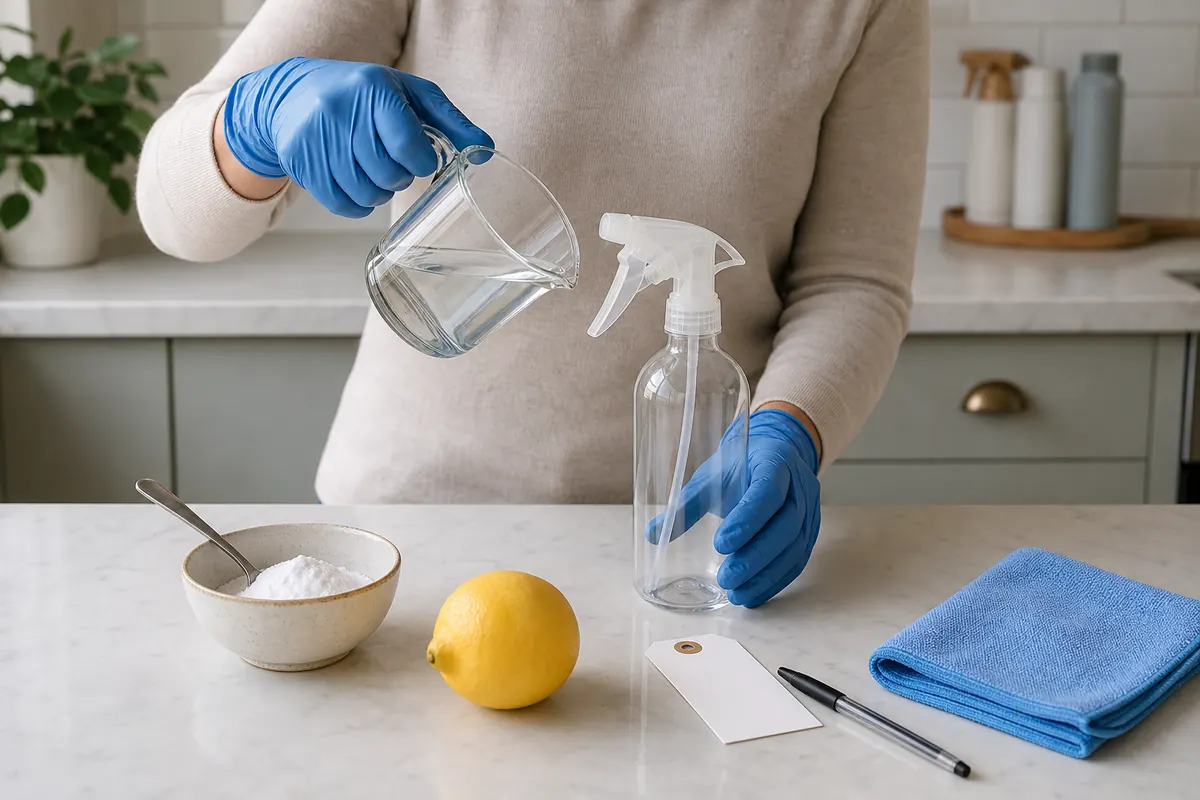
Do not prepare a spray simply because spraying looks convenient. A damp cloth often puts less material into the air and gives better control near sockets, appliances and edges. Apply to the cloth when the surface maker permits it; never spray into vents or directly onto powered equipment.
Gloves must suit the product and task. Replace a torn or contaminated pair, wash your hands after removal and do not touch your face, phone or cupboard handles with dirty gloves. Gloves do not make an unknown mixture safe, and contaminated liquid can enter through the cuff or remain inside. Eye protection is a separate decision where pouring, splashing or overhead work creates a route to the eyes. Keep the preparation zone dry and well lit throughout.
Get Help With Safer Cleaning
Enter your postcode to view our rates and availability in your area.

Label and store homemade cleaners clearly
A plain bottle becomes risky when nobody can identify it. Mark the full contents, intended use and preparation date. Add any known surface exclusion and the instruction not to mix it with other products. If a label becomes wet or unreadable, replace it immediately.
Never put cleaner in a water, juice or soft-drink bottle. Someone may mistake it for a drink. Keep homemade mixtures away from food and medicines, out of children’s reach and away from pets. The bottle should be stable, closed and compatible with its contents. Do not assume that a container is suitable because it has a spray head.
Commercial products should remain in their original containers with their hazard information, child-resistant closure and instructions. The HSE label guidance explains how hazard statements, precautions and pictograms work together. Pouring that product into an anonymous bottle removes the information needed during normal use or an exposure incident.
There is no useful universal shelf life for every water-based homemade cleaner. Ingredients can degrade, separate or become contaminated, and the container changes the result. Make only what you need for a short, known task. Discard a mixture when its identity or age is uncertain, its appearance or smell changes, the container swells or leaks, or you no longer know whether the surface is compatible. Follow local disposal guidance and never combine leftovers.
Write a recipe record, not just a bottle label
The bottle label tells the next person what is inside. A separate recipe record tells you whether the method can be repeated safely. Note the exact ingredient names, measured amounts, water volume, container used, intended surface, test result and date. Copy any surface-maker restriction beside the method. Do not rely on a photo of unlabelled jars or a social post that may later disappear.
Record one formula per card. If you change the concentration, container or application method, treat it as a different formula and reassess it. This prevents a weak dilution from slowly becoming a stronger one through memory and assumption. It also lets another adult decide whether to use, remake or discard the batch without opening and smelling it.
Plan for children, pets and vulnerable residents
Make and use cleaners when children and pets are away from the work zone. Close the container between uses, remove measuring equipment and clean up drips before reopening the room. A high shelf is not always secure: cats climb, children move chairs and bottles fall. Use a closed or locked cupboard where household risk calls for it.
Do not describe a cleaner as pet-safe or child-safe merely because the ingredients are found in food. Concentration, contact with paws or skin, licking, aerosols and residue change the exposure. Fragrances and oils also vary. If a resident has asthma, an allergy or another health concern, ask the appropriate clinician for personal advice and choose an unsprayed, low-exposure method where suitable.

Cleaning is not the same as disinfection
Cleaning removes soil and lowers the material available for microbes to persist in. Disinfection is a defined product-and-process task. It depends on the active ingredient, concentration, surface, wet contact time and application instructions. A recipe that makes a surface look clean is not automatically a validated disinfectant.
For ordinary household soil, start with cleaning. If illness, body fluid, food hygiene, a care need or another situation calls for disinfection, select a labelled product that names the intended use. Follow its dilution, contact time, rinsing, ventilation and material instructions. Do not modify it with vinegar, fragrance, oils or another cleaner.
You may also enjoy:

Common ingredients still have limits
Vinegar and lemon are acids
Acid can help with some mineral deposits. It can also etch marble and other calcareous stone, affect grout, tarnish metals and damage coatings or rubber parts. Check the material and maker’s advice before use. Our guide to vinegar limits covers the surfaces that need another method.
Bicarbonate is mildly abrasive
Bicarbonate can help with some odours and light soil. Its particles can also dull polished finishes, scratch soft materials or lodge in joins. A paste becomes more abrasive as pressure and rubbing increase. Test first, use little pressure and stop when the finish changes.
Vinegar plus bicarbonate is not a stronger cleaner
The fizz looks active because an acid-base reaction releases carbon dioxide. During that reaction, much of the acid and alkali are consumed. The bubbles may provide a brief mechanical effect in a loose residue. The combined liquid is not a stronger version of both ingredients. Use each ingredient only where it has a compatible, separate purpose. See the fuller explanation of baking soda and vinegar.
Fragrance does not make a mixture safer
Adding lemon peel or an oil can introduce fragrance compounds, residue and another exposure route. A pleasant smell does not prove that a surface is clean, and it may be unsuitable around some residents or pets. Keep a formula simple and skip fragrance when it does not perform a cleaning function.
Surface damage is a stop signal
Cloudiness, a pale patch, lifted colour or a sticky coating may indicate material damage, not dirt left behind. More product and harder scrubbing can enlarge it. Blot away loose moisture using the surface maker’s instructions, stop the experiment and identify the finish before attempting correction. Natural stone, plated metal, sealed timber, painted cabinetry and appliance coatings can need different restoration routes.
When a labelled product is the better choice
Use a suitable labelled cleaner when you need disinfection, the surface has a specialist finish, the contamination is unknown, the appliance has model-specific instructions or the homemade mixture cannot be stored and identified safely. A label does not remove all risk. It gives you a defined purpose, strength, method and set of precautions that a casual recipe may lack.
Stop and get specialist advice for damaged natural stone, valuable finishes, large mould growth, sewage, body fluids outside normal household cleaning, pest contamination or any task involving an unknown chemical. General chemical safety guidance can help you identify the exposure route. It cannot identify an unlabelled substance.
Professional cleaning without a cupboard of experiments
Homemade methods make most sense for small, familiar jobs on confirmed materials. They become a poor trade when every room needs a different experiment, the cleaning burden keeps returning or you cannot check the products and surfaces properly. At that point, the issue is workload and method selection, not finding one more recipe.
Samyx regular domestic cleaning can support recurring household tasks with an agreed scope. Tell the team about sensitive materials, household requirements and any products that must or must not be used before the visit. Unknown, unlabelled or previously mixed chemicals should be removed from the work area and handled through suitable safety guidance.
Book Regular Domestic Cleaning
Enter your postcode to view our rates and availability in your area.
Frequently asked questions
-
Are homemade cleaning products safe?
They can be suitable for a limited task when every ingredient is known, measured and compatible with the surface, and when ventilation, exposure and storage are controlled. Homemade does not mean harmless. Use a labelled product when the chemistry, disinfection need, material or storage life is uncertain.
-
What cleaning products should never be mixed?
Never mix bleach with acids such as vinegar, lemon or acidic toilet cleaner, and never mix it with ammonia. Do not combine commercial cleaners with each other or add homemade ingredients to them. Use one product at a time according to its label.
-
Can vinegar and bicarbonate clean together?
The fizz is an acid-base reaction that releases carbon dioxide. During it, the vinegar and bicarbonate consume much of each other’s useful chemistry. The bubbles may briefly disturb loose residue. The mixture is not stronger than both ingredients used separately for compatible tasks.
-
How long can homemade cleaning products be stored?
There is no universal storage life for every formula. Water, ingredients, contamination and the container all affect stability. Make a small batch, label the full contents, purpose and date, and discard it when the identity, age or condition is uncertain. Never store cleaner in a food or drink container.
Safety note: This guide covers general household cleaning decisions, not medical care, poison treatment, chemical identification or specialist material restoration. If someone may have swallowed, touched or inhaled a harmful substance, follow NHS advice. Call 999 for severe breathing difficulty, collapse or another urgent incident, and use NHS 111 when you are unsure. Do not try to neutralise an unknown mixture.
Author: Svetlana Georgieva (Clara)
Hi, I’m Svetlana Georgieva, but you can call me Clara. As the co-founder and heart behind Samyx Cleaning, I’m devoted to sharing the art of a clean space. Let’s journey into a cleaner, more joyful life together with tips from London's cleaning experts.

Discover more of our cleaning secrets: