
Best Way to Clean Sofa Fabric Safely

Last modified on: 27/07/2026
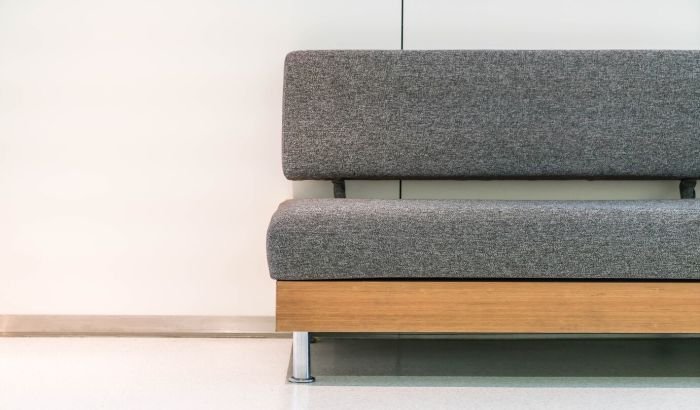
The best way to clean sofa fabric is to identify what the upholstery can tolerate, remove dry soil first, test one compatible treatment and use as little moisture as the job allows. A sofa that looks hard-wearing can still contain unstable dye, a water-sensitive finish or absorbent filling, so the care label and the manufacturer’s instructions should guide every decision.
Match the method to the sofa care code
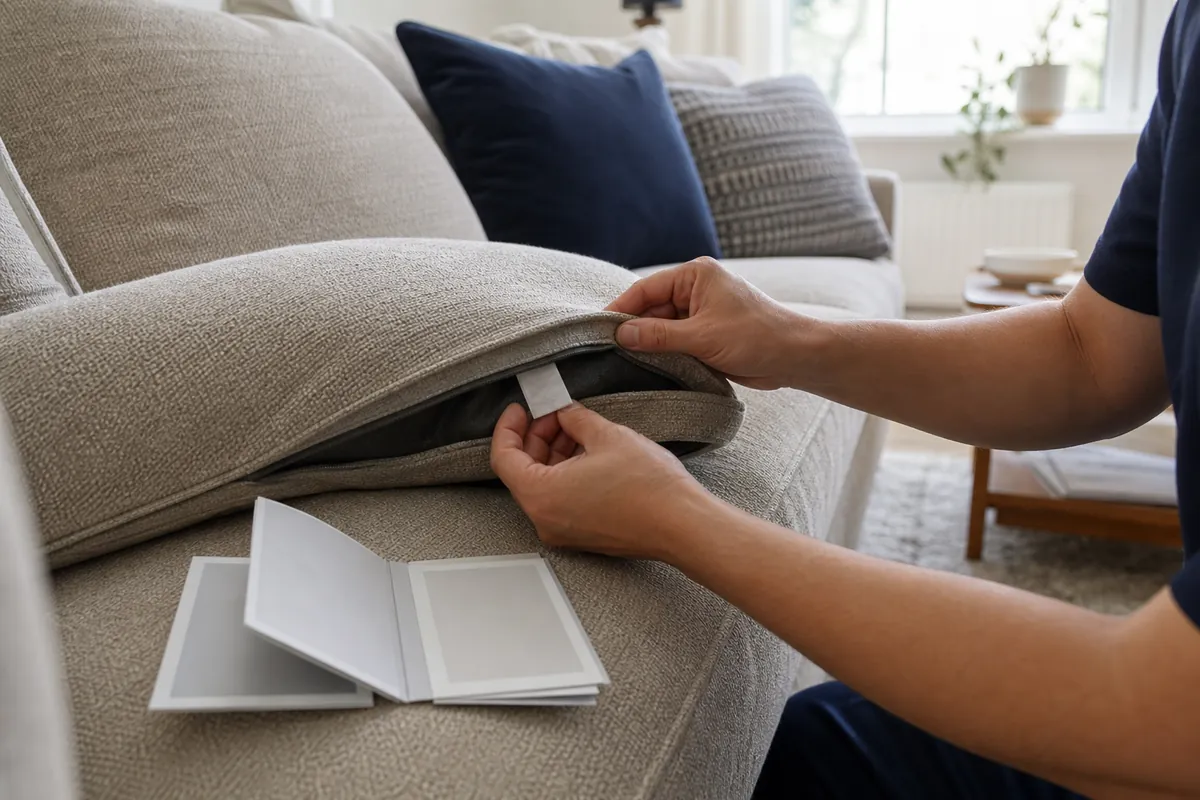
- Find the care label and read the manufacturer’s instructions. Do not assume that a removable cover is machine-washable.
- Remove cushions where possible, inspect the fabric and vacuum the surface, seams and crevices before using any liquid.
- Patch-test one upholstery-compatible treatment in a hidden area. Blot a mark from its edge towards the centre without rubbing it wider.
- Remove treatment residue, reshape the fabric and allow every layer to dry completely. Stop if the code is X, the dye transfers, the texture changes or the filling becomes wet.
Key takeaways
- The safest method depends on the upholstery, backing, dye, filling and manufacturer’s instructions, as well as the visible stain.
- Dry vacuuming comes before spot treatment because dampening loose soil can turn it into a harder-to-remove mark.
- A hidden-area test should check colour transfer, texture, rings and residue after the test area has dried.
- More solution is not more effective. Controlled application, blotting and residue removal reduce the risk of overwetting.
- Cushions should not be replaced or used until the covers, seams and filling are fully dry.
Table of Contents
Read the care code and assess the sofa
Begin with the label beneath a seat cushion, under the frame or inside a zip opening. Some upholstery uses W, S, W/S or X codes. Other furniture provides written instructions or no usable code at all. These letters are a starting point, not permission to ignore the full label. Codes are not applied identically by every manufacturer, and a cleaning product’s own directions still matter. Learning how to read product labels helps you compare the permitted fabric method with the product’s intended surface and application.
| Label or condition | What it generally indicates | Practical decision |
|---|---|---|
| W | A water-based upholstery method may be allowed | Use only a fabric-compatible product, patch-test it and control moisture |
| S | A water-free solvent method may be required | Do not substitute water, washing-up liquid or a water-based machine; consider a trained cleaner |
| W/S or S/W | Either of the stated method families may be possible | Choose according to the stain and manufacturer’s directions; still patch-test |
| X | Routine care is normally limited to vacuuming or brushing | Do not wet-clean or apply solvent at home; seek material-specific advice |
| No code, unclear label or valuable fabric | Compatibility is unknown | Contact the manufacturer or use professional assessment before introducing moisture or chemistry |
Next, inspect the entire sofa in good daylight. Look for loose threads, weakened seams, faded areas, old water rings, dye transfer, damaged zips and previous product residue. Identify whether the fabric is a delicate natural fibre, a synthetic blend, velvet-like pile or a coated performance textile. A matching arm cover or spare fabric swatch can help with testing. Remember that the finished upholstery may have aged differently.
Also ask where the contamination has gone. A small surface mark is different from a drink that has passed through the cover into foam, feathers or batting. Surface cleaning cannot reliably remove contamination held deep in the filling, and adding more liquid may spread it. Stop early if the sofa is antique, structurally damaged, heavily saturated or made from a material you cannot identify.
Best way to clean sofa fabric step by step
1. Prepare the area and record the condition
Move side tables, throws and loose objects away. Protect the floor if a permitted liquid treatment will be used, and provide ventilation without placing the sofa in harsh direct sun. Photograph existing marks, colour variation and wear so you can tell whether a later change was already present.
Remove seat and back cushions only if they are designed to come away. Check each label because the body fabric, cushion cover and accent cushions may have different instructions. Empty pockets and test zips gently without forcing them.
2. Vacuum the surface, seams and gaps
Use a clean upholstery attachment and moderate suction. Work across the top, back, arms, seat platform, sides and front rail, then reach into seams and crevices. Support loose fabric with one hand and keep the tool moving. A soft brush may help lift hair from a durable weave. Aggressive brushing can disturb pile or pull threads.
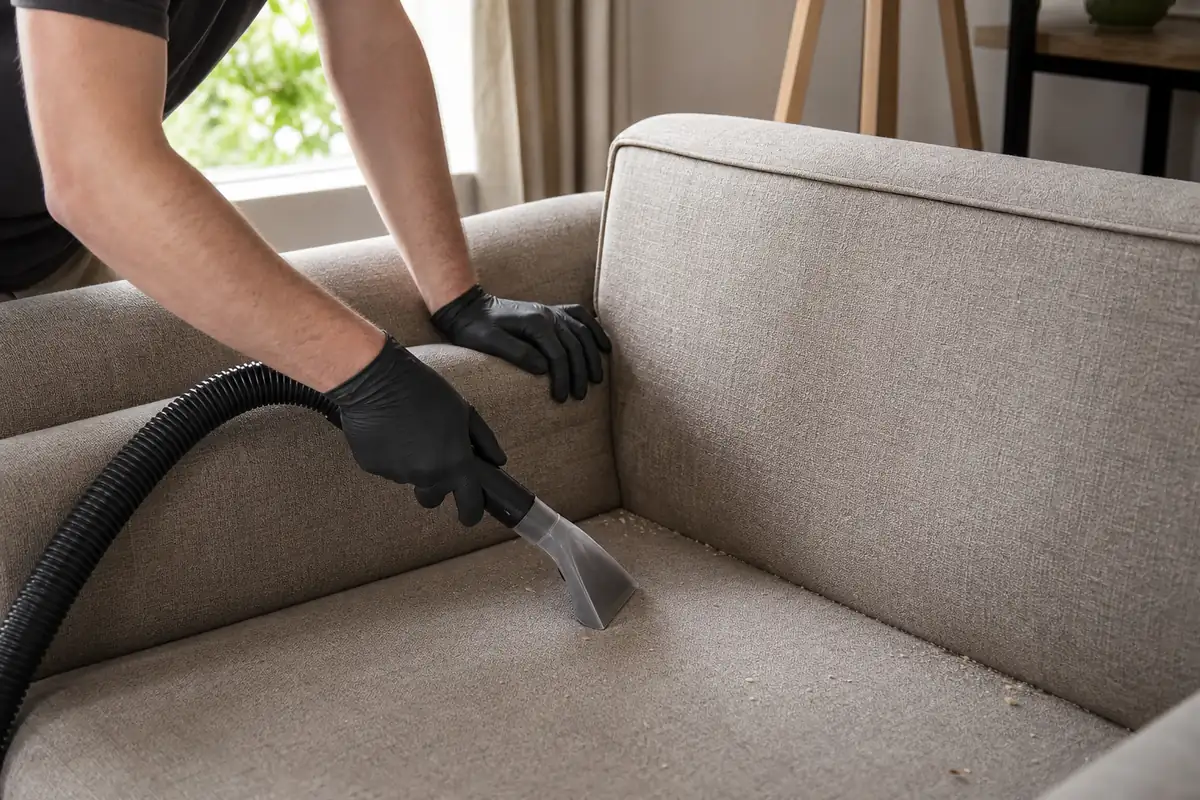
This dry stage is not cosmetic. Grit can abrade fibres when people sit down; crumbs and hair also interfere with even spot treatment. Vacuum both sides of loose cushions if the construction permits it, and use a crevice tool carefully along piping without pressing hard against the stitching.
3. Patch-test one compatible treatment
Select a product made for upholstery and compatible with the care instructions. Test it behind the sofa, beneath a skirt or on another inconspicuous finished area. A useful test includes the complete process: application, blotting or extraction as directed, residue removal and full drying.
Press a clean white cloth against the dry test area. Stop if colour transfers, the surface becomes stiff or sticky, the pile changes, a ring develops or the backing shows through. Read the ventilation and personal-protection directions too; general cleaning-product hazards still apply when a treatment is suitable for the textile.
4. Blot the mark without spreading it
For a fresh spill, lift any solids without pushing them into the weave, then press dry white towels onto the liquid. Work from the outer edge towards the centre. Change to a clean section of cloth as soil transfers. Rubbing can spread the stain, distort the surface and make a pile fabric look permanently different even when the colour has improved.
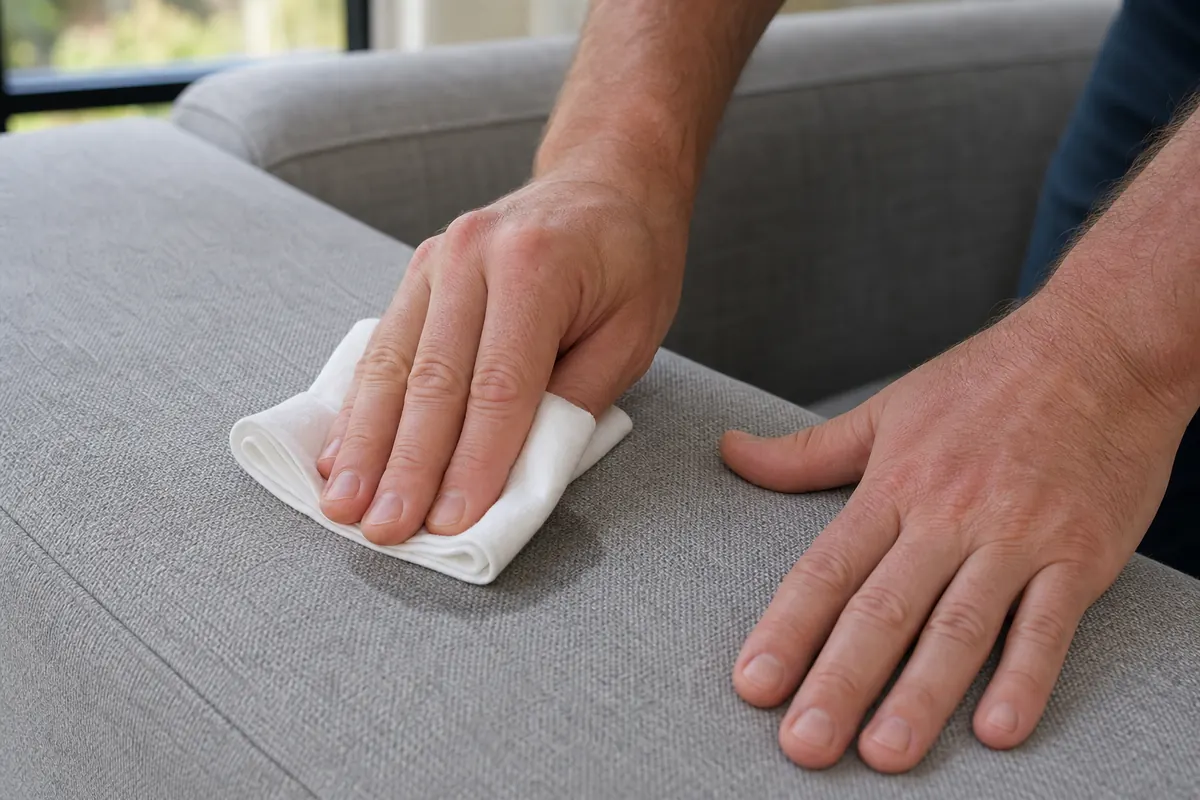
Apply a permitted treatment to the cloth or exactly as its directions specify; do not automatically pour or spray it onto the sofa. Treat a controlled area and feather the edge only when the product method calls for it. Several light passes are safer than one wet pass. Repeated unsuccessful treatment is a reason to stop, not to escalate the chemistry.
5. Remove residue and limit extraction moisture
Cleaner left in the fabric can attract soil, feel tacky or create a pale edge. Follow the product directions for blotting, rinsing or dry extraction; do not improvise a rinse on S- or X-coded fabric. If a compatible upholstery extractor is used, release solution sparingly and make extra suction-only passes. The objective is to recover moisture and leave the cushion as dry as the process allows.
Compare the treated patch with the surrounding panel when it is damp and again after it dries. Wet fabric often looks darker, so do not keep adding product simply because the colour has not immediately matched. Avoid sitting on, covering or replacing cushions during this assessment.
6. Reshape and dry before reassembly
Smooth the fabric in its normal direction and restore piping or cushion corners before they set in a distorted position. Open windows where conditions allow and use a fan to move room air across the upholstery – never hot air into it. Check seams, undersides and the filling, not only the surface. A cover can feel dry even when moisture remains inside.
How to clean sofa cushions
A zip does not prove that a cushion cover is washable. Some covers are intended to be removed only during manufacture or professional work, and washing can shrink the cover enough that it no longer fits the insert. Check the cover label, the sofa instructions and the filling before separating anything.
If machine washing is expressly permitted, close zips as directed, use the stated cycle and avoid changing the temperature or detergent dose. Wash matching covers together when the instructions allow it so that one cushion does not change differently from the others. Do not machine-dry unless the label permits it, and refit only according to the manufacturer’s directions.
For fixed or non-washable covers, use the same dry-vacuum, patch-test and controlled-treatment process as the sofa body. Keep foam, feather or fibre filling as dry as possible. A pet accident or large drink that has entered the insert affects more than the surface: recurring odour can mean contamination remains below the cover. Enzyme products are not universal; use one only when both the product and upholstery instructions support it.
Turn and reshape cushions during drying if their construction allows it. Keep wet cushions apart so air reaches all sides. Do not stand delicate cushions on an edge if that deforms the filling, and do not return them to the frame when the underside or zip area is cool and damp.
Can you steam clean or shampoo a fabric sofa?
Sometimes. It is not a universal method. “Steam cleaning” is used loosely for hot-water extraction, steam vapour and hired carpet machines, even though they apply and recover moisture differently. Check the sofa instructions and the equipment manual before choosing any of them.
A W or W/S code may allow a suitable water-based upholstery process. It does not automatically approve every machine, temperature or cleaning solution. An S code should not be treated with a water-based shampoo, and an X code normally rules out home liquid treatment. Unknown fabrics need assessment before any trial with a powerful machine.
Where extraction is permitted, use an upholstery hand tool, upholstery-approved chemistry and a conservative flow. Make repeated recovery passes and prepare the room for immediate drying. A machine intended only for carpet may deliver too much liquid or the wrong solution for a sofa. Steam vapour also introduces heat and moisture without necessarily removing dissolved soil, so it should not be described as interchangeable with extraction or as guaranteed disinfection.
You may also enjoy:

Treat stains and odours without stacking products
Identify what caused the mark before treating it. Water-based drinks, oils, make-up, ink and biological spills behave differently, and the wrong treatment can set a stain or spread it. A sound stain-removal method starts with removal of excess material, a compatibility check and controlled transfer into a clean cloth.
Blot a fresh drink quickly and keep the affected area small. With grease, lift solids and use only a label-compatible upholstery route; flooding with water can push oil outward. After a pet accident, absorb fresh liquid and assess whether it has reached the filling. If odour returns after the surface dries, further spraying may mask the problem and add moisture to the insert.
Water rings often arise from uneven wetting, dissolved residue or a previous treatment edge. Do not chase a ring with repeated spot applications unless the manufacturer-approved process specifically addresses the whole panel. Silk, viscose, velvet, loosely woven textiles and unstable dyes need especially cautious delicate-fabric care; professional assessment may be the safer first action.
Use one treatment at a time and complete its residue-removal directions. Do not combine vinegar, bicarbonate, peroxide, bleach, solvent, enzyme cleaner or detergent in a home-made sequence. Mixtures can react, produce irritating vapour, leave deposits or make the original stain harder to identify. If one correct attempt produces no transfer, pause and reassess.
Can you use Fairy Liquid or homemade cleaners?
Washing-up liquid is designed for dishes, not automatically for upholstery. Its surfactants, dyes, fragrance and foaming level may leave sticky residue, create a ring or require more rinsing than the sofa can tolerate. A W code means a suitable water-based upholstery method may be possible; it does not specifically approve Fairy Liquid.
Homemade mixtures have the same compatibility problem. Vinegar is acidic, bicarbonate leaves particles, peroxide can affect colour and fragranced oils add another residue. “Natural” does not mean safe for every fibre, finish or household. Choose a product intended for the upholstery and follow its dilution, contact-time, ventilation and residue-removal directions.
How to dry sofa fabric and cushions fully
Drying is part of cleaning, not a waiting period after it. Remove as much moisture as the permitted method allows, then maintain airflow around every treated surface. Separate loose cushions, expose their undersides and keep the sofa away from normal use. A fan and safe ventilation are preferable to concentrated heat, which can shrink a cover, set a distortion or affect adhesives and finishes.
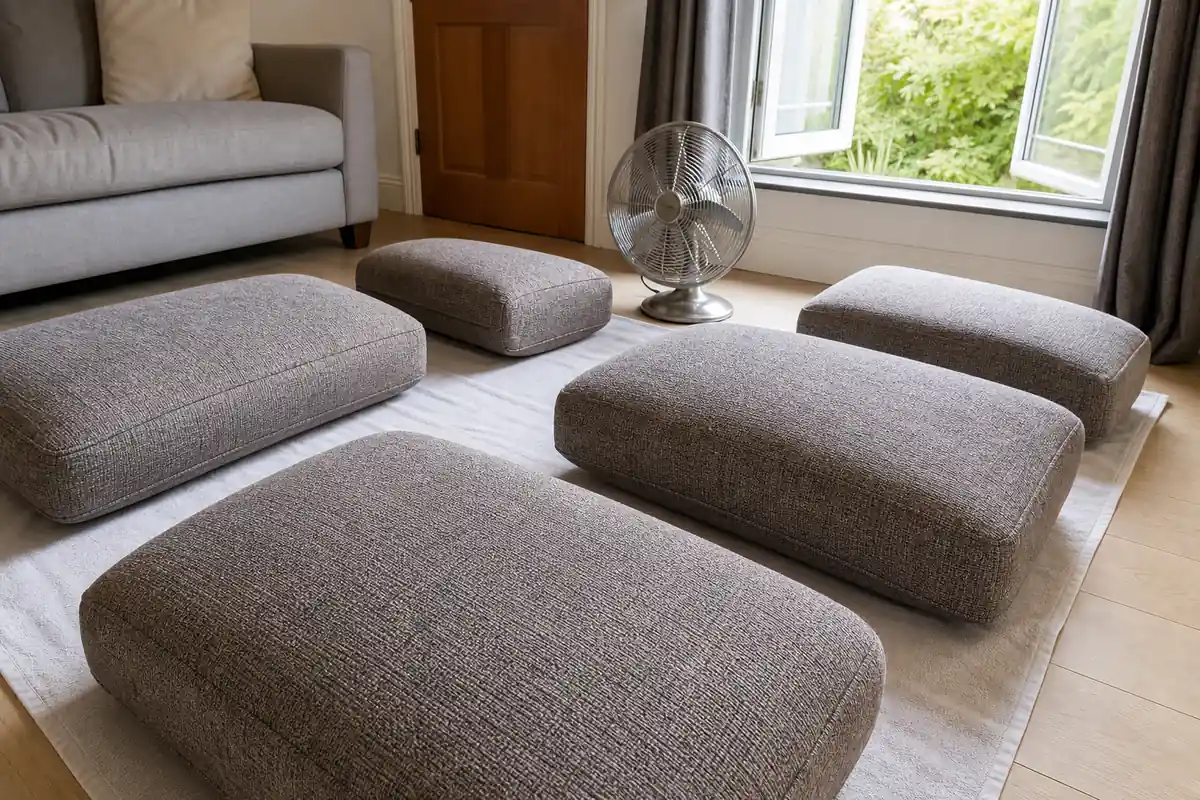
Drying time cannot be reduced to one universal number. It depends on the amount of moisture, fabric, backing, filling, room temperature, humidity and airflow. Check the deepest accessible point, seams, piping and zip areas. Do not judge only by the face fabric, and do not cover a damp sofa with throws.
If the filling was saturated, a musty smell develops, a stain reappears from below or the sofa cannot be dried promptly, stop using it and arrange an appropriate assessment. Continuing to wet the surface is unlikely to solve a problem held inside the cushion.
How Samyx Cleaning can help with sofa fabric
Professional help is sensible when the code is X or unclear, dye transfers during testing, the textile is delicate or valuable, several seats need even cleaning, or contamination has reached the filling. It is also appropriate after unsuccessful home treatment, because a technician needs to know what has already been applied.
A professional should still inspect the fabric and choose a compatible method. One process cannot suit every sofa. Samyx’s upholstery cleaning service provides a relevant route for London households that need the sofa’s material, condition and stains assessed before treatment.
Need Help Cleaning Your Sofa?
Enter your postcode to view our rates and availability in your area.

Keep a fabric sofa cleaner between treatments
Vacuum visible surfaces and gaps during normal room cleaning, using an attachment that does not snag the textile. Deal with spills promptly, rotate compatible loose cushions to distribute wear and wash removable throws by their own labels. Avoid eating over delicate upholstery when practical. Do not cover the sofa permanently if that traps moisture or rubs dye onto the fabric.
There is no single deep-cleaning calendar for every household. Follow the manufacturer’s care schedule and respond to visible soil, spills, odour or changes in use. Regular dry-soil removal usually creates less risk than repeated wet treatment. If dust is the main issue, targeted furniture care can be more appropriate than another full clean.
Frequently asked questions
-
What is the best thing to clean a fabric sofa with?
Use a product and method approved by the sofa manufacturer for that upholstery. Vacuum first, patch-test the complete process in a hidden area and use the minimum effective moisture. No single cleaner is safe for every fabric, dye, backing and filling.
-
How do you clean a fabric sofa if there is no care label?
Treat the material as unknown. Dry-vacuum carefully, contact the manufacturer if possible and arrange material-specific assessment before using water, solvent, steam or an extractor. A hidden-area test reduces risk but does not identify the full construction.
-
Can removable sofa cushion covers go in the washing machine?
Only when the cover label expressly permits machine washing. A zip does not prove washability, and an unsuitable cycle can shrink, distort or fade a cover so it no longer matches the sofa or fits the filling.
-
Can you steam clean or use a carpet cleaner on a fabric sofa?
Only when the sofa instructions and the equipment manual both support that method. Use upholstery-compatible chemistry and tools, limit moisture, recover as much liquid as possible and plan complete drying. S-coded, X-coded and unknown fabrics need a different decision.
-
Can you use Fairy Liquid to clean a fabric sofa?
Do not assume so. Washing-up liquid may foam heavily, leave residue or create rings and is not automatically approved by a W code. Use an upholstery product allowed by the manufacturer and follow its directions after a hidden-area test.
Important: Follow the sofa manufacturer’s care instructions and the cleaning product directions before general advice. Patch-test one treatment, keep moisture to the minimum and never combine cleaning products. Do not use or cover the sofa until the fabric, seams and filling are completely dry. Stop home treatment if colour transfers, the texture changes, the filling is saturated, the code is X or unknown, or full drying cannot be confirmed.
Author: Svetlana Georgieva (Clara)
Hi, I’m Svetlana Georgieva, but you can call me Clara. As the co-founder and heart behind Samyx Cleaning, I’m devoted to sharing the art of a clean space. Let’s journey into a cleaner, more joyful life together with tips from London's cleaning experts.

Discover more of our cleaning secrets: