
DIY Stain Remover: Choose by Stain and Fabric

Last modified on: 04/08/2026
A diy stain remover works best when it is chosen for the stain, the fabric and the garment’s care instructions. No single recipe suits every combination.
The safest starting point is usually simple: remove excess material, blot moisture, check the label, test a hidden area and use the mildest suitable treatment. This guide helps you make that choice without turning the laundry area into a chemistry experiment.
Key takeaways
- The best home treatment depends on both the stain and the material beneath it.
- A care label is the limit for treatment, not proof that a stain will come out.
- Cool water and a small amount of compatible laundry detergent are a safer starting point for many washable fabrics than a strong homemade mixture.
- Never mix cleaning products or store a homemade mixture for later.
- Keep stained clothing away from heat until you have checked the dry fabric.
Table of Contents
How to choose a DIY stain remover
Start with four questions: What caused the mark? What is the fibre? Is the colour stable? What treatments does the care label permit? A red sauce mark on washable cotton and a similar-looking mark on silk may need completely different decisions.
| Stain family | Examples | Safer first action | Main risk |
|---|---|---|---|
| Water-based and tannin | Tea, coffee, juice | Blot, then flush with cool water if the label permits | Rubbing pigment deeper or spreading the ring |
| Protein | Blood, egg, milk | Flush with cold water from the reverse | Heat can make removal harder |
| Oil and grease | Cooking oil, butter, cosmetics | Lift solids and absorb fresh oil before pretreating | Heat reveals or fixes the remaining oily shadow |
| Pigment or dye | Ink, makeup, grass | Use the dedicated method after a colour test | The treatment may move garment dye too |
| Unknown or mixed | Old marks, sauces, transferred colour | Use a mild detergent test or seek specialist advice | Guessing can lock in one component or damage the finish |
This table is a decision aid, not a promise. Many everyday stains contain several components. Chocolate, for example, can combine fat, protein and pigment. Makeup may contain oil, wax and colour. Deal with removable solids first, then use the method suited to what remains.
Before you treat the stain
Read the care label
The label tells you the maximum permitted washing, bleaching, drying, ironing and professional-care treatments. The care symbols are limits, so a milder treatment is allowed when it is sufficient. If the label says dry-clean-only, do not assume that careful hand washing is an equivalent option.
Remove excess without spreading it
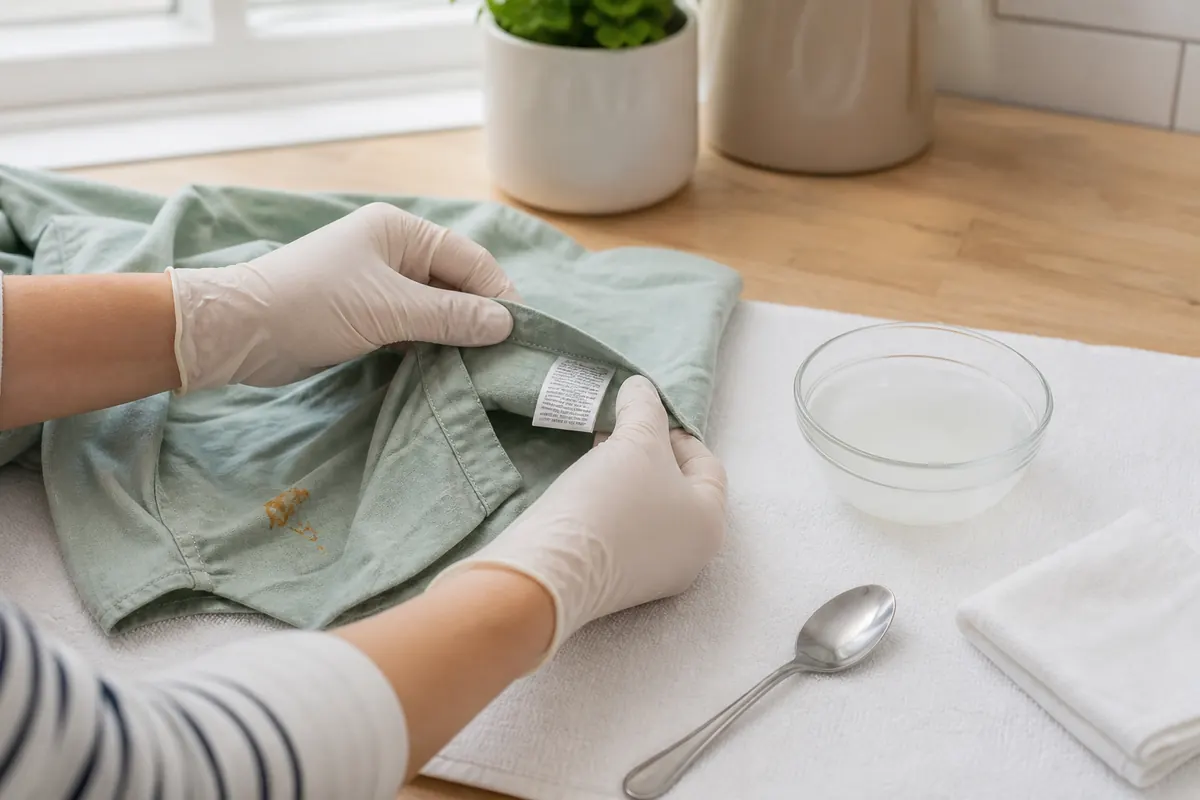
Lift thick residue with the edge of a spoon or a blunt scraper. Place a clean white towel beneath a washable garment so transferred colour is easy to see. Blot liquid with another white cloth, changing to a clean section as it picks up the stain. Scrubbing can distort fibres and enlarge the affected area.
Run a meaningful patch test
Test the proposed solution on an inside seam or hem. Apply it for the same contact time you intend to use on the stain, rinse if required, and let the test area dry. Stop if colour transfers, the finish changes, the fabric stiffens or the fibres become rough. A quick dab followed by immediate inspection can miss damage that appears during drying.
Keep heat out of the process
Wash only after the pretreatment has been rinsed or used as its product label directs. Then air-dry the garment and inspect it in good light. A tumble dryer or iron can make a remaining stain much harder to remove. If the mark is improving and the fabric remains stable, repeat the same controlled process before escalating.
Three controlled home methods
These methods are intentionally narrow. Choose one that fits both the stain and the label. Do not combine them into a stronger formula, and do not keep a mixed bottle for future use.
1. Cool detergent solution for washable fabric
For a small, water-compatible mark on a washable and colourfast fabric, place a white towel beneath the stained layer. Add one or two drops of liquid laundry detergent to about 250 ml of cool water. This is a spot-treatment dilution, not a substitute for the dosing instructions on the detergent label.
- Patch-test the diluted solution and allow the test area to dry.
- Dampen a white cloth, then blot from the outside of the mark towards the centre.
- Move to a clean part of the backing towel as the stain transfers.
- Rinse according to the care label, wash normally and air-dry for inspection.
Use restraint. More detergent can leave residue and create a larger tide mark. Stop if the fabric colour changes, the stain spreads or it fails to lift.
2. Dry absorption for fresh oil
If oil is still sitting on the surface, blot it first. On a sturdy washable fabric that has passed a hidden test, cover the dry mark with plain cornflour and leave it for 15 to 30 minutes. Brush or shake the powder away gently, keeping it clear of your face. Repeat once if it continues to pick up oil, then use a compatible laundry pretreatment.
The powder absorbs free oil; it does not finish the wash. Detailed methods vary between cooking grease, motor oil and hair products, so use the dedicated method for oil stains before escalating. Do not tumble-dry when a darker patch remains.
3. Cold-water flush for fresh protein
For fresh blood, egg or milk on a washable garment, hold the reverse of the stained area under gently running cold water. Working from the back helps push material out along the route it entered. Avoid hot water at this stage. After flushing, use a care-label-compatible laundry pretreatment, wash as directed and air-dry.
Do not use this method on dry-clean-only fabric or on an item that should not be saturated. For blood from another person, wear disposable gloves, avoid direct contact and wash your hands afterwards.
Build a small stain-response kit
You do not need a shelf of homemade bottles. A useful kit is mostly about control: white cotton cloths, a white towel for backing, a blunt spoon, a small bowl, a measuring spoon, disposable gloves and the laundry detergent you already use. White cloths make colour transfer visible. A measured bowl discourages pouring product directly onto the garment.
Keep product labels readable and retain the original packaging. If you need to move a small quantity to the work area, pour it into a clearly separate bowl and discard the remainder as its label directs. Never return used liquid to the original container. Rinse reusable tools before they are used for another task, and do not use food-preparation utensils for stain treatment.
A clean work surface matters too. Treat one garment at a time and isolate the stained layer so the mark cannot transfer to the back or another sleeve. Keep coloured towels away from the test because their dye or lint can confuse the result. Good lighting helps you see whether the stain has moved, faded or merely become wet and temporarily less visible.
Why a first attempt may fail
The stain was misidentified
A dark mark might be grease, transferred dye, mildew, scorched fibre or wear that only resembles a stain. If nothing transfers and a mild compatible wash makes no difference, pause. Repeated wetting will not repair lost colour or damaged fibres. Look at the garment dry and in daylight before deciding that stronger chemistry is needed.
The stain has more than one layer
A sauce can leave a removable oily halo after its coloured solids have gone. A cosmetic may lose its pigment and retain wax. Work in a logical order: lift solids, absorb free oil, then use the mild washable-fabric treatment. Rinse between distinct stages and never place one household chemical over another.
Too much liquid spread the mark
A soaked cloth can drive dissolved material beyond the original edge and create a ring. Use a damp, not dripping, applicator and make several small transfers. Replace the backing towel before it becomes saturated. On an item with padding, lining or a bonded finish, stop before liquid reaches layers that cannot dry quickly.
The garment was checked before drying
Wet fabric looks darker and can hide a faint oily shadow. Air-dry after the labelled wash, then inspect both sides. If the stain has clearly improved and the colour, texture and shape are unchanged, one repeat of the same treatment is more controlled than switching to a stronger recipe. If there is no improvement, reassess the stain or use professional care.
Choose the next step by stain type
Ink and strongly coloured marks
Ink is not one substance. Ballpoint paste, washable marker and permanent ink can respond differently. Alcohol-based treatments may also move the garment dye or affect a print. Put a white towel behind the stain and follow the specific method for ink stains. Stop if the garment colour appears on the towel.
Perspiration and deodorant residue
Underarm marks can combine body oils, perspiration, antiperspirant salts and detergent residue. Treating every yellow or stiff patch as the same stain can waste time. The guide to sweat stains separates washable white, coloured and delicate fabrics and keeps bleaching decisions tied to both labels.
Makeup and nail products
Foundation and lipstick may contain oil, wax and pigment. Mascara can be water-resistant. Nail polish is different again and may require a compatible solvent check. Avoid rubbing either mark. Lift excess product and use the dedicated method for the product and fabric. Do not reach automatically for acetone or peroxide.
Old or unknown stains
An old mark may have oxidised, been heated in a previous wash or contain more than one substance. Photograph it before treatment, check the pockets and ask what may have spilled. If the cause remains unknown, begin with the mild detergent test only when the garment is washable. Improvement may take more than one cycle. Repeated stronger treatments can damage the dye or fibre before the stain disappears.
Set a sensible stopping point. A faint shadow is sometimes less noticeable than a bleached patch, roughened surface or distorted seam. When the mark has not changed after a correctly tested treatment and labelled wash, more contact time is not automatically better. Record what you used, rinse out any remaining treatment and take the dry garment to a textile cleaner if its value justifies another attempt.
You may also enjoy:

What not to mix or store
A homemade stain treatment should not be a collection of every familiar cupboard ingredient. Combining products can cancel their useful action, damage fabric or create a dangerous exposure. Use one clearly identified treatment at a time, rinse as instructed and keep every product in its original labelled container.
- Never mix chlorine bleach with acids or ammonia. The UK’s Health and Safety Executive warns that incompatible cleaning chemicals can release toxic gases. Follow its chemical-mixing guidance and the product label.
- Do not mix bleach with an unknown residue. Rinse the item and area thoroughly before considering another labelled product.
- Do not store mixed recipes. Ingredients can react, lose effectiveness, build pressure or become impossible to identify later. Make only the small amount needed for an immediate tested treatment.
- Do not put homemade liquid in a food or drink container. Keep children and pets away from the work area and remove bowls immediately after use.
The familiar combination of bicarbonate and vinegar fizzes because an acid and a base react. The bubbles can help loosen some debris mechanically. Much of the original acidity and alkalinity is consumed. It is not a universal stain remover, and the mixture can leave residue or spread a mark.
Be cautious with hydrogen peroxide
Hydrogen peroxide can have a bleaching effect. Even a household product may lighten a coloured garment, alter a print or weaken an unsuitable fibre. Do not assume that a low concentration makes it safe for every fabric, and do not add it to a stored detergent recipe.
If both the garment and product instructions permit its use, test a hidden area, use it by itself as directed and rinse or wash afterwards according to the labels. Skip it on unknown dyes, vintage textiles and delicate items unless their specialist care instructions explicitly support it.
When the garment needs specialist care
Stop home treatment when the care label requires professional cleaning, the fibre or finish is unknown, colour continues to transfer, or the item is valuable or difficult to replace. Silk, wool, leather, suede, acetate, embellished garments and structured clothing can be changed by water, abrasion or solvents.
For stains on silk, blot only what is safe to lift and use the garment’s professional-care route. Tell the cleaner what caused the stain and what, if anything, has already been applied. This information helps them avoid an incompatible next step.
Clothing methods do not transfer to carpets
A carpet has pile, backing, adhesive and sometimes underlay, so soaking it like a washable garment can spread contamination or leave a slow-drying area. Blot a spill, check the carpet manufacturer’s instructions and avoid flooding. Do not promise yourself that a household mixture has reached or removed everything below the surface.
If the spill is large, persistent, strongly coloured, odorous or has reached the backing, professional carpet cleaning can match the process to the carpet construction and soil. Tell the technician which products have already been used.
Book Professional Carpet Cleaning
Enter your postcode to view our rates and availability in your area.

Frequently asked questions
-
What is the best homemade stain remover?
There is no single best recipe for every stain and fabric. For many small marks on washable, colourfast clothing, a very dilute liquid laundry-detergent solution is a controlled starting point. Check the care label, identify the stain, patch-test and air-dry before using heat.
-
Can baking soda and vinegar remove stains?
They may help in separate, material-compatible uses. Mixing them consumes much of the acid and base and is not a universal stain treatment. The fizz may loosen some debris. The liquid can also spread a stain or leave residue. Choose a method for the specific stain and surface.
-
Can hydrogen peroxide be used on coloured clothes?
Only when the garment and product instructions permit it and a hidden test shows no colour or finish change. Hydrogen peroxide can bleach dyes and is unsuitable for some fibres. Do not combine it with other cleaners or store it in a homemade mixture.
-
How do you remove old set-in stains?
Identify the likely stain, check the care label and begin with the mildest compatible pretreatment. Wash as directed and air-dry for inspection. Repeat a successful controlled cycle without jumping between chemicals. Heat-set or oxidised marks may not disappear completely.
Safety note: This guide covers ordinary household laundry decisions, not poison treatment, infection control or specialist textile restoration. Follow garment and product labels. If someone may have swallowed, touched or inhaled a harmful substance, follow NHS advice; call 999 for severe breathing difficulty, collapse or another urgent incident, and use NHS 111 when you are unsure.
Author: Svetlana Georgieva (Clara)
Hi, I’m Svetlana Georgieva, but you can call me Clara. As the co-founder and heart behind Samyx Cleaning, I’m devoted to sharing the art of a clean space. Let’s journey into a cleaner, more joyful life together with tips from London's cleaning experts.

Discover more of our cleaning secrets: