
Best Way to Clean Upholstery Safely

Last modified on: 18/08/2026
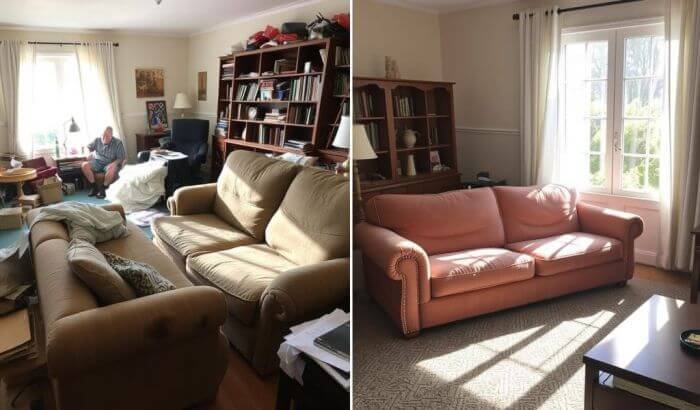
The best way to clean upholstery is to identify the covering and construction first, follow the manufacturer’s care instructions, remove dry soil and test the full cleaning method in a hidden area. The correct amount of moisture depends on the fabric, dye, backing, filling, trims and care code, so a recipe that suits one chair can leave another with rings, shrinkage or colour loss.
Key Takeaways
- W, S, WS and X codes are starting points, not permission to use every product in that category.
- Dry soil should be removed before spot treatment so it does not become wet residue.
- A dry patch test must check colour, texture, rings and residue, not only the first few minutes.
- Fixed padding, trims and furniture joints can make an apparently simple fabric clean much riskier.
- Unknown codes, delicate fibres, broad staining and repeated failed treatments are sensible professional stop points.
Table of Contents
Best way to clean upholstery starts with its care code
Look beneath loose cushions, along the lower frame or under the item for a sewn-in label. Read the furniture maker’s care instructions as well as any cleaning letter. A code describes a broad cleaning route; it does not confirm dye stability, filling tolerance, adhesive condition or compatibility with a particular household product.
| Label or construction | What it usually indicates | Practical route | Stop point |
|---|---|---|---|
| W | A water-based cleaning route may be permitted | Use only a maker-approved or correctly labelled product, after a complete hidden test | Dye transfer, a tide mark, texture change or slow-drying filling |
| S | A solvent method may be specified | Keep water away and arrange the exact labelled or professional solvent process | Do not substitute rubbing alcohol, garment cleaner or another solvent recipe |
| WS or W/S | Water-based or solvent routes may be possible | Choose the least aggressive compatible method for the stain and construction | The code still does not approve every water or solvent product |
| X | Vacuuming or light dry brushing only | Remove loose soil carefully and seek specialist advice for marks | No liquid or solvent spot treatment |
| No code or unreadable label | The safe route is unknown | Ask the manufacturer or a suitable upholstery professional | Do not treat it as W because the fabric feels durable |
| Removable cover | The cover can be detached, not necessarily washed | Follow the separate cover label and refitting directions | Do not machine-wash or dry-clean solely because a zip is present |
Letters also need context. A replacement cover, reupholstered chair or second-hand item may have no reliable label for its current fabric. A loose cushion can carry a different construction from the fixed arms and frame. Treat each material zone according to its own instructions.
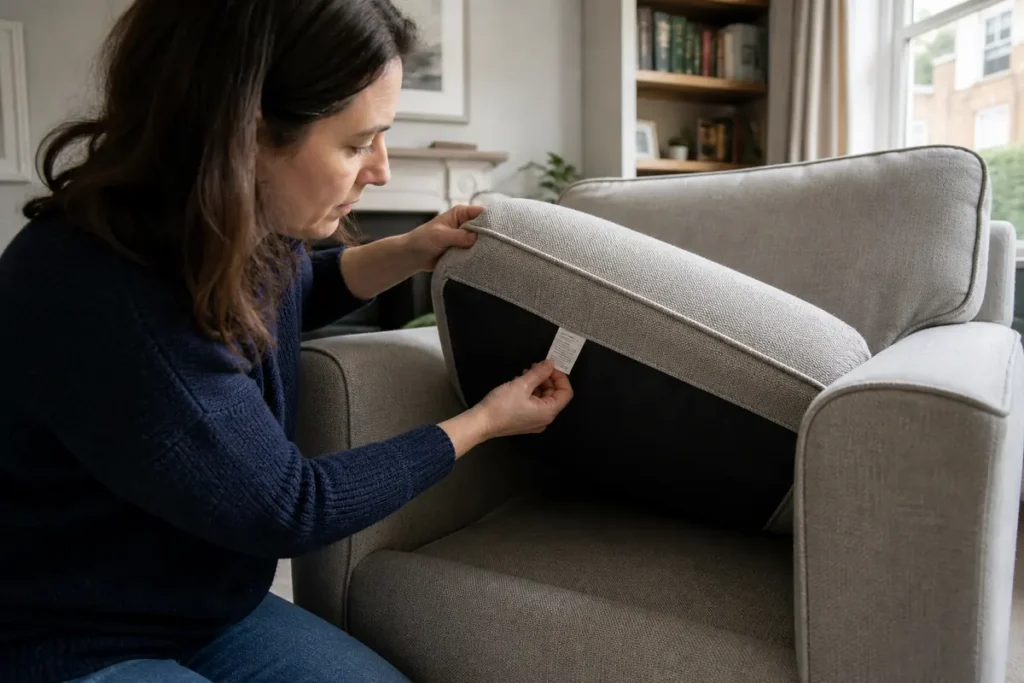
Inspect the whole chair or sofa before adding moisture
Run clean hands over the item and note loose threads, open seams, pulled buttons, worn pile and damaged zips. Check whether piping, decorative braid, leather panels, wooden arms or metal studs touch the fabric. Moisture can move dye from a trim into a pale panel or mark an unsealed wooden edge.
Press the cushion lightly and watch how quickly it recovers. Foam, feather, fibre and layered padding dry at different rates. Fixed padding gives you no simple way to inspect the inside, and liquid that reaches it can wick back to the cover as a ring. A sour smell after a previous clean often points to residue or slow drying rather than a need for more fragrance.
Identify the soil before selecting treatment. Loose crumbs, body oils, a fresh drink spill, old unknown marks, ink, grease and pet accidents are separate problems. Remove any safe-to-lift solid material without pushing it into the weave. Do not scrape across delicate pile, velvet or loosely woven cloth.
Vacuum upholstery from broad panels into seams
Fit the vacuum attachment recommended for the item. Check the nozzle for grit, rough edges and trapped hair before it touches the fabric. Reduce suction if the manual provides a setting for delicate upholstery, and place a clean mesh barrier between tool and fabric only when the maker permits that technique.
- Remove loose cushions and photograph their orientation if shapes or covers are easy to mix up.
- Vacuum the back, arms and broad sitting panels with overlapping light passes.
- Use a crevice tool carefully along seams, under piping and between the seat and frame.
- Clean both permitted sides of removable cushions and the platform beneath them.
- Inspect buttons and tufting by hand; do not pull the nozzle against a loose thread or trim.
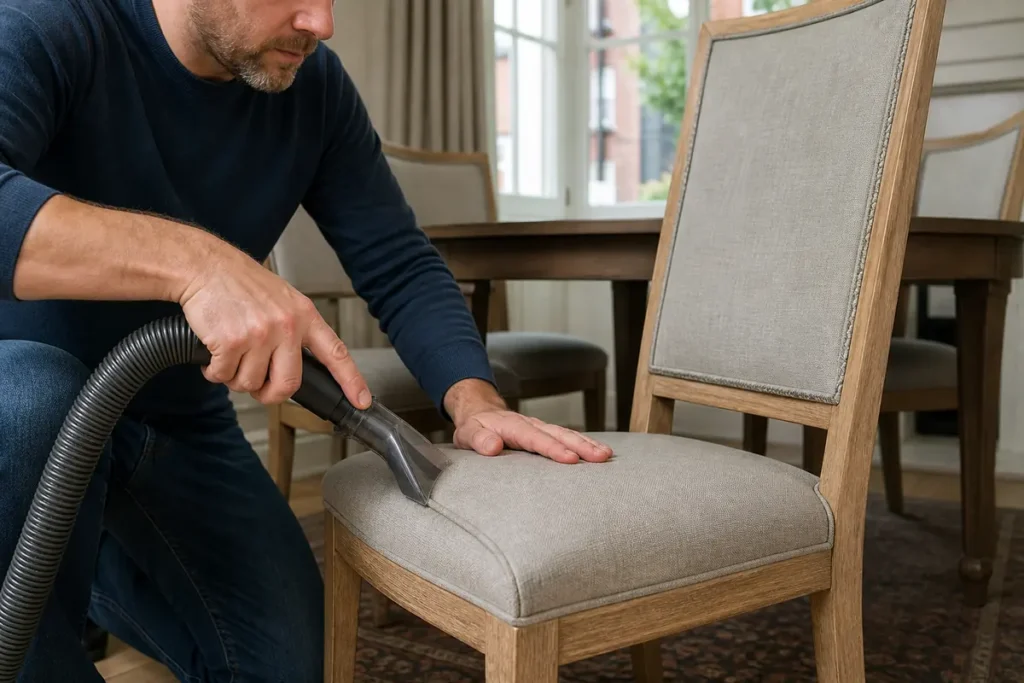
Empty or maintain the machine when airflow drops. A blocked filter, full container or hair around a brush can reduce pickup and spread odour. The separate vacuum maintenance process covers those checks without turning furniture care into appliance repair.
Patch-test the cleaner, tool and drying sequence
A product can be labelled for upholstery and remain wrong for one particular item. Test a hidden zone that includes the same fabric and, where possible, the same backing. Use the proposed dilution, cloth, pressure, dwell time, removal method and drying conditions. Testing only a drop of solution does not test the full process.
Blot the test with a clean white cloth and inspect it for transferred colour. Check the wet fabric for darkening, then leave it undisturbed until fully dry. Look again in daylight for a ring, faded patch, stiff residue, raised pile, shrinkage or adhesive change. Continue only when the dry result is stable.
A microfibre cloth is a tool, not proof of compatibility. Its weave, colour and condition matter, and a cloth loaded with cleaner can still over-wet a cushion. Use clean white material for transfer checks and fold it to expose a fresh face.
Treat a spot without creating a larger ring
Blot fresh liquid from the outside towards the centre with clean absorbent material. Lift and replace the cloth; do not rub back and forth. For dried or unknown marks, identify the likely substance before choosing chemistry. A general stain remover decision still has to be narrowed by the upholstery code and construction.
Apply a permitted cleaner to the cloth or tool when the label directs, keeping the amount controlled. Do not pour a solution directly onto fixed upholstery. Work on the stained zone with light, repeatable pressure and avoid spreading across buttons, trims or a join between two materials.
Some fabrics develop a boundary when only the centre of a panel becomes wet. That does not justify washing the entire chair. Follow the maker’s panel-cleaning instructions or stop for professional assessment. Repeatedly feathering water beyond the mark can enlarge the affected zone and saturate the filling.
You may also enjoy:
Chair construction changes the cleaning route
An upholstered dining chair often has thin fixed padding over a rigid seat, with fabric stapled underneath and a wooden frame around it. Crumbs gather where the seat meets the back, and hand contact marks the top rail. Keep liquid away from exposed wood and avoid forcing it through the fabric into the board or padding.
Armchairs add deeper seams, removable cushions, piping, buttons and several fabric directions. Clean a permitted test area with the pile lying naturally, and support a loose cushion so pressure does not distort the zip or edge. Tufting can hold moisture around buttons long after the flat panel feels dry.
Leather, coated fabric and suede are not interchangeable with woven upholstery. Identify the finish before applying anything. Marks on genuine leather belong to a finish-first route such as the guidance for leather stains; suede and nubuck generally need specialist material care.
Upholstery dry cleaning is a method decision
“Dry cleaning” can describe a solvent-based or very low-moisture professional route for upholstery. It is not an instruction to apply garment dry-cleaning fluid at home, and an S code does not approve a bottle simply because it contains solvent. Ventilation, fire risk, residue, dye and filling compatibility all belong to the product and professional method.
Removable covers are another source of confusion. A zip makes removal possible; the care label decides whether washing or off-site dry cleaning is permitted. Covers can shrink enough to become difficult to refit, and drying them separately may create a colour difference from the fixed frame.
Ask for assessment when the label specifies S, the code is missing, the furniture is valuable, or silk, viscose, velvet, wool, suede, loose dye or fragile trim is involved. A professional should still test the item and explain the chosen route. “Dry” is not a promise of zero moisture or zero risk.
Ask About Upholstery Care
Enter your postcode to view our rates and availability in your area.

Remove permitted residue and dry the filling
Follow the cleaner label after treatment. A water-based process may call for controlled rinsing or extraction; another product may not. Residue left at the surface can stiffen the fabric or attract new soil, and too much rinse water can carry the problem into the filling.
- Press with a clean dry towel where the approved method calls for moisture recovery.
- Stand removable cushions in the orientation recommended by the maker, with air reaching permitted sides.
- Use room ventilation and a clean fan across the item; keep direct heaters and hairdryers away.
- Keep people and pets off the furniture until the cover, seams and filling are fully dry.
- Check for a returning ring, odour, stiffness or dye change after drying before repeating treatment.
Drying time cannot be reduced to one universal number. Indoor humidity, temperature, airflow, fabric density, filling depth and the amount applied all change it. A surface can feel dry while moisture remains around a seam or inside a cushion.
When professional upholstery cleaning fits
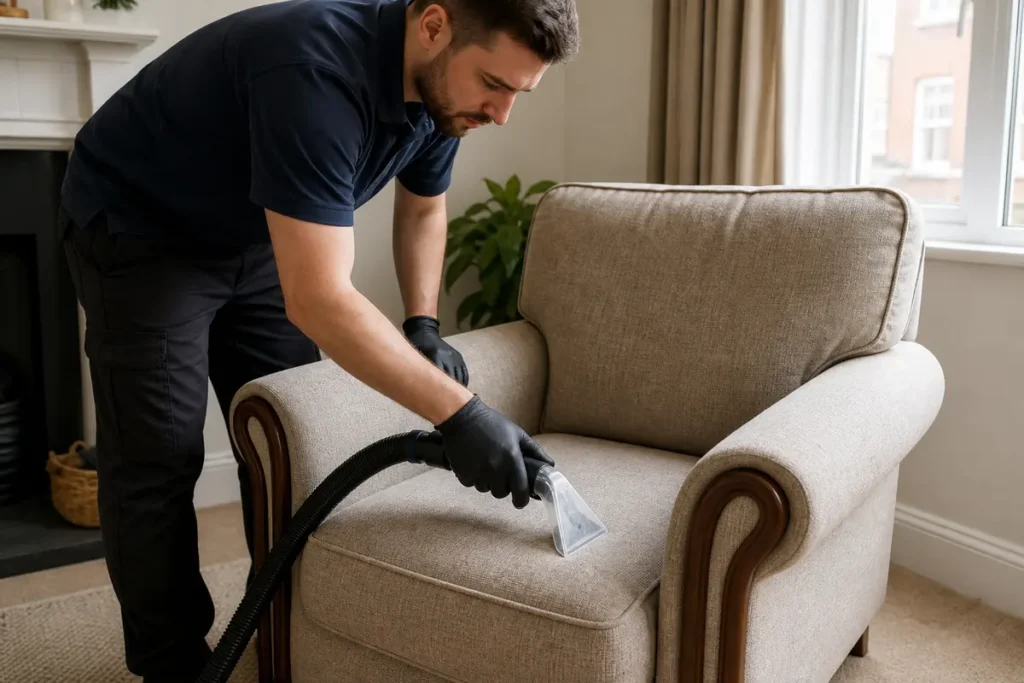
Samyx Cleaning can assess compatible upholstered sofas, armchairs and dining chairs in London. The inspection considers fabric condition, code, dye stability, stain type, trims and filling before a method is selected. Depending on that assessment, professional upholstery cleaning may use controlled pre-treatment and hot-water extraction or another suitable route.
Hot-water extraction applies solution and recovers it through a hand tool; it is not the same as directing household steam at fabric. Compatibility and moisture recovery matter more than the popular name of the method. S-code, X-code, delicate, damaged or undocumented items may need another specialist decision.
Tell the office what the label says, which areas are affected, what has already been applied and whether cushions or covers are removable. Cleaning cannot repair torn cloth, failed foam, loose springs, colour loss, sun damage, delamination or dye that has already moved into another panel. An honest assessment may recommend repair, specialist textile care or replacement instead of further cleaning.
Book Upholstery Cleaning
Enter your postcode to view our rates and availability in your area.
Frequently asked questions
-
What is the best thing to clean upholstery with?
The best choice is the product and method permitted by the furniture manufacturer for that exact fabric and construction. Check the care label, remove dry soil, patch-test the complete process and use controlled moisture. No single household cleaner suits all upholstery.
-
Can you use washing-up liquid to clean a sofa?
Only when the sofa maker and the product label permit a water-based method for that fabric. Washing-up liquid can leave residue, create rings or affect dyes when it is too strong or difficult to rinse. Do not use it on S-code, X-code or undocumented upholstery.
-
Can upholstery fabric be dry cleaned?
Some upholstery is assigned an S or other specialist route, and some removable covers have their own dry-cleaning instruction. That does not make garment solvent suitable for home use. Follow the furniture or cover label and arrange a professional method where the instructions require it.
-
How do you clean a grubby upholstered chair?
Check the label and construction, vacuum the panels and seams, then test a compatible cleaning method in a hidden area. Treat marks with controlled moisture and dry the cover and filling fully. Stop if the code is missing, colour transfers, rings form or fixed padding becomes wet.
Important: The furniture manufacturer’s care instructions and the cleaning-product label take priority over general guidance. Patch-test the complete method in a hidden area and inspect it after drying. Use the gloves, ventilation, rinsing, extraction and re-entry steps named for the product. Never mix bleach with ammonia, vinegar or another acid, and never combine two cleaning products. Keep solvent products away from heat, flames and ignition sources. Stop if colour transfers, fabric lightens, pile changes, rings form, adhesive softens, seams pull, wood or metal marks, or filling remains damp. Seek manufacturer or suitable professional advice before treating delicate, valuable, antique, undocumented or damaged upholstery.
Author: Svetlana Georgieva (Clara)
Hi, I’m Svetlana Georgieva, but you can call me Clara. As the co-founder and heart behind Samyx Cleaning, I’m devoted to sharing the art of a clean space. Let’s journey into a cleaner, more joyful life together with tips from London's cleaning experts.

Discover more of our cleaning secrets: