
How to Get Out Grass Stains Without Damaging Clothes

Last modified on: 26/08/2026

How to get out grass stains safely: remove loose soil, identify the fabric and care label, use one compatible pretreatment, wash as directed and air-check the garment before applying heat.
A green mark can contain plant pigments, small plant particles and ground-in soil. Pause before choosing a product. The useful method changes when the garment is coloured, delicate, stretch denim, already washed or exposed to dryer heat. Treating every mark with the same pantry mixture can trade a stain for fading, abrasion or fibre damage.
Key Takeaways
- Grass marks combine plant material and soil, so the fabric, dye and stain state control the method.
- Remove dry grit first and avoid hard scrubbing that pushes particles deeper or wears the surface.
- Use one care-label and product-label compatible treatment at a time, followed by the required rinse or wash.
- Dark and stretch denim need extra dye, abrasion and elastane checks.
- Air-check the garment before tumble drying or ironing because heat can make remaining residue harder to treat.
Table of Contents
How to get out grass stains starts with three checks
Check the garment, the mark and its history before choosing a product. Do not start with a mixture. A fresh smear on washable white cotton gives more options than a dried mark on dark stretch denim. Wool, silk, acetate, decorated sportswear, coated outdoor clothing and dry-clean-only garments may exclude common laundry treatments.
| What you find | First decision | Main risk |
|---|---|---|
| Fresh green mark with loose soil | Lift particles, blot moisture and check whether reverse flushing is allowed | Rubbing pigment and grit further into the weave |
| Dried green and brown residue | Brush off dry soil gently before testing a labelled pretreatment | Abrasive brushing or an over-strong product |
| Washed, not heat-dried | Inspect the dry result, then repeat one compatible pretreatment if the fabric is unchanged | Layering products without rinsing between them |
| Heat-dried or ironed | Treat as an older resistant mark and set a lower expectation | Escalating chemistry until the dye or fibre changes |
| Dark or stretch denim | Test for indigo transfer and read the elastane blend care | Fading, pale scrub patches and loss of stretch recovery |
| Wool, silk or dry-clean only | Stop home treatment unless the care label and product explicitly allow it | Enzyme damage, water marks, shrinkage or dye movement |
Check pockets, trims, prints, reflective strips and contrast stitching too. A product that suits the main fabric can still affect a coating or decoration. If a hidden colourfastness test transfers dye to a white cloth, stop before treating the visible mark.
What a grass stain actually contains
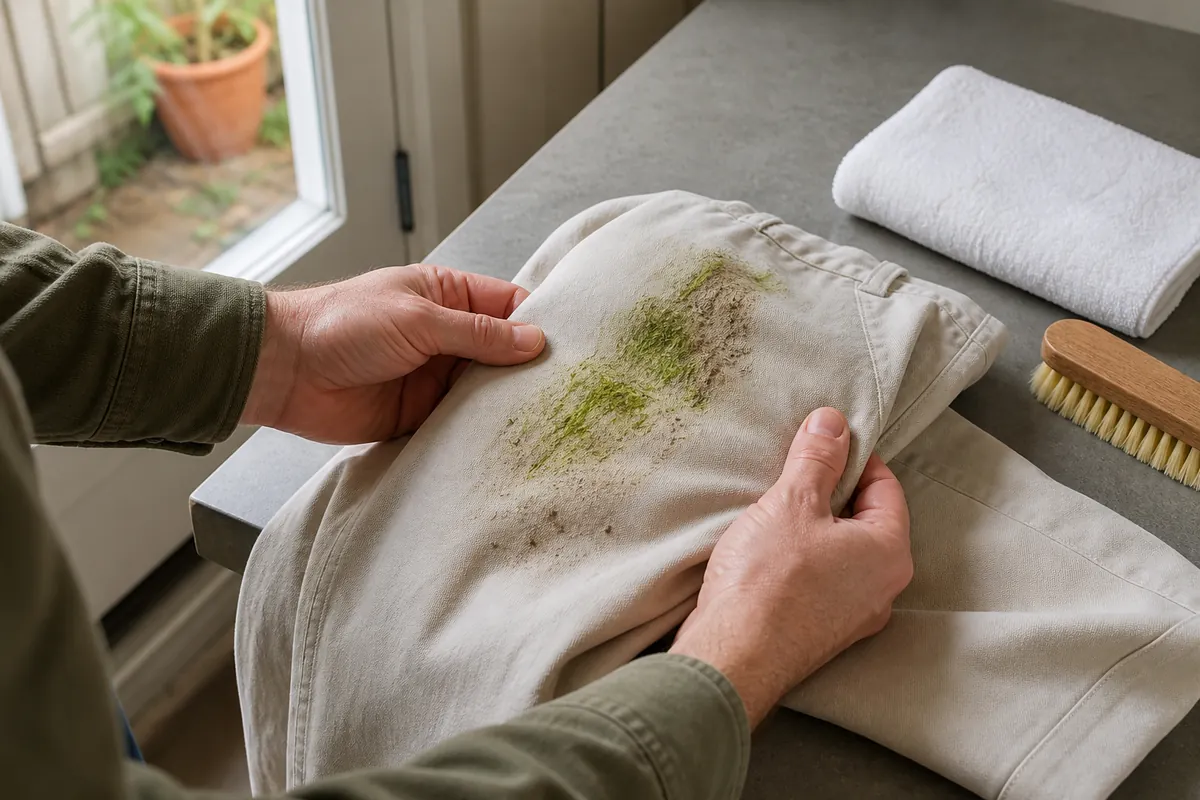
The visible green usually comes from plant pigments transferred under pressure. Crushed leaves and blades can also leave fine plant material and moisture, and a fall or slide often adds soil, clay or mud. The proportions change from one incident to another, which is why a single chemical classification does not describe every grass stain.
Soil should be removed as a physical contaminant before wet treatment. Pigment caught in the fibres needs a compatible laundry route. A brown outline after washing may be remaining soil, transferred dye, product residue or a changed fabric surface. Inspect the dry garment before deciding that the green stain itself survived.
A mark that is not mainly grass needs a different owner. Food, ink, oil and transferred colour can leave green, brown or dark residues with different treatment limits.
You may also enjoy:

Grass and mud need separate steps
Wet mud spreads easily and can hide the edges of the plant stain. Lift any solid material, then let loose surface soil dry when the garment construction permits. Brush it away over a bin or outdoors using a clean soft tool. Starting wet treatment with a layer of grit still attached can drive mineral particles through the weave.
After the soil is removed, reassess the colour. A smaller green mark can be treated locally. A broad brown tide line may need a full garment wash approved by the care label so the edge of the treated zone does not dry into a new ring.
Method for washable, colourfast clothes
1. Remove loose grass and soil
Take off grass blades and plant fragments without smearing the mark. If wet mud covers the area, let the loose surface soil dry, then use a soft clothes brush or the blunt edge of a spoon to lift it away. Support the fabric and work gently so the tool does not polish, pull or roughen the weave.
2. Read the care label and product label
Confirm the fibre, maximum wash conditions, bleach symbols, drying limits and whether professional cleaning is specified. Read the pretreatment label for excluded fibres and colours, protective equipment, contact time, rinsing and wash instructions. Do not use a product on a garment type it does not name as compatible.
3. Flush from the reverse when appropriate
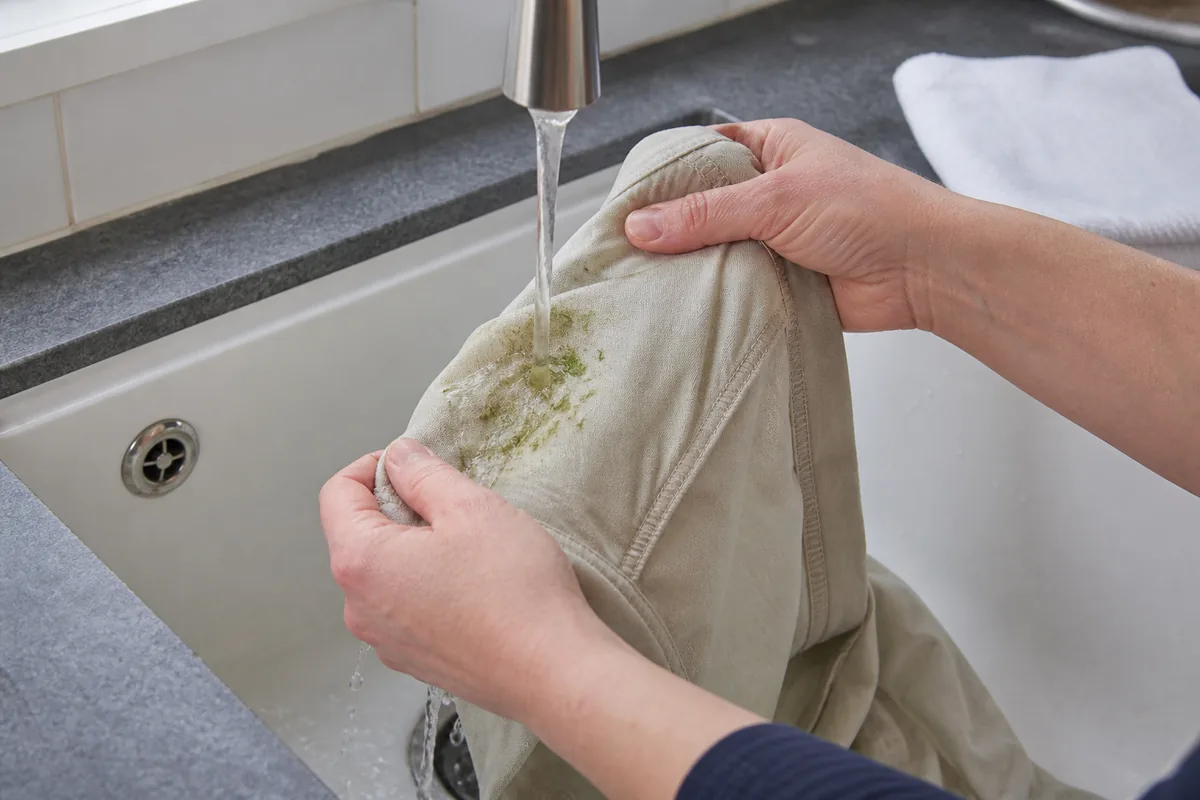
For a washable, colourfast garment whose label permits water treatment, turn the marked area over and run a gentle stream through the back of the fabric. This directs loosened material away from the route by which it entered. Use a water temperature allowed by the care label and pretreatment instructions; an unknown or delicate item should not be flushed by default.
4. Test one compatible pretreatment
A labelled liquid laundry detergent or stain pretreatment may be suitable for ordinary washable cotton or synthetic clothing. Biological products contain enzymes that can help with some organic residues, yet they are not suitable for every fibre. Follow the garment and product exclusions, measure the stated amount and test a hidden seam first.
5. Apply without aggressive scrubbing
Place a clean white towel beneath the stain if the product directions allow local treatment. Dab or work the product in with the action named on its label. Hard brushing can spread colour loss across denim, raise fibres on cotton and damage printed sportswear. Keep the treated area within the mark and do not exceed the labelled contact time.
6. Rinse or wash as directed
Some products require rinsing before the main wash; others go directly into a compatible cycle. Use the wash programme and temperature permitted by both labels. Wash the garment separately if dye transfer occurred during testing or the product instructions advise separation. Do not add a second stain chemical to the same treated area.
7. Air-check before heat
Inspect the damp garment, then let it air dry if the care label permits. Daylight reveals faint green, brown or pale scrub patches more clearly than a wet surface. Tumble drying or ironing can make remaining residue harder to treat. If the fabric and dye are unchanged, one repeat of the same compatible route may be more controlled than switching chemicals.
Keep the treatment edge controlled
Use a clean white support cloth and replace it as colour or soil transfers. Dab from the outside of the mark towards its centre when the product directions call for local work. Do not soak a wide area merely to chase a small edge. If a ring appears after drying, check whether it is product residue, displaced soil or dye change before repeating.
Choose the route for the fabric and colour
Washable cotton and polyester
Ordinary colourfast cotton and polyester often allow a labelled laundry pretreatment followed by machine washing. Check blends, finishes and prints before assuming the base fibre decides everything. Cotton can lose colour or become abraded through hard brushing. Polyester sportswear may contain coatings, elastane, transfers or reflective details that narrow the product choice.
School uniforms and sports kits
Inspect badges, heat-applied numbers, reflective strips, waterproof panels and contrast piping before pretreatment. Turn the item inside out only when its construction and wash directions allow it. Treating one knee or elbow is often safer than soaking an entire dark uniform. Keep team kits separate if a colourfastness test shows any transfer.
Repeated stains on the same area can weaken or fade the surface through accumulated brushing and washing. Compare the marked zone with the matching knee or sleeve, and stop when the remaining difference is wear rather than removable residue.
White and coloured garments
White fabric is not automatic permission for chlorine bleach. The fibre, optical finish, stitching and care symbols still control. Colour-safe oxygen products also need explicit garment and product approval. Whitening, yellowing and bleach-symbol decisions have a separate route for white clothes.
Rigid and stretch denim
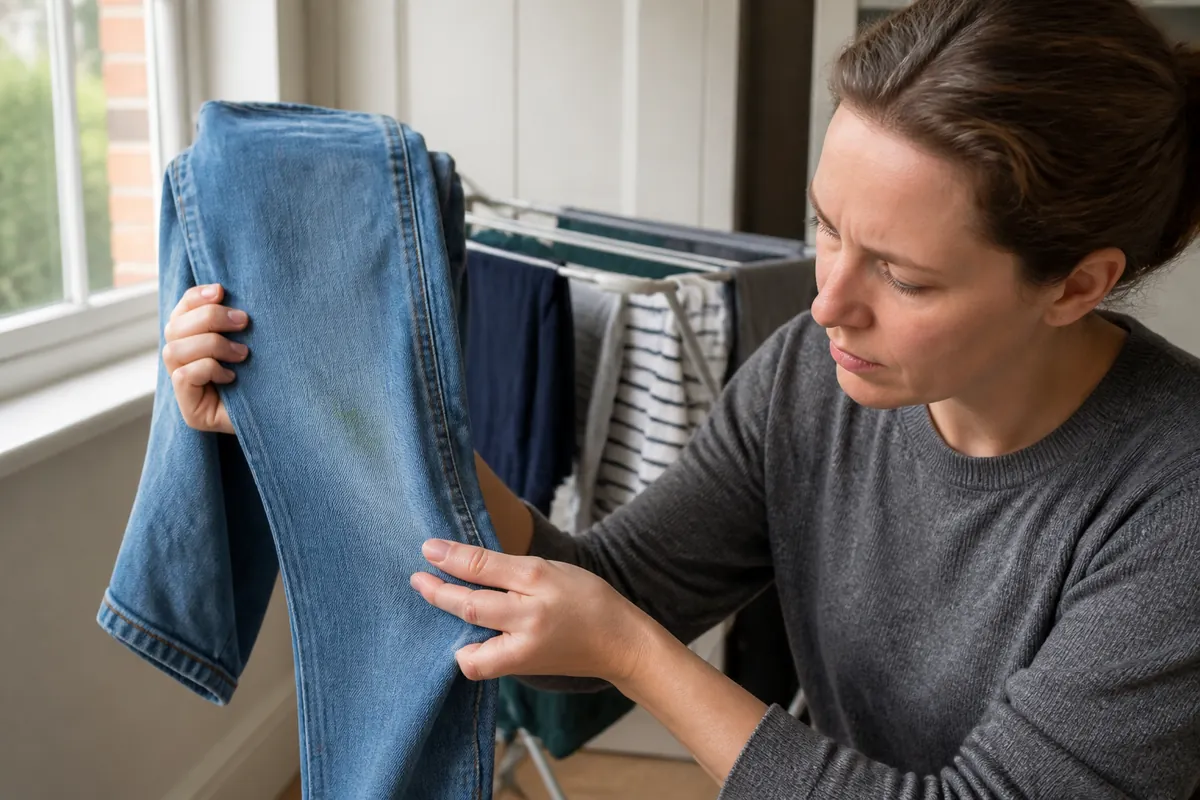
Dark indigo can transfer during a hidden test even when the jeans are otherwise washable. Treat the smallest practical area and avoid repeated brushing that creates a pale halo. Stretch jeans add elastane or another elastic fibre, so high heat, oxidising products and long soaking may be restricted. Read both the fibre percentages and the care label.
Wool, silk and delicate fabrics
Do not apply a biological or enzyme-heavy product unless its label explicitly allows the exact fibre. Wool and silk are protein fibres and can also distort, shrink, lose dye or develop water marks through unsuitable handling. Acetate, viscose, embellished garments and structured clothing have their own risks. Stop home treatment when the care instructions are unclear.
Dry-clean-only clothing
Do not soak or experiment on a dry-clean-only garment. Remove loose dry debris without rubbing, keep the item away from heat and take it to a reputable dry cleaner promptly. Point out the grass mark, any mud, products already used and whether the garment has been washed or heated.
Fresh, dried, washed and heat-dried marks
| Stain state | Controlled next step | When to stop |
|---|---|---|
| Fresh | Remove particles, blot moisture, reverse-flush if permitted and use one compatible pretreatment | Dye transfers or the finish changes during the hidden test |
| Dried, not washed | Lift dry soil first, then allow the labelled pretreatment its full stated contact time | Fibres roughen, colour lightens or the product excludes the garment |
| Washed, not heated | Let the item dry, identify what remains and repeat the same compatible route once if appropriate | The remaining patch looks like fading, abrasion or transferred dye |
| Heat-dried or ironed | Use a labelled old-stain route only when the garment allows it and expect more than one assessment | Escalation would require unapproved oxidiser, solvent, abrasion or heat |
| Unknown previous treatment | Rinse only if the care label permits and product history is understood, or seek garment-care advice | There may be an unlabelled chemical already in the fibres |
An old mark may improve after another compatible cycle, remain visible or reveal permanent dye and fibre change. No household method can promise complete removal. Let the dry result guide the next step. Compare the treated area with an unstained seam in daylight before increasing the strength, duration or mechanical action.
Household remedies and laundry products need limits
| Product or idea | Possible role | Boundary |
|---|---|---|
| Biological detergent | Labelled pretreatment for compatible washable fibres | Check enzyme and fibre exclusions; never assume wool or silk compatibility |
| Non-biological detergent | Alternative where the garment and detergent labels permit it | May still affect dye or finish and still needs the stated dose and contact time |
| Oxygen-based bleach | Labelled stain route for selected washable whites or colours | Use only when both labels permit it; test colourfastness and do not combine products |
| Chlorine bleach | Only where the garment care symbols and product directions explicitly allow it | Can damage fibres, dyes, trims and stretch components; never mix with acids or ammonia |
| White vinegar | No universal grass-stain role | Acidity can affect dyes, fibres and finishes; see the white vinegar limits and never combine it with bleach |
| Hydrogen peroxide | Oxidising ingredient in some labelled treatments | Can lighten colour or affect fibres; read the separate hydrogen peroxide safety boundary |
| Rubbing alcohol | Appears in online stain recipes | Can move dye or affect finishes and adhesives; use only with explicit garment guidance |
| Bicarbonate or toothpaste | No default treatment | Abrasive rubbing can create a pale or rough patch and mixture claims do not prove fabric compatibility |
| Washing-up liquid | May be permitted for a specific washable item and small oily component | It is not a universal laundry pretreatment and may create foam or residue in a washing machine |
Never layer a pantry ingredient over laundry detergent to make the treatment stronger. Chemical reactions, pH changes and extra residue can reduce cleaning action or damage the garment. Rinse between products only when the labels direct that sequence, and do not reuse an unlabelled mixture kept from an earlier job.
When the stain remains after a careful repeat
Let the garment dry and identify the remaining problem. A green or brown deposit may still be removable soil. A pale patch, rough nap, shiny scrub mark, stretched seam or transferred dye is material change. Further stain treatment cannot restore missing colour or rebuild damaged fibres.
Stop when a second compatible attempt produces no improvement, the care label excludes stronger treatment or the garment is valuable, delicate, structured or heavily dyed. A reputable dry cleaner or garment-care specialist can assess the construction and the products already used. Share the full treatment history so incompatible chemistry is not added later.
Keep the product name, dilution, contact time, wash programme and drying history with the garment. Those details are more useful to a specialist than a general description such as stain remover or home remedy.
When Samyx Cleaning can help beyond the garment
Samyx Cleaning does not provide laundry, dry cleaning, garment stain removal or textile restoration. If the same grass, mud or soil incident has also affected compatible household surfaces or the wider room, an agreed one-off cleaning visit may help with that separate household work. Confirm the surfaces, condition and requested scope when booking.
Important: Follow the garment care label and cleaning-product label over general guidance. Test colourfastness and compatibility in a hidden area, use any stated gloves and ventilation, and rinse, wash and dry exactly as directed. Never mix cleaning products, especially chlorine bleach with ammonia, vinegar, acids or another cleaner. Stop for dye transfer, fading, whitening, texture change, fibre weakening or seam distortion. Take a valuable, delicate, dry-clean-only, unknown or damaged garment to its manufacturer or a qualified garment-care professional before further treatment.
Book One-Off Cleaning
Enter your postcode to view our rates and availability in your area.

Frequently asked questions
-
What is the best way to remove grass stains?
Remove loose grass and soil first, read the garment care label and test one compatible laundry pretreatment on a hidden area. Treat for the labelled time, rinse or wash as directed and inspect after air drying. The best product and temperature depend on the fibre, colour, finish and stain state.
-
Does washing-up liquid remove grass stains?
Washing-up liquid may be allowed for a specific washable garment when an oily component is present, but it is not a universal grass-stain or machine-laundry product. Check the garment and product directions, test a hidden area and avoid combining it with another cleaner.
-
How do you get dried grass stains out of clothes?
Brush away loose dry soil, then use one labelled pretreatment that suits the fibre and colour. Give it the stated contact time, wash according to both labels and air-check the result. Repeat the same compatible route once if the fabric is unchanged; stop for fading, roughness or fibre damage.
-
Can old grass stains come out after washing?
Some washed grass stains can improve, especially when they have not been tumble-dried or ironed. Let the garment dry, identify whether the remaining patch is residue or material change and repeat only a compatible treatment. Heat-exposed marks may be harder to shift, and complete removal cannot be promised.
Author: Svetlana Georgieva (Clara)
Hi, I’m Svetlana Georgieva, but you can call me Clara. As the co-founder and heart behind Samyx Cleaning, I’m devoted to sharing the art of a clean space. Let’s journey into a cleaner, more joyful life together with tips from London's cleaning experts.

Discover more of our cleaning secrets: