
How to Clean with Hydrogen Peroxide Safely

Last modified on: 02/08/2026
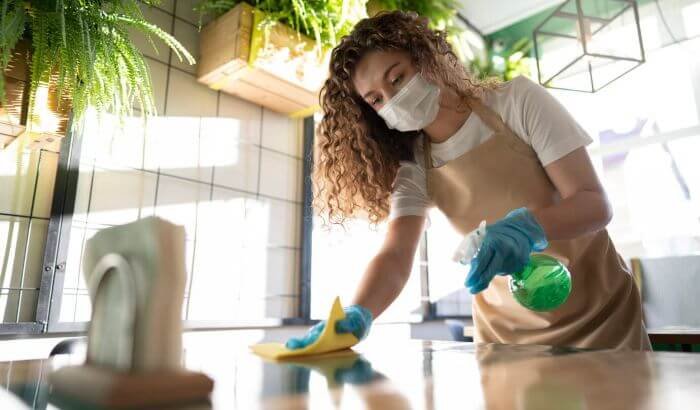
How to clean with hydrogen peroxide safely starts with the product label, not a universal recipe. Confirm what is in the bottle, whether that product is intended for the task, and whether the surface maker permits an oxidising cleaner. Remove ordinary soil first, follow the stated application and contact instructions, and never mix the product with another cleaner.
Key takeaways
- A concentration such as 3% does not prove that every bottle has the same permitted uses, dose or contact time.
- Cleaning removes visible soil. Disinfection is a separate product-specific task that depends on a relevant label claim and exact directions.
- Hydrogen peroxide can alter dyes, coatings, sealants and finishes. The product label and surface-maker guidance must agree before use.
- Do not combine it with bleach, vinegar, ammonia products, bicarbonate paste or an unknown residue from an earlier cleaner.
- A stopped treatment is a successful safety decision when the alternative is permanent material damage.
Table of Contents
What hydrogen peroxide can and cannot do
Hydrogen peroxide is an oxidising substance. In a suitable formulation it may help change some organic residues, lighten particular stains or support a product’s stated antimicrobial use. The same oxidising action can also remove colour, dull a coating or change a sensitive finish. Useful chemistry and material risk come from the same reaction.
It is not a substitute for removing dust, grease, soap film or food residue. Those layers can shield the surface and consume the product before it reaches the intended target. Start with the cleaning method approved for the material. Rinse away that cleaner where directed and allow the surface to reach the condition required by the peroxide label.
Cleaning and disinfection should not be used as interchangeable words. A person can clean a worktop without making a disinfection claim. To disinfect, the specific product must state that use and identify the surfaces, application method, wet contact time and any final rinse. A generic household bottle does not acquire those instructions from an online recipe.
Hydrogen peroxide is also not a general degreaser, limescale remover or restoration product. Grease may need a compatible surfactant or alkaline cleaner. Mineral deposits may need a material-safe descaling method. Bleached dye, etched stone, failed sealant and damaged varnish need repair or replacement, not a stronger dose.
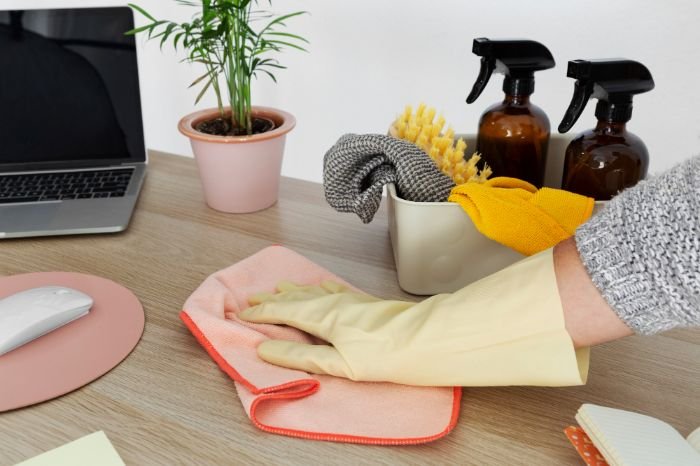
Check the product, surface and room before use
Read the actual product label
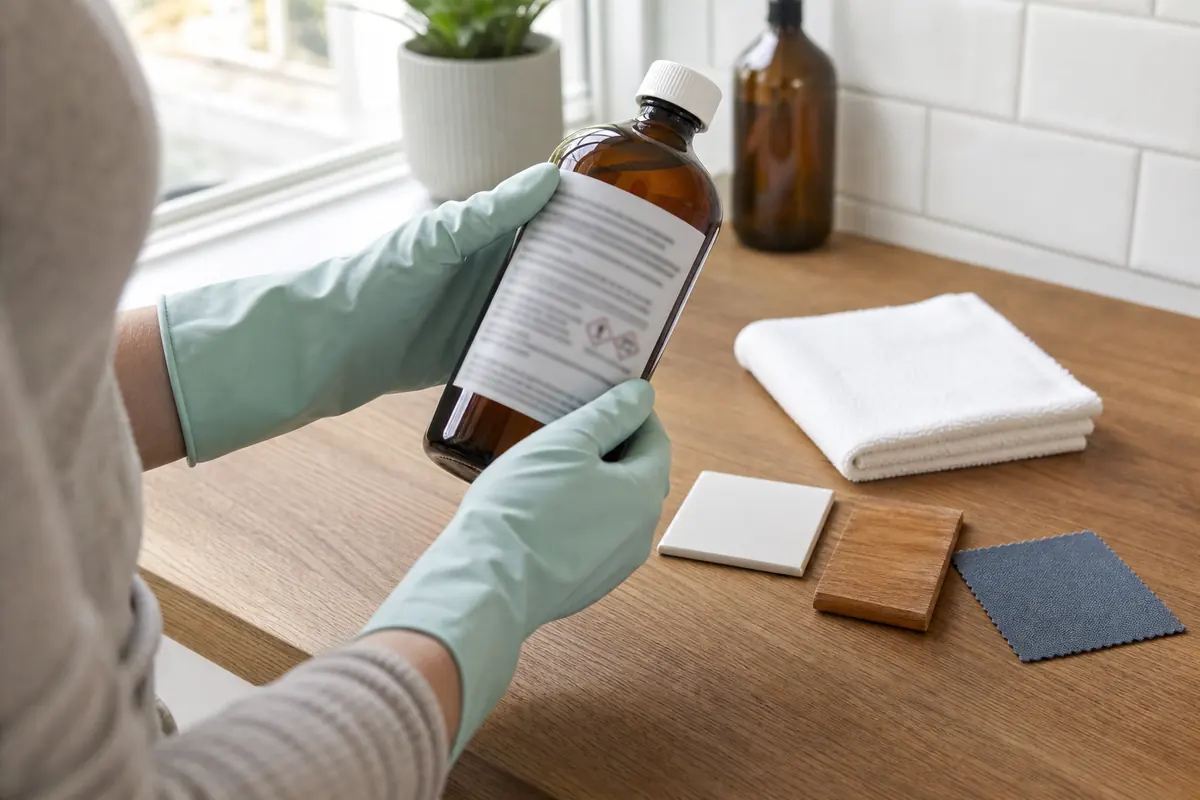
Read the label on the bottle in your hand. Look for concentration, intended use, excluded materials, application method, contact time, protective equipment, ventilation, storage, first-aid and disposal instructions. If a bottle has no readable identity or directions, do not guess what it contains or how old it is.
Higher concentration is not a quality upgrade for household cleaning. It changes exposure and material risk, and a stronger product may require controls that are not realistic in a home. Do not dilute a concentrate, copy a commercial method or transfer a product into another container unless its own directions explicitly require and explain that action.
The wider principles in chemical safety still apply: one product at a time, readable instructions, suitable ventilation, correct protective equipment and secure storage.
Identify the complete surface
A surface name is rarely enough. A worktop may be laminate, compact laminate, quartz composite, sealed stone, solid surface or coated timber. White tile may be glazed ceramic beside porous grout and silicone sealant. Fabric may combine cotton, elastane, coloured thread, print and adhesive-backed trim.
Check the maker’s care guidance for every part the liquid could reach. Confirm whether the surface is sealed, recently repaired, worn, cracked or already discoloured. For food-contact areas, children’s items or pet-accessible surfaces, use the rinse and drying instructions stated for that product and item. Do not infer suitability from the fact that peroxide later decomposes.
When both instructions permit a hidden-area test, apply the smallest stated amount to a genuinely inconspicuous place. Let it complete the stated process and dry before judging it. Wet material can hide changes in colour and gloss. Testing does not make an excluded material suitable; it only checks an allowed one for an unexpected reaction.
Prepare the room and the people in it
Open the ventilation route required by the label and clear unnecessary people, pets, food and loose items from the immediate task area. Wear the stated eye, skin or respiratory protection. Place the bottle where it cannot be knocked over, and have clean water and suitable cloths ready for any instructed rinse.
How to clean with hydrogen peroxide step by step
- Define the goal. Decide whether you are removing ordinary soil, treating a compatible stain, addressing a small surface mark or carrying out product-labelled disinfection. One task should not drift into another midway through the process.
- Confirm product permission. Match the label’s intended use and surface list to the item. If the use is absent, ambiguous or contradicted by the surface maker, choose another method.
- Prepare safely. Ventilate, wear the stated protection, isolate the area and keep the product in its original container. Do not prepare a larger quantity than the label requires.
- Remove loose material. Vacuum, sweep or lift debris without spreading it. Blot a spill without rubbing it into a porous surface.
- Clean visible soil. Use the surface-compatible cleaning method first. Grease, soap film and dirt are cleaning problems even when a later disinfecting step is justified.
- Remove the earlier cleaner. Rinse as directed and let the surface reach the dry or damp condition required by the peroxide product. Unknown residue counts as another cleaner.
- Apply exactly as directed. Use the labelled method, amount and coverage. Do not strengthen it with less water, a longer soak or a second ingredient.
- Respect the stated contact time. For a disinfection claim, the surface normally must remain in the condition described by the label for the full stated period. Do not borrow a time from another formulation.
- Rinse, wipe and dry as required. Food-contact, skin-contact and residue-sensitive items may have a specific final step. Follow it before returning the item to use.
- Inspect before repeating. Check colour, gloss, texture, coating and joints in good light. Stop if the material changes or the result has stalled.
Choose the route by task
| Goal | Check first | Controlled route | Do not assume | Stop signal |
|---|---|---|---|---|
| Routine hard-surface cleaning | Material, coating and soil type | Use the compatible cleaner; peroxide only if its label adds a permitted role | That oxidation removes grease or limescale | Dulling, whitening or tackiness |
| Disinfection | Product claim, surface and contact directions | Pre-clean, then follow the exact labelled process | That every household bottle is a disinfectant | Surface cannot stay in the required condition safely |
| Glazed tile or grout | Glaze, grout, sealant, colour and maker guidance | Clean first; test and treat only where permitted | That tile, grout and sealant react alike | Colour, sealant or joint changes |
| Washable white textile | Care label, fibre, trim and stain source | Use a labelled laundry product or permitted spot route | That white means bleach-safe | Weakness, yellowing or trim change |
| Coloured or delicate textile | Dye stability, fibre and finish | Prefer a colour-safe labelled method and hidden test | That a weak solution cannot fade dye | Dye transfer or texture change |
| Small surface mould mark | Material, area, moisture source and label use | Clean only a manageable permitted surface and correct moisture | That bleaching proves removal below the surface | Rapid return, porous damage or spreading growth |
| Stone, wood or metal finish | Exact material, sealant and manufacturer instructions | Use the approved material-specific cleaner | That a hidden test overrides an exclusion | Loss of gloss, colour or coating |
| Electronics or valuable item | Manufacturer procedure and specialist value | Follow the maker or use a specialist | That a household spray is suitable | Any moisture entry or finish change |
Ordinary hard surfaces
For routine dirt on a compatible sealed surface, start with the product intended to remove that dirt. Hydrogen peroxide may have no useful role once the soil is gone. If its label permits a separate stain or hygiene step, carry it out only after the first cleaner has been removed and the material is ready.
Product-specific disinfection
A disinfection claim belongs to a product and method, not to the ingredient name alone. Check what organisms and surfaces the label covers, whether pre-cleaning is required, how the product must be applied, how long the surface must remain wet and whether rinsing follows. If those details are missing, describe the task as cleaning, not disinfection.
Glazed tile, grout and sealant
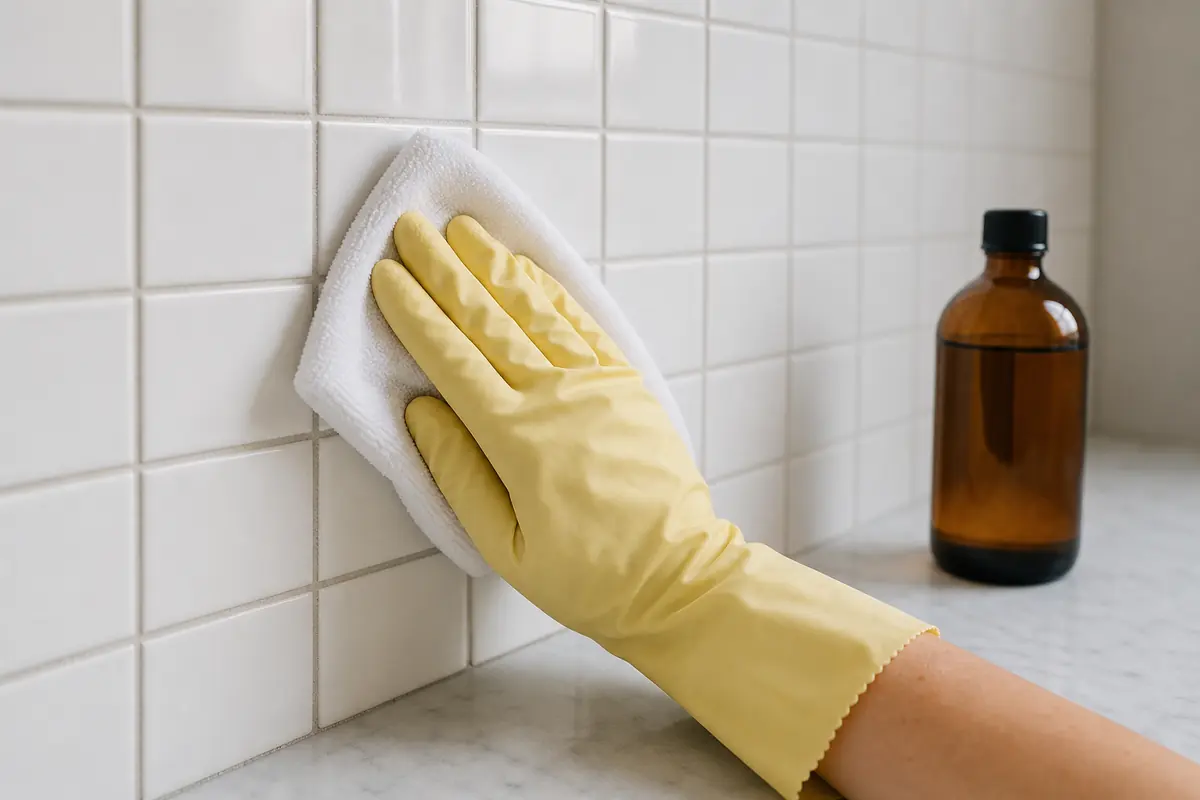
Glazed ceramic, cementitious grout and flexible sealant are three different materials. A treatment tolerated by the tile face may lighten grout or affect the sealant edge. Clean soap film first, keep the application local and inspect every boundary. Repeated bleaching can hide a moisture problem without fixing it.
Textiles and household stains
Start with the stain source, garment or upholstery label, fibre and dye. Peroxide can alter coloured cloth and protein fibres. Upholstery may also have backing, foam or fire-retardant treatments that should not be saturated. The broader stain treatment sequence is source-led: blot, choose a compatible product, rinse or wash as directed, and inspect before heat.
Small surface mould marks
First decide whether the mark is on a washable non-porous surface or inside porous grout, sealant, plaster, timber or soft furnishing. A compatible product may clean a limited surface mark. Colour change does not prove that growth below the surface is gone. Correct condensation, leaks or ventilation problems, and stop DIY work when the affected area spreads, returns quickly or involves damaged porous material.
What not to clean with hydrogen peroxide without approval
Avoid hydrogen peroxide by default where neither the product nor the item maker names the use. This includes unknown finishes, valuable items and materials where a small colour or gloss change would be permanent.
- Natural and engineered stone: the stone, resin, polish and sealer can respond differently. Use the method approved for that specific natural stone installation.
- Wood and coated furniture: liquid can enter joints or grain. Oxidation may lighten timber and alter oil, wax, varnish or paint.
- Coloured, delicate or structured textiles: dye, fibre, adhesive, backing and trim create several failure points. Dry-clean-only and valuable items belong with a specialist.
- Decorative or reactive metals: plated, polished, patinated and lacquered finishes need maker-approved care. Do not treat every object as solid stainless steel.
- Electronics and controls: sprays can enter seams, ports, switches and sensors. Power down and use the manufacturer’s cleaning instructions.
- Large or recurring contamination: sewage, extensive mould, sharps, unknown chemicals and infection-control settings require an appropriate specialist; these are not household-bottle jobs.

Never mix hydrogen peroxide with another cleaner
The professional rule is simple: do not mix hydrogen peroxide with bleach, white vinegar, acids, ammonia products, disinfectants, detergents or an unknown cleaner. A mixture can change chemical behaviour, release gas or heat, splash, damage the surface or cancel the labelled performance.
This includes improvised bicarbonate pastes. Even when two ingredients are commonly presented as a household hack, the mixture has no universal material permission, dose, stability or disinfection claim. The abrasive paste can create its own finish damage and make residue harder to rinse from grout and texture.
Sequential use also needs control. Do not apply peroxide over a surface that still holds another product. Remove the first cleaner according to its directions, rinse with clean water when permitted, and let the area dry before deciding whether a separate second process is both necessary and allowed. Never reuse a bottle or trigger head that previously held a different chemical.
Storage, expiry and disposal
Keep hydrogen peroxide in its original opaque, labelled container with the cap closed. Light, heat and contamination can reduce stability; the correct shelf life and storage temperature come from that product’s label. Do not leave a decanted spray bottle in daylight or top up an older container with a new product.
Record the opening date if the maker recommends it, and inspect the packaging before use. A swollen, leaking, damaged or unreadable container should not be handled as an ordinary cleaning bottle. Do not judge potency by putting the liquid on skin; bubbling depends on contamination and biology, not a reliable household concentration test.
Use the disposal route printed on the label and the relevant local authority guidance. Do not pour an unknown concentration down a drain, combine leftovers or move the liquid into an unlabelled container. Keep it secured away from children, pets, food and incompatible products until disposal is complete.
When to stop and where Samyx can help
Stop when dye transfers, gloss drops, a coating softens, wood lightens, metal changes, sealant swells or the item develops a new ring or texture. Also stop if the product becomes warm, the container leaks, unexpected vapour appears or another chemical may be present. Leave the immediate area when needed and follow the product’s incident instructions.
Samyx does not treat an unverified household peroxide bottle as a universal professional method, and it does not provide specialist mould remediation, hazardous-waste work, infection-control certification or restoration of etched, bleached or chemically damaged materials. Those jobs need the appropriate specialist.
When the real need is a broader reset of compatible household surfaces, one-off cleaning can cover the agreed rooms and tasks using product and surface decisions made for the property. Tell the team about previous treatments, stains, coatings and damaged areas before work begins.
Book One-Off Cleaning
Enter your postcode to view our rates and availability in your area.

Conclusion: The label decides the method
Hydrogen peroxide can be useful when a named product, compatible material and defined task align. The reliable sequence is to identify the goal, clean ordinary soil, remove previous products, apply only as directed, complete the stated final step and inspect the dry surface. That method is less dramatic than a universal recipe and better protects the people, materials and result that the cleaning is meant to serve.
Frequently asked questions
-
Can you use straight hydrogen peroxide for cleaning?
Only when the product label permits undiluted use for that exact task and the surface maker allows it. A concentration such as 3% does not create a universal method. Do not strengthen, dilute or extend the contact time beyond the directions.
-
What should you not clean with hydrogen peroxide?
Avoid any material or finish excluded by the product or item maker. High-risk examples include unknown stone sealers, wood coatings, coloured or delicate textiles, decorative metals, electronics and valuable items. A hidden test does not override an explicit exclusion.
-
Can you mix hydrogen peroxide with vinegar or bicarbonate?
Do not mix hydrogen peroxide with vinegar, bicarbonate or another cleaner unless a manufacturer explicitly supplies that method. Use one labelled product at a time, remove it as directed, rinse when permitted and let the surface dry before a separate process.
-
Does hydrogen peroxide disinfect household surfaces?
Some products have a specific disinfection claim, but the ingredient name or concentration alone is not enough. Use only a product labelled for the target surface and purpose, after any required pre-cleaning, and follow its exact application, wet contact time and rinse instructions.
Important: Hydrogen peroxide products, concentrations, labels and permitted uses vary, and household materials differ in colour, coating, sealant and condition. Follow the product label and surface-maker instructions, ventilate the room, wear the stated protection and test only where both instructions allow. Never mix hydrogen peroxide with another cleaner or reuse a container that held a different product. Stop if colour, gloss, texture or finish changes, and use a material specialist or remediation professional when the item or contamination is outside routine household cleaning.
Author: Svetlana Georgieva (Clara)
Hi, I’m Svetlana Georgieva, but you can call me Clara. As the co-founder and heart behind Samyx Cleaning, I’m devoted to sharing the art of a clean space. Let’s journey into a cleaner, more joyful life together with tips from London's cleaning experts.

Discover more of our cleaning secrets: