
How to Remove Tea and Coffee Stains from Your Carpet

Last modified on: 01/09/2026

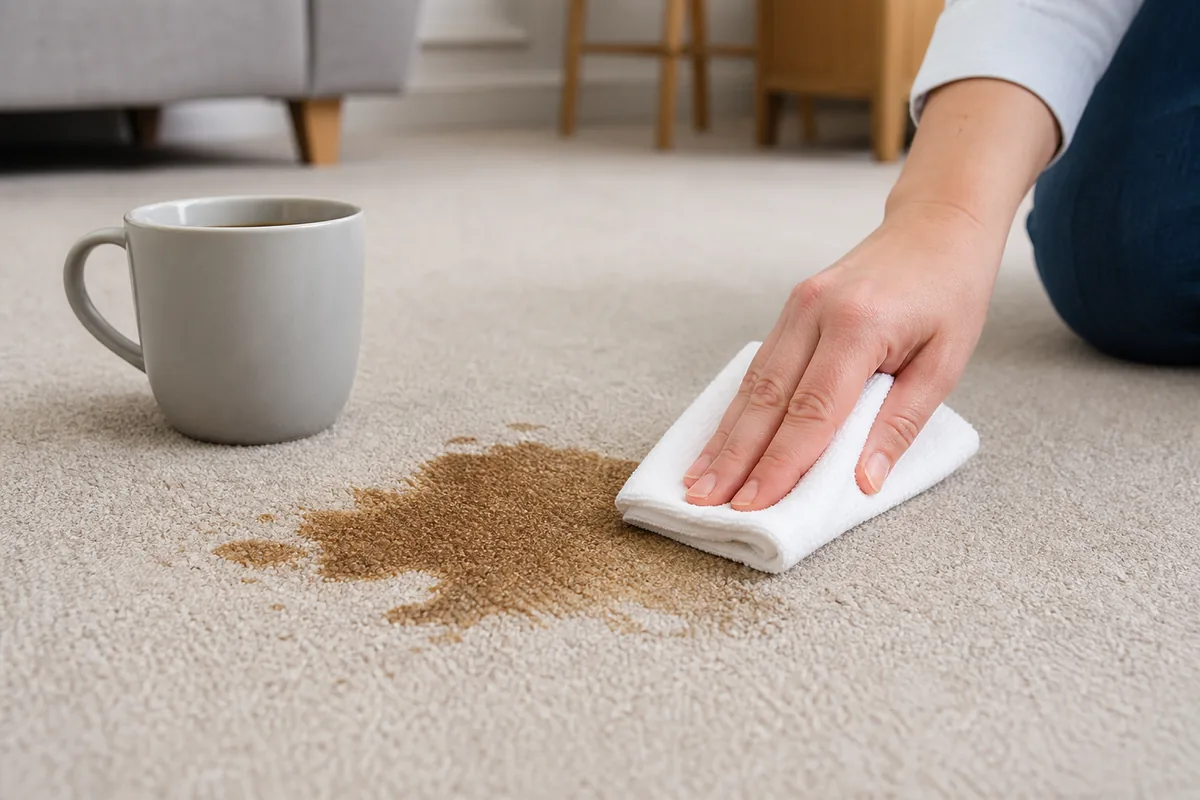
To remove coffee stains from carpet, blot the spill immediately, work from the edge inwards and check the fibre before applying any solution.
Nothing ruins tea time like a nasty stain on your carpet. Whether you prefer tea or coffee as your morning (or afternoon – I’m not judging) pick-me-up, spills can be a serious problem.
Cleaning coffee and tea stains from your carpet is not as easy as it may seem. If you don’t know what you’re doing, there’s a great chance you’ll bring your favourite floor covering’s untimely demise.
On the other hand, if you don’t act quickly, the tea or coffee stain may become a permanent fixture in your home, which most people want to avoid. So what can you do?
Key takeaways
- Blot a fresh spill; scrubbing can spread the drink and distort the carpet pile.
- Identify the fibre and patch-test a hidden area before treating the visible mark.
- Black coffee and tea mainly leave tannin colour; milk and sugar add protein, fat and sticky residue.
- Use controlled moisture, remove cleaner residue and dry the carpet fully to reduce wicking.
- Stop when colour transfers, the pile changes or the stain reaches an unknown, delicate or valuable carpet.
Table of Contents
Remove coffee stains from carpet: choose the first response
The safest first move depends on what was spilled, how long it has been there and what the carpet is made from. Use this table to select the response before reaching for a household recipe.
| What you see | First response | Main risk | Next decision |
|---|---|---|---|
| Fresh black coffee or plain tea | Blot immediately with a clean white absorbent cloth, working from the edge inwards | Rubbing spreads the tannin mark and can disturb the pile | Check the care label and use a compatible carpet treatment only if colour remains |
| Coffee or tea with milk, cream or sugar | Blot the liquid and remove any solids without pushing them deeper | Dairy, fat and sugar can leave odour or sticky residue after the brown colour fades | Choose a labelled treatment compatible with both the carpet and the food residue |
| Dried mark | Do not scrape or flood it; test a small amount of compatible treatment on a hidden area | Repeated wetting may spread the stain into the backing | Work in short controlled passes and reassess after complete drying |
| Wool, natural fibre, handmade rug or unknown material | Pause and check the manufacturer’s guidance or seek specialist advice | Colour loss, shrinkage, texture change or backing damage | Avoid assuming that a method suitable for synthetic carpet is safe here |
| Mark returns after drying | Stop adding more product and let the area dry fully | Residue or liquid below the surface may wick back into the pile | Controlled professional rinsing and extraction may be more suitable |
Ask About Carpet Cleaning
Enter your postcode to view our rates and availability in your area.

Why do coffee and tea leave stains on your carpet?
Why are coffee stains so hard to remove? The short answer is “tannin”. The long answer involves a verbose scientific exploration of biochemistry, which for the purposes of this article can be boiled down to a few key points.
Tannins are naturally occurring chemical substances. You can find them in many fruits, trees, and other plants. This includes coffee and tea.
Tannins are natural pigments. They’re great at binding with a variety of substances (including the fibers your carpet is made of). As a natural consequence, once the stains set in, they’re almost impossible to remove.
Think about it – if tannin can stain your cups, you’re hardly going to remove it from your carpet or rug. The good news is that stains don’t set in right away. Even in the darkest of hours, hope shines through. Let’s talk about some cleaning methods.
Note: If you don’t know what you’re doing, it’s best to leave this job for professionals. Many people attempt to clean coffee and tea stains from their carpets, only to ruin them in the process. Ask yourself if saving a few pounds is worth the risk. If the answer is “yes”, read on.
Side note: Whatever cleaning method you choose, it’s best to test it on an inconspicuous area of the carpet or rug. This way, if things go sideways, you won’t have to replace your floor covering.
Can coffee stains be removed from carpet?
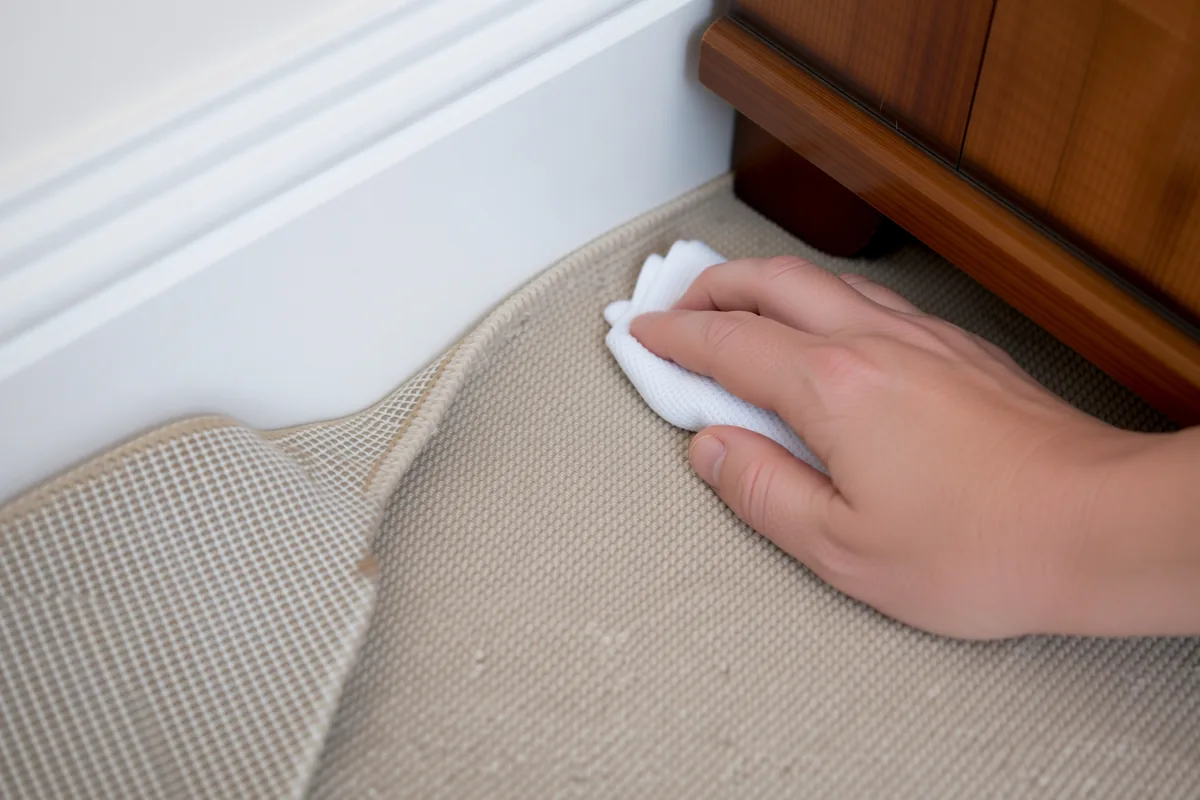
Are dry coffee stains a permanent fixture on your carpet or rug? The answer in most cases is a resounding “No”. Very rarely are tea and coffee stains impossible to remove. And oftentimes, the problem is caused by using the wrong method when trying to remove them, rather than the stains, themselves.
There are plenty of methods you can use to remove coffee stains from your carpet. Baking soda, white vinegar, and even dish soap are only some of the suggestions you’ll find below.
A dried mark is not proof that the carpet is permanently stained. The result depends on the fibre, dye stability, spill ingredients, earlier products and how far the liquid travelled. Work on a small area, use minimal moisture and wait until the carpet is fully dry before deciding whether another pass is justified.
How to clean tea and coffee stains using baking soda
Baking soda is a staple in eco-friendly cleaning. It’s an effective solution to many problems. Tea and coffee stains on your carpet are one of them.
To turn baking soda into the perfect carpet cleaner, here’s what you’ll need: a cup of baking soda, a damp cloth, a clean cloth (dry), and a bowl.
- Step 1: Pour the baking soda into the bowl.
- Step 2: Take the damp cloth and dip it into the baking soda.
- Step 3: After you coat the cloth with baking soda, buff the stained area of the carpet.
- Step 4: Rinse with cold water.
- Step 5: Repeat the steps above until you’re satisfied with the result.
- Step 6: Give the area a final rinse and dry it with the clean cloth.
Note: You can use baking soda on most carpets and rugs. But just to be sure, check in with your manufacturer’s notes. And, as always, before applying the solution to the stains, test it out on a small area out of sight to make sure you won’t ruin your floor covering.
Current care limit for bicarbonate
The steps above record the original method. Bicarbonate is not a universal stain remover, and rubbing powder or paste into the pile can distort fibres or leave residue. Check the carpet guidance before use. Apply only to a tested compatible area, keep moisture controlled and remove the residue thoroughly.
Do not treat visible fizzing as proof that a stain has been neutralised. When bicarbonate meets an acid, much of the useful chemistry of both ingredients is consumed. Judge the result only after the area has been rinsed or extracted as appropriate and dried completely.
How to remove coffee stains using white vinegar
Here’s what you’ll need: white vinegar, a spray bottle, a clean cloth, and warm water.
- Step 1: Mix a 1:2 solution of white vinegar and warm water in a spray bottle.
- Step 2: Spray the tea or coffee stain.
- Step 3: Gently rub the solution into the fibres with the cloth. Do it a few times, if necessary.
- Step 4: Rinse with cold water.
Current care limit for vinegar
The fixed vinegar ratio above is not suitable for every carpet. Acid may affect some dyes, natural fibres, backings and stain-resistant treatments. Do not spray an unknown carpet directly or soak the pile. Use the carpet maker’s instructions and a hidden-area colour test to decide whether vinegar belongs on that particular surface.
Blotting places less stress on the pile than rubbing. Stop if colour transfers to the white cloth or the surface changes. Vinegar must never be mixed with bleach or another cleaning product.
If there was sugar or milk in the coffee, you’ll need a separate solution to clean that stain. An enzyme cleaner would work best. Simply mix the enzyme cleaner with warm water according to the instructions and dab the stain. Once you’re done, dab it with a dry cloth and dry it out.
Milk and sugar leave more than a tannin mark
Black coffee or plain tea mainly creates a coloured tannin mark. Milk, cream and flavoured drinks also introduce protein and fat. Sugar can leave a sticky residue that attracts soil. A carpet may look cleaner while the residue below the surface later produces an odour or a darker patch.
Use cool or tepid moisture first and follow the label of a treatment intended for the carpet and residue. An enzyme product is not automatically suitable for wool, natural fibres or every dye. Apply sparingly, blot or extract it, carry out any labelled rinse and dry the full depth of the treated area.
You may also enjoy:

How to get tea and coffee stains out of your carpet with dish soap
To remove tea and coffee stains from your rug using dish soap, here’s what you’ll need: a tablespoon of dish soap, white vinegar, warm water, a microfibre cloth, and a sponge.
- Step 1: Blot the stain as much as you can with a damp cloth.
- Step 2: Mix a solution of a tablespoon of dish soap and 2 cups of warm water. Add some vinegar to strengthen the solution.
- Step 3: Apply the mixture to the stain and scrub with the microfibre cloth until the stain is a distant memory.
- Step 4: Rinse the solution with cold water using the sponge.
- Step 5: Blot the area dry with another cloth.
Current care limit for dish soap
The steps above preserve the original household method. Washing-up liquid can create foam and a sticky residue that is difficult to remove from carpet. Do not combine it with vinegar by default, and do not scrub an untested fibre. A low-residue product labelled for the carpet is easier to dose and rinse.
If this method is compatible with the care instructions, use the smallest workable quantity. Blot or extract the liquid, carry out a controlled clean-water rinse and press dry towels onto the area. Avoid leaving detergent in the backing.
How to clean hot drink stains using a commercial detergent
This is probably the easiest and most straightforward method for cleaning coffee and tea stains. Here’s what you’ll need: a suitable carpet cleaning detergent and a couple of rags.
- Step 1: Blot the stain with a clean rag.
- Step 2: Pour a bit of warm water over the area to dilute the stain.
- Step 3: Spray the detergent directly onto the stain.
- Step 4: Leave the product for a couple of minutes.
- Step 5: Rinse the area with cold water.
- Step 6: Repeat if the stain is still visible after drying out.
Note: Carefully read the label before you use any type of cleaning detergent. Make sure it’s suitable for your particular carpet and that you’re using it correctly.
Control the amount applied even when the product is labelled for carpet. Remove the treatment as the label directs, use clean dry towels or extraction to recover moisture, and ventilate the room. Do not use direct heat to force-dry the pile.
Why a coffee stain can return after drying
A surface can look clean while dissolved coffee, milk or detergent remains deeper in the pile, backing or underlay. As moisture travels upwards during drying, that residue can move with it and become visible again. This is commonly called wicking.
- Press dry white towels onto the treated area to recover as much moisture as possible.
- Keep the area ventilated and undisturbed until it is dry through the pile.
- Do not keep adding detergent each time the colour reappears.
- Arrange controlled rinsing and extraction if the mark repeatedly returns, feels sticky or smells of milk.
When professional carpet extraction is the safer step
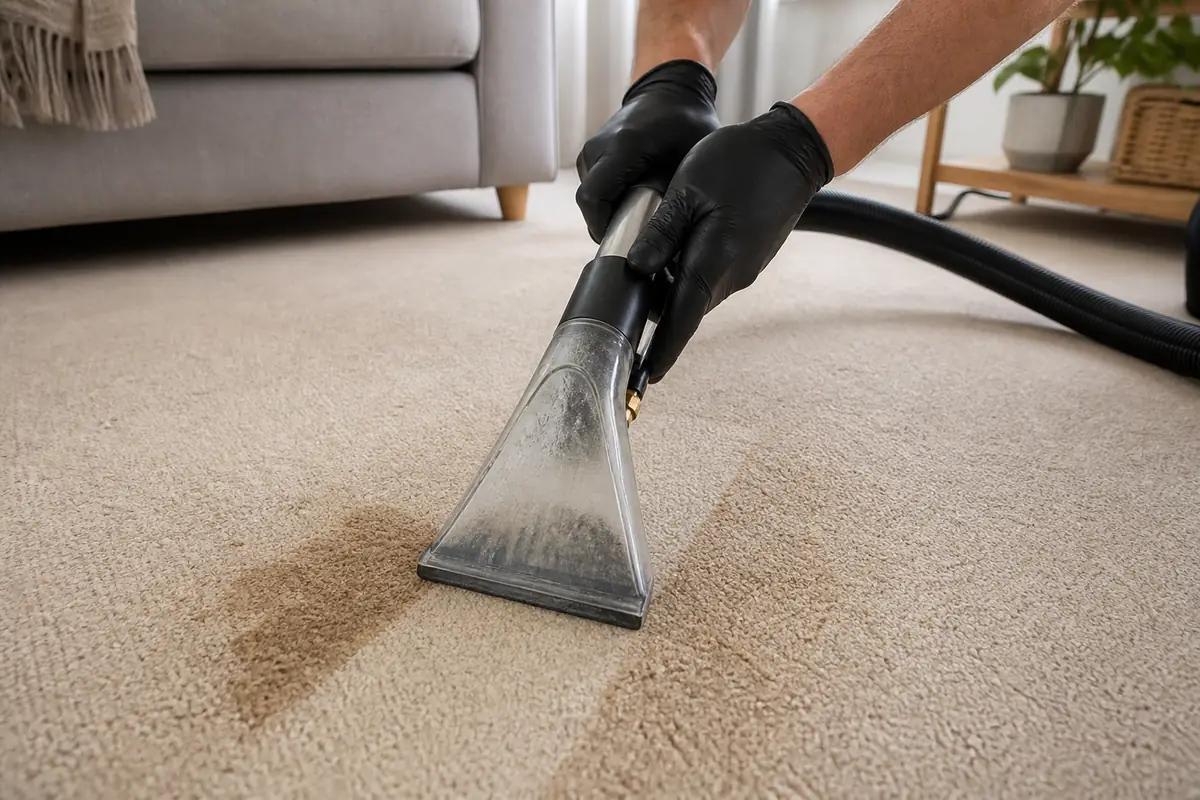
Stop DIY treatment when the carpet is wool, natural fibre, handmade, valuable or unidentified; when dye transfers to the test cloth; or when the pile, backing or adhesive changes. A large spill, dried milk residue, repeated wicking or several earlier products also makes further experimentation risky.
Samyx Cleaning provides carpet cleaning in London. Tell the office what was spilled, what has already been applied and whether the carpet material is known. That information helps the team assess the stain and choose an appropriate cleaning process; removal cannot be guaranteed for every fibre, dye or prior treatment.
Book Carpet Cleaning
Enter your postcode to view our rates and availability in your area.
Frequently asked questions
-
How do you get dried coffee stains out of carpet?
Check the carpet fibre and care instructions, patch-test a hidden area and apply a small amount of a compatible labelled carpet treatment. Work from the edge inwards, blot or extract rather than scrub, remove residue as directed and reassess only after complete drying.
-
Does coffee stain carpet permanently?
Coffee is not automatically permanent. The result depends on the fibre, dye, age of the spill, milk or sugar content, earlier treatments and how deeply the liquid travelled. Colour loss or damage caused by a previous product cannot be cleaned away like a normal stain.
-
Does bicarbonate of soda remove tea stains?
Bicarbonate may absorb moisture or help with some residues on a compatible carpet, but it is not a universal tannin remover. Powder and paste can lodge in the pile or affect some fibres. Check the care guidance, patch-test and remove the residue thoroughly.
-
What changes when coffee contains milk or sugar?
Milk adds protein and fat, and sugar leaves a sticky residue. The brown tannin mark may fade while residue remains below the surface, causing soil attraction or odour. Use a treatment labelled for the carpet and the food residue, then rinse or extract and dry as directed.
-
Why does a coffee stain come back after drying?
Liquid and dissolved residue can remain in the pile, backing or underlay, then move upwards as the carpet dries. This wicking can recreate the visible mark. Stop adding product, dry the area fully and consider controlled professional rinsing and extraction if it recurs.
Important: Follow the carpet manufacturer’s care instructions and the cleaning-product label over general guidance. Patch-test a hidden area with a clean white cloth. Do not mix cleaning products, scrub the pile or soak the backing and underlay. Stop if colour transfers, the surface lightens, the pile changes or adhesive and backing are affected. Wool, natural fibres, handmade rugs, valuable carpets and unknown materials need specialist advice. Keep children and pets away from the treated area until it is rinsed as directed and fully dry.
Conclusion
Tea and coffee stains don’t have to be the end of your carpet. There are plenty of methods you can try if you feel like dealing with the stains yourself. And if not – you can always give us a call.

Author: Atanas Dzhingarov
Hi, I’m Atanas - brand consultant and writer. I’m helping Samyx Cleaning create the best cleaning company blog on the Internet. Join us on our journey and learn how to live a cleaner, healthier, happier life in the process.
Discover more of our cleaning secrets: