
Best Way to Clean a Mattress: Stains, Urine and Safe Drying

Last modified on: 27/07/2026

The best way to clean a mattress is to identify its construction first, remove dry soil, treat only the affected area with minimal moisture, and let every layer dry completely before the bed is used again.
Clean the surface without soaking the filling
- Check the mattress care label and identify the construction. Wash a removable cover only when its own label permits it.
- Strip the bed, inspect both sides and vacuum the surface, sides and seams before introducing moisture.
- Blot fresh liquid, patch-test one compatible treatment and use the smallest useful amount. Do not rub or saturate the filling.
- Dry the mattress completely before covering or sleeping on it. Stop if the core is wet, the material changes, mould is suspected or full drying is uncertain.
Key takeaways
- The care label and mattress construction decide which methods are safe.
- Dry vacuuming comes before stain treatment, steam or extraction.
- Blot a spill; do not scrub it across the cover or force it deeper.
- Use one compatible cleaner at a time and stop if colour, texture or support changes.
- A mattress is not ready for bedding or sleep until its cover and filling are fully dry.
Table of Contents
A mattress collects loose dust, hair, skin flakes and small debris even when it is protected by sheets. Body oils and perspiration can gradually discolour the cover; an untreated spill can leave a visible mark or odour. Cleaning is most manageable when loose material is removed regularly and accidental moisture is dealt with before it travels into the filling.
This does not mean every mark is a health emergency or that aggressive “deep cleaning” is automatically better. The practical objective is to remove accessible soil without damaging adhesives, quilting, foam or fire-safety components. Persistent allergy or respiratory symptoms need appropriate medical advice; mattress cleaning should not be presented as treatment.
Choose the method by material and problem
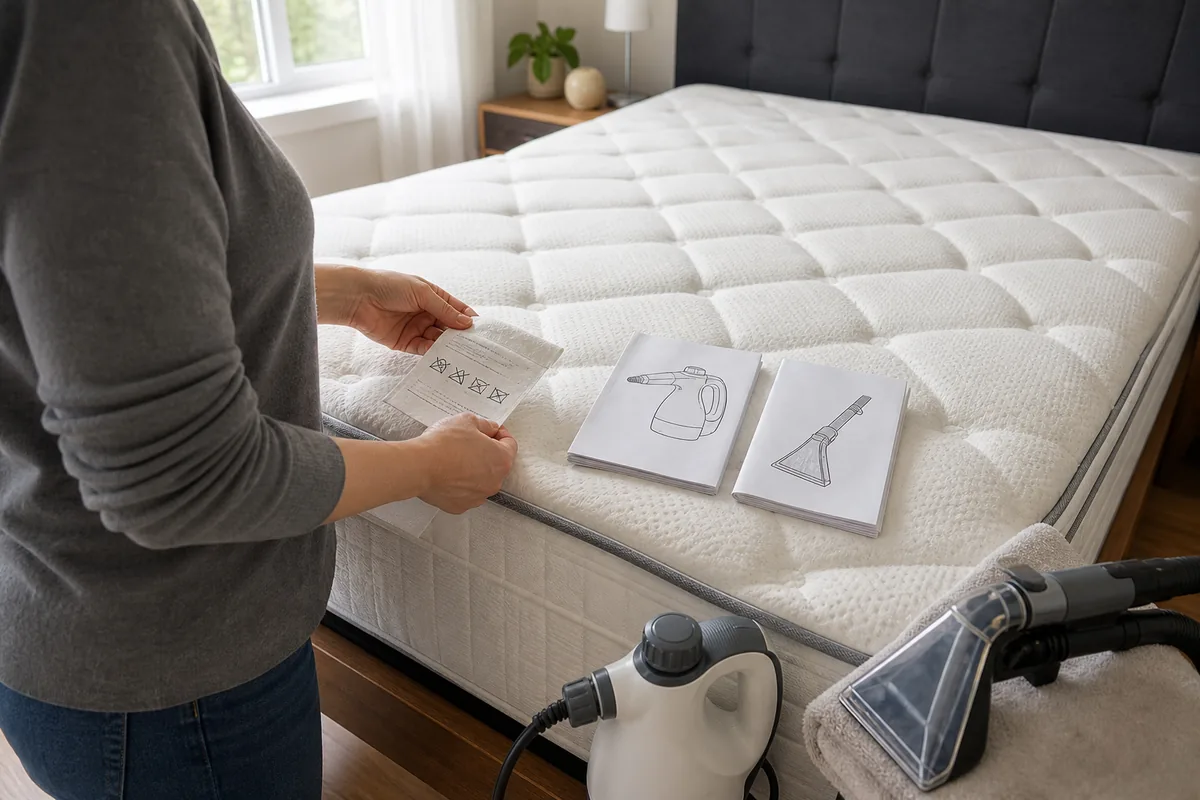
Read the sewn-in care information and any manufacturer guidance before choosing a product or machine. The instructions on product labels also matter: dilution, dwell time, ventilation and rinsing requirements are not interchangeable.
A zip does not automatically make a mattress cover machine-washable. Some covers are designed to be removed only for inspection or service, and washing can shrink the fabric or affect a treatment applied during manufacture. If the construction is unknown, use the least intrusive route: dry soil removal, a hidden-area test and very limited surface moisture.
Prepare the work area before opening a cleaner. You need several clean white towels, a separate white test cloth, a vacuum with a clean upholstery attachment and good airflow. White cloths make dye transfer easier to see and avoid introducing colour from a cleaning rag. Keep children and pets away from the area for the full product dwell and drying period stated on the label.
Photograph the care label and the untreated mark in natural light. The record helps you compare progress without repeatedly wetting the same patch. It is also useful if you later ask the manufacturer or a cleaner to assess the result. Measure the affected area and check whether the same outline appears underneath; a wider underside mark suggests that surface-only treatment may be insufficient.
| What you find | First action | Compatible route | Stop condition |
|---|---|---|---|
| Loose dust, hair or crumbs | Vacuum the surface, sides and seams | Dry upholstery attachment | The fabric snags or the care instructions prohibit vacuuming |
| Small fresh spill | Press with dry white towels | One patch-tested, label-compatible treatment | Liquid has reached the filling or colour transfers |
| Dried urine mark or odour | Identify the construction and affected depth | One compatible enzyme or manufacturer-approved route | Odour returns, the core is affected or full drying is uncertain |
| Yellow sweat or body-oil mark | Dry vacuum and hidden-area test | Minimal mild treatment permitted by the label | Dye, texture or finish changes, or old yellowing no longer improves |
| Steam or extraction considered | Read the mattress and machine instructions | Only an expressly compatible surface or equipment method | Unknown foam, damaged cover, excess wetting or no reliable drying plan |
| Suspected mould or deep contamination | Isolate the mattress and stop | Professional assessment or replacement decision | Do not continue adding moisture |
Best way to clean a mattress step by step
1. Strip and inspect the mattress
Remove sheets, the protector and any removable topper. Launder each removable item according to its own label without assuming one temperature suits everything. Inspect the top, sides, seams and underside in good light. Look for loose soil, a localised surface mark, a wider damp patch, damaged stitching, pest signs or possible mould before deciding that home cleaning is appropriate.
If the mattress is dry and structurally sound, open the window and give yourself enough time to finish the job and dry the surface. If it is already damp inside, adding another product can make the problem harder to assess.
2. Vacuum the surface and seams
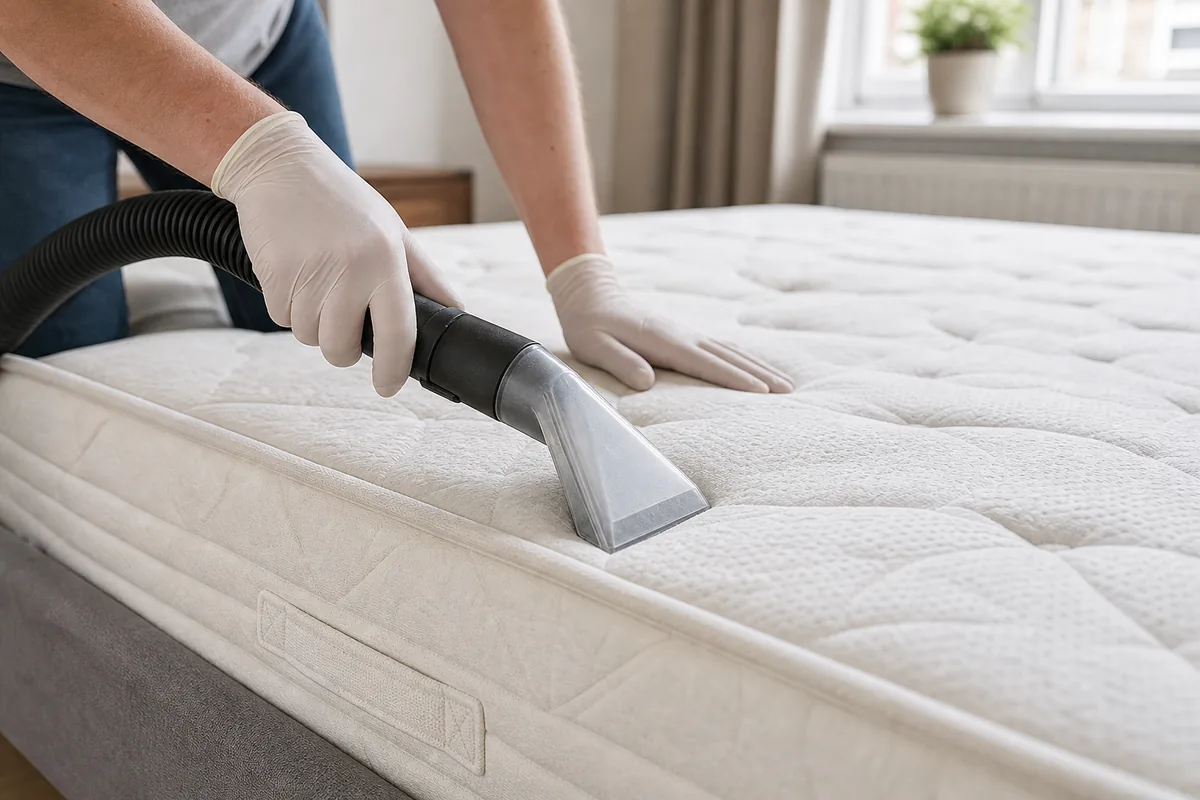
Use a clean upholstery attachment on a suitable low-to-moderate setting. Work slowly over the top, then the sides and accessible underside. Pay attention to quilting, piping and seams, where hair and fine debris settle. Keep the nozzle moving and stop if it pulls threads, catches tufting or distorts a delicate cover.
3. Patch-test one treatment
Choose a cleaner only after matching it to the care instructions, cover fabric and type of mark. Apply a small amount to an inconspicuous edge with a white cloth. Let the test area settle and check the cloth and mattress for dye transfer, paling, roughness, tackiness or distortion. A successful test reduces risk; it does not justify soaking the visible area.
4. Blot; do not scrub
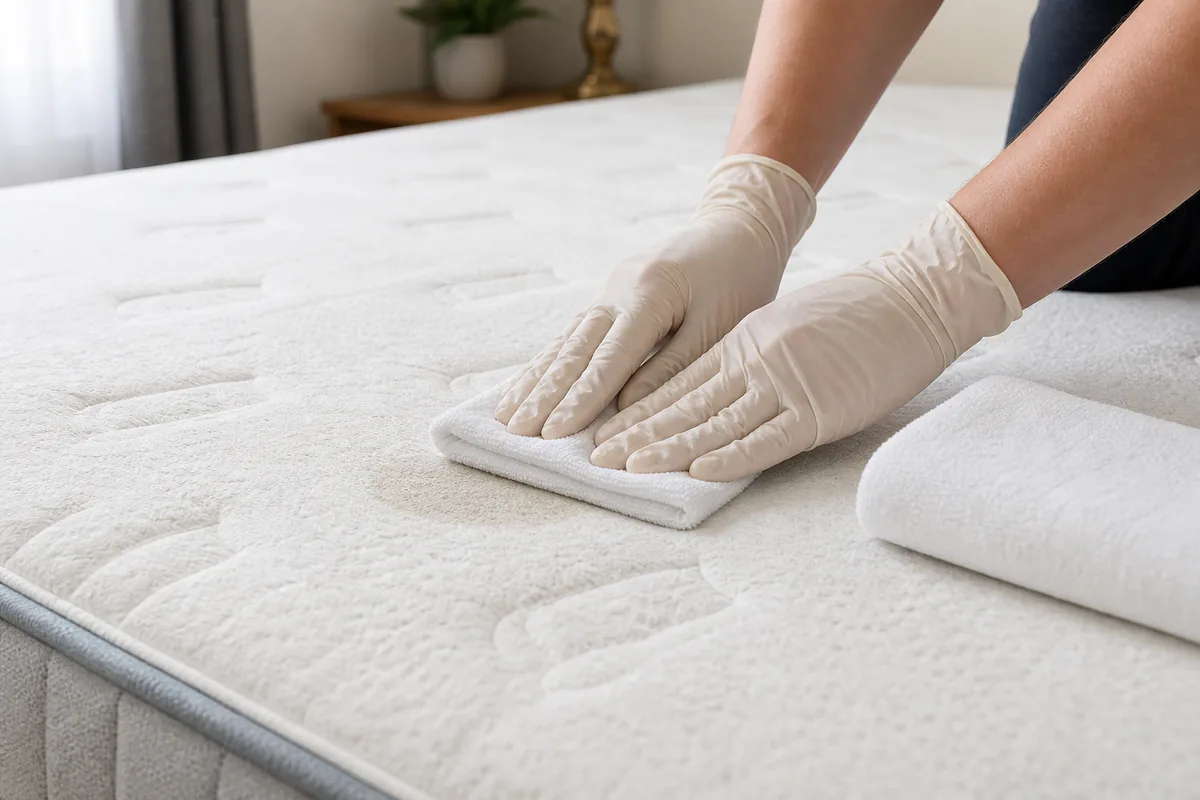
For a fresh spill, press clean dry towels straight down to absorb as much liquid as possible. Change to a dry section as it becomes damp. Work from the edge towards the centre so the affected area does not spread. Scrubbing can push liquid through the ticking and abrade the surface, so continue with repeated light pressure.
5. Remove residue with minimal moisture
Apply the tested treatment to the cloth, not directly over the bed, unless the product and mattress instructions specifically require another method. Blot, inspect and repeat only when useful transfer continues. If the product requires residue removal, use a second barely damp cloth followed by dry towels. Do not follow one cleaner immediately with vinegar, peroxide, bicarbonate or another formula: residues can interact and make the result unpredictable.
6. Dry before remaking the bed
Press with dry towels to remove accessible moisture, then leave the mattress uncovered with air moving around the treated area. Do not judge dryness only by the top fabric. Seams and padding can remain damp after the surface feels normal. The dedicated drying checks below are part of the cleaning process, not an optional finishing touch.
How to clean urine and sweat stains
Urine creates three separate problems: free liquid, a visible mark and odour. A method that lightens the surface may not remove contamination held deeper in foam or padding. First decide whether the incident is small and fresh, old but localised, or large enough to have reached the core.
Fresh urine
Remove wet bedding and a washable protector without pressing them into the mattress. Use dry white towels to absorb the spill, replacing them until little moisture transfers. If a removable cover is explicitly washable, treat it separately. Guidance for children’s bedding can help with the removable layers. The mattress filling still needs its own compatibility decision.
If the manufacturer permits spot treatment, choose one compatible method. An enzyme cleaner may help with biological residue when both the product and mattress instructions allow it; follow its dilution, dwell and residue directions exactly. Use the smallest amount that reaches the affected surface. Do not pour liquid into the bed in an attempt to “flush” the urine out.
Dried urine and odour
Inspect the underside and nearby seams before treating an old mark. A small surface stain with no remaining odour is different from a patch that smells again in humid conditions or after pressure is applied. The latter suggests residue below the surface, where repeated DIY wetting may spread the affected area without extracting it.
Patch-test one permitted treatment and stop if the cover changes or no useful transfer occurs. Do not alternate enzyme cleaner, vinegar, peroxide and bicarbonate in repeated rounds. If the spill was large, reached an unknown depth, or the odour returns after full drying, arrange an assessment. Deep saturation can make professional extraction or replacement more realistic than another surface treatment.
Record what happened before asking for help: approximate spill size, when it occurred, products already used, mattress type and whether the underside was affected. This prevents incompatible repeat treatment and helps a professional judge whether extraction can reach the problem. A cleaned-looking top is not proof that the core is dry or free from residue.
Sweat and yellow marks
Yellow areas are not always fresh sweat. Body oils, oxidation, age and residues from previous cleaners can produce a similar appearance. Begin with dry vacuuming, then test a mild treatment allowed by the mattress maker. Using only lightly damp suds or a treated cloth gives more control than spraying the whole patch.
Blot from the outer edge and check a white towel for actual soil transfer. Stop if the fabric lightens unevenly, feels rough, becomes tacky or the mark no longer changes. Old oxidation may only lighten. Chasing a perfect white finish with stronger chemistry can leave a larger bleached area or damage the ticking.
A broad pale area often develops gradually and needs a more restrained approach than a new local spill. Treat a small test section first and compare it after drying, since a wet patch can look temporarily darker or cleaner. Repeating treatment across the whole sleeping surface before the test has dried increases the chance of rings and uneven colour.
Steam cleaners and carpet extractors: compatibility first
Can you steam clean a mattress?
Use steam only when the mattress manufacturer expressly allows it. Steam introduces heat and moisture, and different machines release very different amounts. Memory foam, latex, adhesives, quilted fillings and treated covers can respond differently, so a general “yes” is not a safe substitute for the care instructions.
A brief moving pass of surface vapour is also not the same as hot-water extraction. Steam does not automatically remove embedded soil, urine or cleaning residue, and it should not be described as guaranteed sanitising. Do not steam an unknown, damaged, deeply soiled or moisture-sensitive mattress. If the approved method is used, keep the tool moving, avoid prolonged dwell and start only when complete drying is realistic.
Can you use a carpet cleaner on a mattress?
A spray-and-extract carpet machine is not automatically suitable for a mattress. Check that the mattress instructions permit wet extraction and that the machine manual permits mattress or upholstery use. A floor head is not appropriate; the machine needs a clean upholstery hand tool, compatible chemistry and enough suction to recover the delivered solution.
- Confirm approval in both manuals before setting up the equipment.
- Check the mattress for foam, damage, open seams or previous saturation.
- Use only upholstery-approved solution at the stated dilution and patch-test it.
- Limit solution delivery and make additional suction-only passes.
- Stop if the tool cannot recover moisture or a same-day drying plan is not credible.
Keep cables, ventilation and product handling within the machine instructions. The information on cleaning-product hazards is useful when setting up a safe work area; it does not override the two equipment-specific manuals.
Do a dry planning pass before filling the machine. Decide where the waste water will be emptied, how the mattress will be supported, which face will dry first and how air will reach the underside. If the room is humid, poorly ventilated or needed for sleep that evening, postpone wet extraction. A powerful machine cannot compensate for an unsuitable mattress or insufficient drying conditions.
How to dry a mattress completely
Drying time depends on how much moisture entered the mattress, the construction, room temperature, humidity and airflow. A small surface treatment may dry within several hours; padding affected by a spill or extractor can take much longer. Do not promise a fixed time.
After blotting, expose as much of the mattress as the maker allows. Open windows when conditions are suitable and use a fan to move room air across the surface. A dehumidifier can help in a closed room when used according to its instructions. If the mattress can be repositioned safely, allow air to reach the underside; do not bend or stand a construction that the manufacturer says must remain flat.
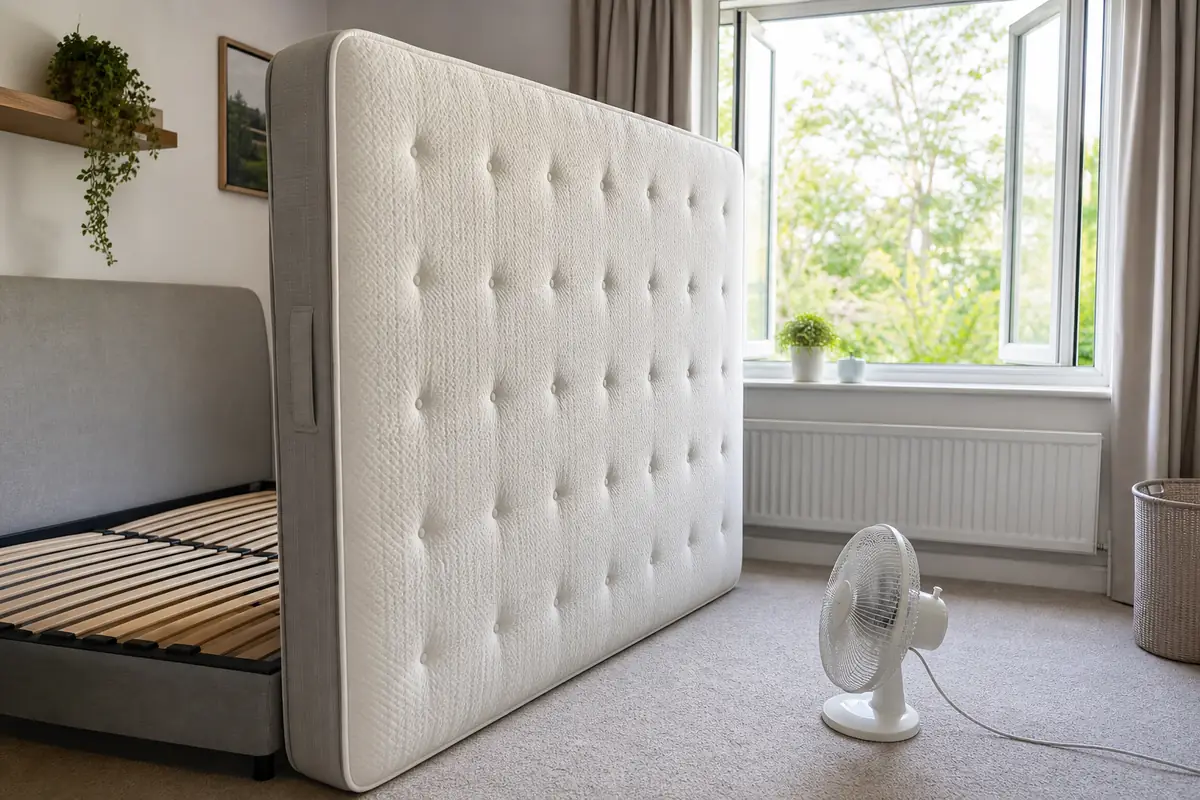
Check the treated area, seams and underside for coolness, dampness and returning odour. Leave the mattress uncovered if any sign remains. Avoid hairdryers, heaters and other concentrated heat, which can affect covers, foams and adhesives. Bedding and body weight trap moisture, so remake the bed only when all accessible layers feel and smell fully dry.
When cleaning is not enough
Stop home treatment when a large volume has reached the core, odour returns after complete drying, the cover or foam has changed, seams are open, or the mattress has smoke, fire or unknown chemical contamination. Suspected mould is also a stop condition: do not keep adding liquid or attempt to cover the area. The decision then is professional assessment versus replacement, not a stronger household recipe.
Pest signs require an appropriate pest-control route, not ordinary mattress cleaning. Structural sagging, broken springs and loss of support are replacement or warranty questions. A regular bedroom cleaning routine can control accessible dust around the bed; it cannot reverse damaged filling or deep contamination.
You may also enjoy:

Keep the mattress cleaner between treatments
- Use a washable protector suited to the mattress and launder it by its own label.
- Deal with spills immediately instead of waiting for the next scheduled clean.
- Vacuum accessible surfaces during normal bedroom care if the manufacturer permits it.
- Air the bed before remaking it and manage persistent room humidity.
- Rotate or turn the mattress only in the way its maker recommends.
There is no useful universal rule that every mattress needs the same wet “deep clean” on a fixed date. Follow the manufacturer’s care cycle, respond to visible soil and incidents, and favour dry maintenance over unnecessary moisture.
Inspect the protector after every spill and replace it when its waterproof layer cracks, peels or no longer contains liquid. Keep food and open drinks away from the bed when possible. If someone is unwell or has continence needs, prepare spare labelled bedding and absorbent protection in advance so a fresh incident can be contained without searching for supplies.
How Samyx Cleaning can help with a mattress
Professional help is sensible when the affected area is large, the filling may be wet, odour keeps returning, the construction is unclear or suitable extraction and drying equipment are not available. Samyx lists mattresses within its London upholstery cleaning service. Suitability still depends on the material, condition and contamination, so describe the mattress and spill accurately before booking.
Need Help Cleaning a Mattress?
Enter your postcode to view our rates and availability in your area.

Frequently asked questions
-
What is the best thing to clean a mattress with?
There is no universal best product. Start with a vacuum and a clean white cloth, then choose one cleaner permitted by the mattress care instructions and suited to the specific mark. Patch-test it and use minimal moisture.
-
How do you get urine out of a mattress?
Blot fresh liquid with dry towels, then use one mattress-compatible treatment according to its label. Do not soak the filling or stack several recipes. Recurring odour or deep saturation needs professional assessment or replacement consideration.
-
Can you steam clean a mattress?
Only if the mattress manufacturer permits steam and you can control moisture and drying. Avoid steaming unknown, damaged or moisture-sensitive constructions, and do not assume steam extracts embedded soil or urine.
-
Can you use a carpet cleaner on a mattress?
Only when both the mattress and machine instructions allow it. Use a clean upholstery tool, approved chemistry, limited solution and repeated dry passes. Do not proceed without a reliable full-drying plan.
-
How long should a mattress dry after cleaning?
There is no fixed time. A light surface treatment may take several hours; deeper moisture can take much longer. Keep the mattress uncovered and out of use until the surface, seams, underside and filling show no dampness, coolness or returning odour.
Important: Follow the mattress care label and product instructions before general advice. Patch-test any treatment, keep moisture to the minimum and do not combine cleaning products. Do not sleep on or cover a mattress until it is completely dry. Stop home treatment if the filling is saturated, the fabric or foam changes, mould is suspected, or you cannot confirm full drying; seek an appropriate professional assessment and consider replacement where contamination or material damage cannot be removed safely.
Author: Svetlana Georgieva (Clara)
Hi, I’m Svetlana Georgieva, but you can call me Clara. As the co-founder and heart behind Samyx Cleaning, I’m devoted to sharing the art of a clean space. Let’s journey into a cleaner, more joyful life together with tips from London's cleaning experts.

Discover more of our cleaning secrets: