
Homemade Window Cleaner: What Works and What Is Safe Around Children

Last modified on: 27/08/2026
Homemade window cleaner can work well when the recipe matches the glass, the surrounding materials and the soil you need to remove. The important decisions are not whether an ingredient sounds natural, but how much you use, where the liquid can travel and whether the glazing manufacturer permits it.
This guide gives one measured starting formula for compatible ordinary uncoated glass, plus a vinegar-free route and clear stop conditions. It also explains why windows streak, how to protect frames and sills, and what “safer around children” should mean in practice.
Key Takeaways
- Identify the glazing and adjacent materials before choosing vinegar, detergent or a manufacturer-approved alternative.
- Measure a small batch; extra washing-up liquid is a common cause of sticky residue and streaks.
- Remove loose grit first, control the liquid at the edges and use a clean squeegee on a wet pane.
- Treat homemade mixtures as cleaning products: label them, store them locked away and never use a drinks bottle.
- Never mix vinegar with bleach or combine a homemade batch with another cleaner already on the surface.
Table of Contents
Homemade window cleaner formula selector
A recipe should solve a defined problem. Ordinary fingerprints, light cooking film and settled dust do not need the same response as mineral deposits, adhesive, paint or a damaged coating. Use the least complicated compatible route that can remove the soil.
| Window or condition | Starting route | Important limit |
|---|---|---|
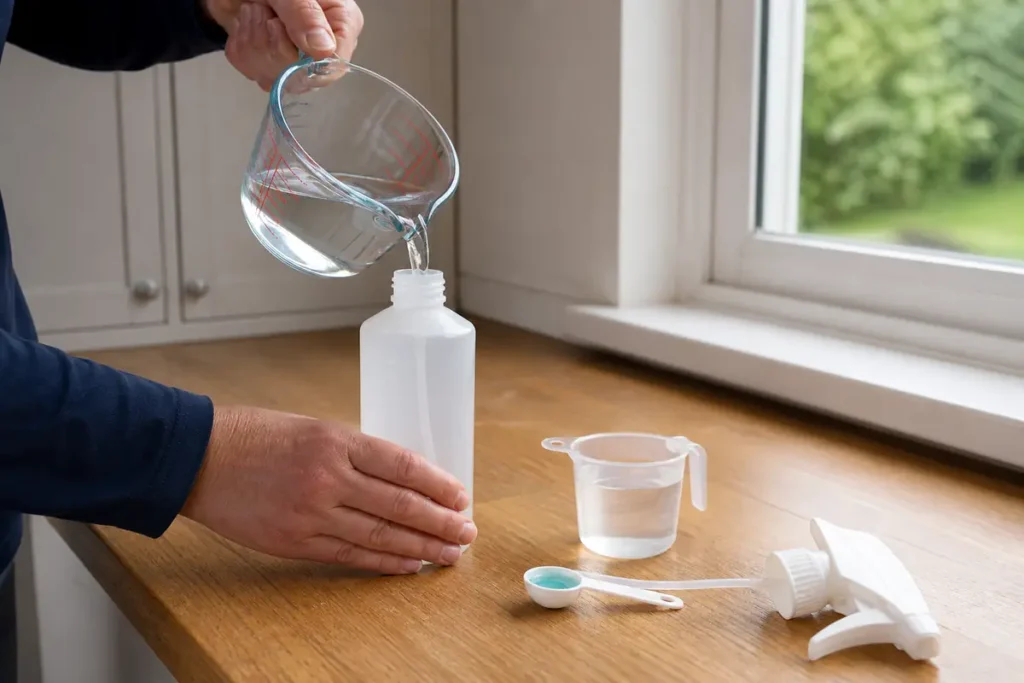
| Compatible ordinary uncoated glass with general soil | About 500 ml water, 60 ml clear white vinegar and 2.5 ml plain washing-up liquid | Test a small area and keep the mixture away from acid-sensitive surrounds |
| Light dust or fingerprints where vinegar is unsuitable | Clean water with a very small amount of compatible plain washing-up liquid | Too much detergent leaves residue; the maker’s method wins |
| Tinted, filmed, coated, low-E or self-cleaning glass | Use only the glazing or film manufacturer’s approved method | Do not assume an acidic or solvent recipe is permitted |
| Unknown glass, damaged film, failed seals or valuable glazing | Pause and identify the system or obtain specialist advice | A hidden test cannot make an incompatible method safe |
| Hard-water marks, adhesive, paint or building residue | Diagnose the deposit and use its specialist owner or an approved product | Do not keep strengthening the everyday formula |
The measured vinegar formula is a starting point, not a promise for every window. Water carries the mixture. Vinegar contributes mild acidity that can help with selected deposits and film. The small amount of washing-up liquid adds wetting and lift for oily marks. More of any ingredient changes both performance and compatibility.
Check the whole window before mixing
The pane is only one part of the assembly. A liquid placed in the centre can run into film edges, rubber seals, painted timber, aluminium, uPVC joints and the sill below. Some of those materials tolerate occasional water but not repeated acid exposure, soaking or scrubbing.
Identify coatings and films
Look for installer paperwork, etched markings, film edges or manufacturer care instructions. Window film, solar-control products, low-emissivity surfaces and self-cleaning glass can carry method restrictions. If you cannot identify the exposed surface, clean only as its maker permits or pause. “Glass” is not enough information.
Inspect frames, seals and sills
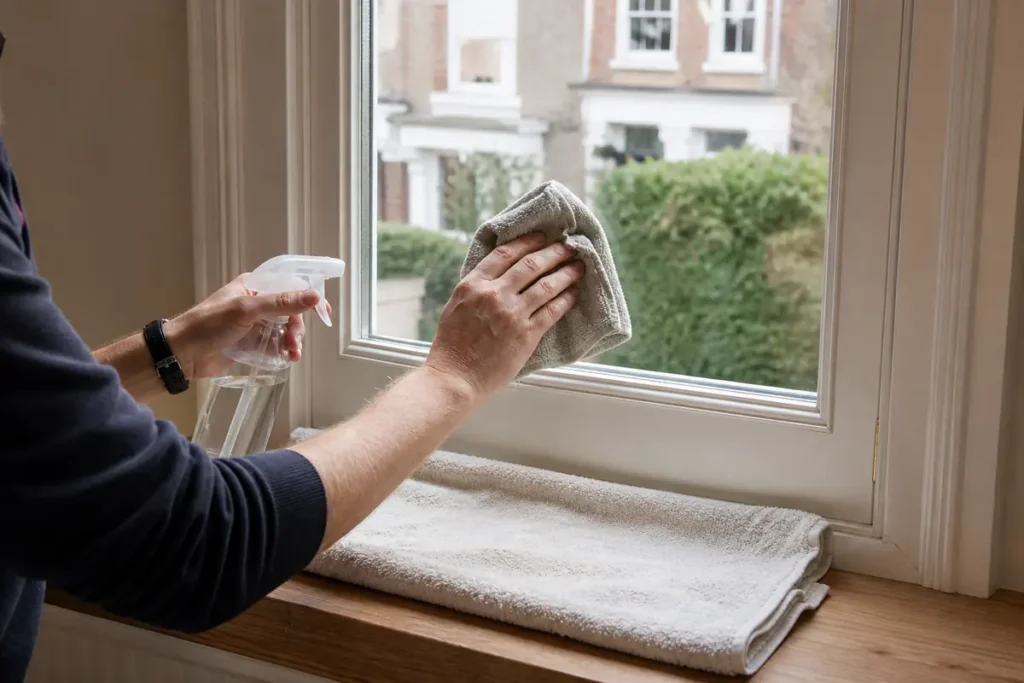
Check for flaking paint, open timber joints, perished seals, loose putty and cracks. Cover the sill with a towel. Where the surrounding finish is sensitive or unknown, put the solution on a folded cloth or washer rather than spraying the whole pane. This reduces drift and helps stop liquid pooling at the lower edge.
Natural stone needs particular care because acids can alter calcite-based surfaces. Painted and metal finishes may also have product limits. If the sill or splashback is valuable, porous or already damaged, isolate it fully before cleaning the glass.
How to use a homemade window cleaner without streaks
Streak-free work depends at least as much on preparation and removal as on the liquid. A dirty cloth, worn blade or dusty frame can put residue straight back onto a clean pane.
- Choose the conditions. Work out of strong sun where possible. A hot pane can dry the solution before you remove it.
- Prepare the area. Move curtains and objects, protect the sill and keep children and pets out of the work area. Stay on firm floor-level access.
- Remove dry contamination. Vacuum or brush loose dust from the frame and track. Lift grit gently so it is not dragged over the pane.
- Mix a small batch. Add the measured water, vinegar and detergent to a clearly labelled cleaning bottle. Close it and invert gently; vigorous shaking creates foam.
- Test discreetly. Confirm there is no change to the exposed glass, film edge, frame or seal. Stop at clouding, colour transfer, tackiness or finish change.
- Wet the pane evenly. Apply enough solution to loosen soil without sending streams into the frame. Work one manageable pane at a time.
- Agitate gently. Use a clean non-abrasive washer or folded microfibre cloth. Do not use a scouring pad or scrape unknown deposits with a blade.
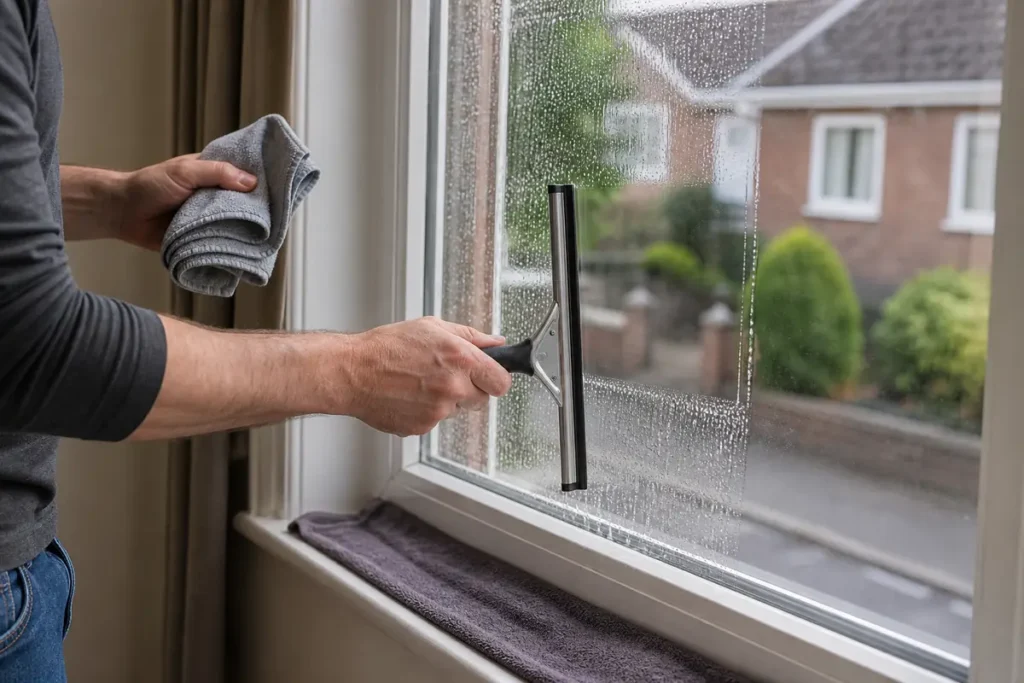
- Squeegee the glass. Set the rubber blade at the top, draw a controlled pass and overlap the next pass slightly. Wipe the blade with a clean cloth after each stroke.
- Detail the perimeter. Use a separate dry cloth for the last narrow edge and any drips on the protected sill. Do not polish the whole pane with a product-loaded cloth.
- Check from two angles. Side light reveals residue, missed edges and blade lines. Diagnose the pattern before applying more solution.
You may also enjoy:

Why homemade window cleaning solution leaves streaks
A streak is evidence. Its position and shape often identify whether the problem is excess product, poor removal, dirty equipment or liquid arriving from the frame. Repeating the same wipe usually spreads the residue more widely.
| What you see | Likely cause | Correction |
|---|---|---|
| Greasy haze across most of the pane | Too much washing-up liquid, a product-loaded cloth or existing polish | Use clean water and tools to remove residue, then reduce the detergent next time |
| Fine white marks after drying | Minerals in the water or unresolved mineral deposits | Try distilled or demineralised water for the working solution and diagnose deposits separately |
| Parallel blade lines | Dirty, nicked or dry squeegee rubber | Clean the blade, keep the pane wet and replace damaged rubber |
| Fast patchy drying | Direct sun, warm glass or too large a working area | Move to a cooler time and clean one smaller pane at a time |
| Marks returning at the perimeter | Dirty frame water or product trapped in seals and corners | Prepare the frame first and use a separate cloth for the edge |
| Cloudiness that does not move | Possible coating, film or glass damage rather than surface soil | Stop adding products and consult the glazing or film supplier |
If the pane is still hazy after the residue has been removed with clean water and clean tools, the mark may not be ordinary dirt. Failed double-glazing seals can create moisture between panes. Etching, scratches and coating failure are material problems, not stronger-cleaner problems.
What each ingredient does and where it stops
Water is the main carrier
Most of the working solution is water. It wets the surface, carries loosened soil and gives the squeegee time to work. In hard-water areas, dissolved minerals can remain as the pane dries. Distilled or demineralised water can reduce that variable, but it cannot repair damaged glass or remove every mineral deposit automatically.
White vinegar provides mild acidity
Clear white vinegar can help with selected films on compatible ordinary glass. Its acidity is also the reason to keep it away from acid-sensitive stone and any finish whose instructions exclude acidic cleaners. Cleaning windows with vinegar is a material decision, not proof that vinegar belongs on every shiny surface.
Do not substitute coloured or culinary vinegar without considering residues and colourants. Do not mix vinegar with bleach or a chlorine-releasing cleaner. If another product was used previously and its residue is unknown, rinse with water and keep the products separate.
Washing-up liquid adds wetting and grease lift
A very small quantity can help water spread and lift fingerprints or light greasy film. It is not there to make foam. Fragranced, coloured, moisturising or highly concentrated products may behave differently, so plain does not mean interchangeable. The broader product ingredients guide explains why function, concentration and label directions must be read together.
Alcohol is not the default child-safety route
Some glass-cleaner formulas use alcohol to change drying and solvent action. That also changes flammability, vapour and storage considerations. This guide does not give a casual alcohol recipe. Use it only when a suitable product or surface manufacturer explicitly permits the method and you can follow the relevant controls.
Why lemon, bicarbonate and essential oils are excluded
Lemon juice varies in strength and can leave sugar, pulp and fragrance residues. Its acidity also carries material limits; the separate lemon juice guide owns those decisions. Bicarbonate is a particulate abrasive and is unnecessary in a routine spray. Combining it with vinegar creates fizz while consuming much of the useful acid and alkali.
Essential oils add fragrance and another exposure variable, not a reliable streak-free function. Natural origin does not settle compatibility, allergy, pet or child-exposure questions. Leave them out of a simple window formula.
Use and store the mixture around children and pets
“Homemade” describes where the mixture was prepared. It does not establish that swallowing, eye contact, inhalation or skin exposure is harmless. Child safety comes from limiting access, controlling application and responding correctly if something goes wrong.
- Mix only the amount needed for the planned work and keep children and pets out of the preparation area.
- Use a dedicated, sound cleaning bottle. Never use a drinks bottle, cup or food container.
- Label the bottle with every ingredient and the date. An unlabelled clear liquid is not acceptable storage.
- Store it upright in a locked cupboard, separate from food, medicines and personal-care products.
- Ventilate the room, avoid misting at face level and wash hands after the task.
- Do not ask a child to mix, spray or carry the solution. A dry, product-free finishing task is a different decision and still needs supervision.
The HSE’s label guidance shows why hazard and precaution information must be read together for packaged products. For a wider household boundary on storage and prohibited mixtures, use the Samyx guide to cleaning products.
If someone may have swallowed, touched or breathed in something harmful, use current NHS poisoning advice. Do not try to make someone sick. Call 999 for severe breathing difficulty, loss of consciousness, a seizure or another emergency; call NHS 111 if you are unsure whether an exposure is harmful.
Mirrors, exterior glass and access need separate decisions
Mirrors
Do not saturate mirror edges. Liquid can travel behind the glass and affect the backing, especially where an edge is chipped or unsealed. Apply a compatible product sparingly to the cloth and keep it on the face. Antique, valuable or already desilvered mirrors need specialist advice.
Exterior windows
Outside panes can carry heavier grit, traffic film, bird deposits, algae and building residue. Remove loose particles before rubbing. Rinse tools more often and do not force the everyday formula to handle paint, mortar, silicone or hard mineral crusts. Those deposits need identification and a surface-compatible specialist route.
Reach and height
A good recipe does not make unsafe access acceptable. Do not stand on chairs, lean out of openings or improvise a platform to reach an exterior pane. Keep DIY work to secure, reachable glass from firm ground. High-level, awkward or damaged glazing requires competent people with suitable access equipment and training.
Where Samyx one-off cleaning fits
An agreed one-off cleaning visit may include reachable internal windows as part of a wider home clean. Confirm the panes, access, condition and priorities when booking. This article does not claim that the service covers external, high-level, specialist, filmed or damaged glazing.
Safety note: This guide covers routine household cleaning of compatible, reachable glass. It is not a substitute for glazing-manufacturer instructions, medical advice, poisoning treatment or competent work-at-height assessment. Stop when the surface or exposure risk is uncertain.
Ask About One-Off Cleaning
Enter your postcode to view our rates and availability in your area.

Frequently asked questions
-
How do you make a streak-free homemade window cleaner?
For compatible ordinary uncoated glass, start with about 500 ml water, 60 ml clear white vinegar and 2.5 ml plain washing-up liquid. Remove loose dust first, use the solution sparingly, squeegee a wet pane with a clean blade and dry the perimeter separately. Follow the maker’s method for coated, tinted, filmed or specialist glazing.
-
Can vinegar damage windows?
Vinegar may be acceptable on compatible ordinary uncoated glass, but the whole assembly matters. Acid can be unsuitable for some films, coatings, sealants, frames and stone sills. Check the glazing and surrounding-material instructions and avoid flooding the edges.
-
Why does my homemade window cleaner leave streaks?
Common causes include too much washing-up liquid, a dirty cloth, a nicked squeegee blade, hard-water minerals, hot glass and residue running from the frame. Remove existing residue with clean water and tools, then correct the cause before adding more product.
-
Is homemade window cleaner safe around children?
Homemade does not mean harmless. Keep children away while mixing and cleaning, use a dedicated labelled bottle, store it locked away and never use a food or drink container. Never mix cleaning products. Follow NHS advice promptly if harmful exposure may have occurred.
Author: Svetlana Georgieva (Clara)
Hi, I’m Svetlana Georgieva, but you can call me Clara. As the co-founder and heart behind Samyx Cleaning, I’m devoted to sharing the art of a clean space. Let’s journey into a cleaner, more joyful life together with tips from London's cleaning experts.

Discover more of our cleaning secrets: