
Types of Brooms for Cleaning: Choose and Use the Right One

Last modified on: 21/08/2026

Types of brooms for cleaning work best when the head, bristle and width match the debris, floor and space in front of you.
A soft indoor broom can gather fine dry dust from a smooth floor, a stiff yard broom can move coarse outdoor debris, and a wide push broom can clear an open area with fewer passes. Choosing by appearance alone often leaves dust behind, scatters crumbs or puts a delicate finish at risk. Start with the mess and the surface, then choose the smallest practical head for the space.
Choose a broom in five checks
- Identify the debris: fine dust, crumbs, hair, leaves, grit or a small local spill.
- Check the floor manufacturer’s care advice and choose bristles that will not abrade, snag or mark the finish.
- Match the head to the space: angled for edges, wide for open floors and compact for stairs or spot cleaning.
- Use short, controlled strokes and collect small piles before they spread or become airborne again.
- Switch to a vacuum, damp method or specialist route when the debris is embedded, wet, sharp, hazardous or stuck to the surface.
Key takeaways
- No single broom is best for every home. The right choice changes with the debris, finish and room layout.
- Soft or flagged bristles suit light dry debris on many smooth indoor floors; stiff bristles belong on compatible rough surfaces.
- A wide head saves passes in open areas, whereas an angled or hand broom gives better control near edges and furniture.
- Slow strokes, small piles and a flat dustpan edge control dust better than fast sweeping across the whole room.
- Clean, dry and store each broom by zone so an outdoor or bathroom tool does not carry dirt into a kitchen or living space.
Table of Contents
Types of brooms for cleaning compared
The useful distinction is not the product name on the handle. Head shape controls reach and coverage, bristle texture controls how the broom meets the surface, and width controls manoeuvrability. Use the table as a first filter, then check the care instructions for the actual floor.
| Broom type | Best suited to | Surface check | Main limit |
|---|---|---|---|
| Soft upright broom | Fine dry dust and crumbs on open indoor floors | Choose clean, flexible bristles for the finish | Can struggle with heavy grit or embedded hair |
| Angle broom | Edges, skirting boards, corners and furniture legs | Keep the pointed edge free from trapped grit | Narrow head makes large rooms slower |
| Push or platform broom | Large open floors, garages and broad outdoor areas | Match bristle stiffness to concrete, paving or the indoor finish | Awkward in tight rooms and around obstacles |
| Stiff yard broom | Leaves, soil and coarse debris on compatible outdoor surfaces | Avoid delicate indoor finishes and loose coatings | May scratch or scatter fine dust |
| Rubber broom | Loose hair on some hard floors and low-pile textiles | Test the material and use light pressure | Does not replace extraction for embedded soil |
| Hand or whisk broom | Stairs, worktops, small piles and spot cleaning | Keep separate tools for food and floor tasks | Poor choice for a whole room |
| Traditional fibre broom | Dry sweeping where its bristle texture suits the floor | Check for shedding, rough tips and trapped grit | Variable stiffness and harder to wash thoroughly |
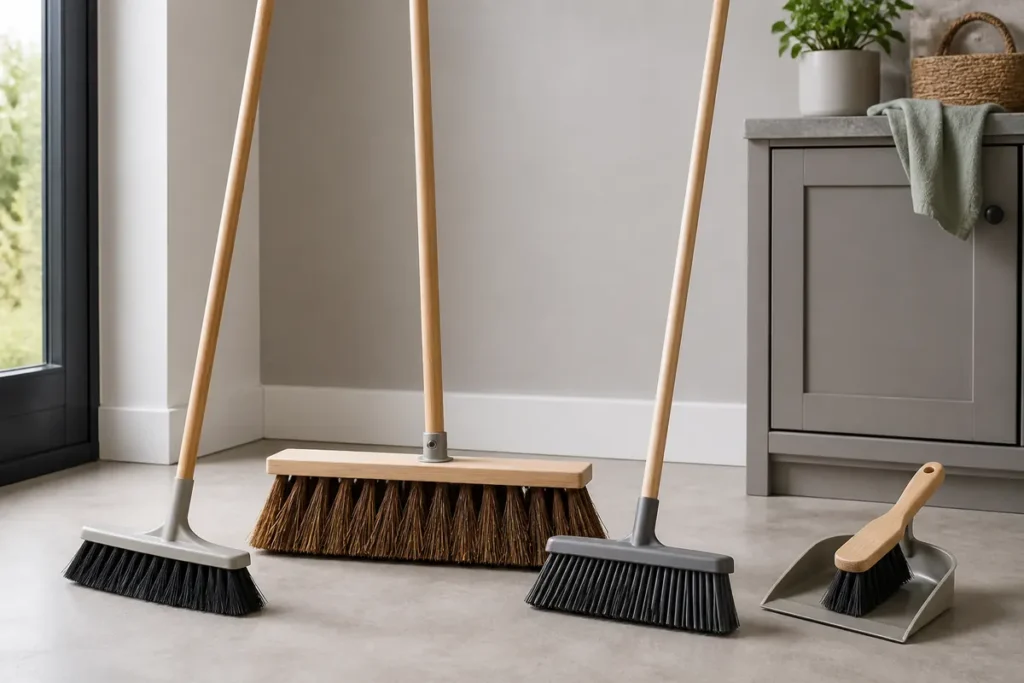
Start with debris, floor and space
Fine dust and light crumbs
Fine dry material needs a head that gathers particles without flicking them across the room. Soft bristles with split or flagged tips can pick up smaller particles more effectively than a very stiff yard head. Keep the broom head clean: oily residue, hair and compacted dust reduce contact with the floor.
Homes with several floor finishes may need more than one tool. A broom that behaves well on textured tile can sound harsh or leave faint marks on a glossy finish. Treat the floor manufacturer’s instructions as the deciding source and retire any head that has trapped grit.
Hair and fibrous debris
Long hair and pet hair often wrap around conventional bristles. A rubber head can gather loose hair into a controllable line on compatible hard floors and may lift surface hair from some low-pile rugs. Embedded hair, fine dander and soil still call for a suitable vacuum. Keep its filters, brush roll and air path in order by following the separate vacuum care routine.
Leaves, soil and coarse grit
Coarse dry debris needs a stronger head and enough space to move it. A stiff yard broom suits compatible paving and rough concrete; a broad push broom covers open garages or paths with fewer passes. Remove stones or sharp fragments separately without driving them under the bristles. Wet leaves can be heavy and slippery, so wait for a manageable condition or use a tool designed for wet outdoor work.

How head shape changes the job
An angled head puts a narrow leading edge into corners and along skirting boards. It also works around chair legs with less furniture movement. Choose it for a furnished kitchen, hall or small flat where control matters more than maximum width. A compact hand broom belongs near a dustpan for stairs, local crumbs and small piles.
A push broom earns its storage space in a broad, uncluttered area. The handle stays in front of the user and the full head moves a band of debris forwards. Very wide heads become tiring or hard to steer when the floor is crowded. For narrow gaps behind furniture, a broom is rarely the complete answer; the right tool for hard-to-reach areas may be a crevice attachment, flexible duster or movable-head mop.
Some shops use the name electric broom for a compact cordless vacuum. It relies on suction and a collection chamber, so compare it by floor-head compatibility, filtration, capacity and maintenance as a vacuum rather than as a manual bristle broom.
Bristle material matters less than behaviour
Natural fibre, synthetic filament and rubber describe the material, not the result on every floor. Judge the contact points. Soft, flexible tips follow a smooth surface and gather light debris. Stiffer, unflagged ends keep their shape against larger particles. Rubber forms a different contact edge and can be rinsed more readily when the product instructions allow it.
Inspect a new broom before use. Rough moulding seams, exposed wires, hard edges or damaged bristles deserve attention before they touch a finished floor. The broader set of cleaning tools should work as a system: the broom handles loose dry debris, a dustpan removes the pile, and another compatible method deals with residue that remains attached.
How to use a broom without spreading dust
- Remove chairs, mats and small obstacles that can be moved without strain. Pick up sharp or awkward items separately.
- Begin at the edges and work in sections towards a clear collection point. Avoid racing across the entire room.
- Hold an upright broom with one hand high for guidance and the other lower for control. Keep your shoulders relaxed and change position instead of twisting through a long reach.
- Use short strokes that keep the head in contact with the floor. Fast flicking sends fine particles back into the air.
- Collect several small piles. Place the dustpan lip flat against the floor and finish with short strokes towards the pan.
For a push broom, guide the head forwards in short runs and clear the collected line before it becomes too heavy. Pulling can help position the head for the next run, though the main cleaning stroke is normally a push. An upright or angled broom is commonly drawn towards the collection point. The head design and floor response decide the motion.

When sweeping is the wrong method
A broom is a dry-debris tool. It will not remove a sticky film, grease, dried food or soil held inside a textured surface. Sweeping those areas can smear the residue or load the bristles. Move to a compatible damp method only after loose grit has gone and the floor’s care instructions permit moisture.
Vacuuming is usually the better route for carpet, deep joints, upholstery edges and large amounts of very fine dust. A dustpan and brush offer safer control for a small local pile. Glass, needles, pest waste, building dust, unknown powders and contaminated material need a risk-specific method, protective equipment and disposal route. Do not sweep material when its identity or hazard is unclear.
You may also enjoy:

Keep indoor and outdoor tools separate
A yard broom can carry soil, grit and organic debris into the home. Bathroom and utility-room heads may collect residues that do not belong near food-preparation areas. Mark or store tools by zone, and use a separate hand brush for worktops. Colour coding is useful only when everyone in the household follows the same scheme.
Remove hair and trapped debris after use. Wash the head only when its materials and fixings are designed for it, then rinse away any permitted cleaner and let the broom dry fully with the bristles unsupported. A damp head stored against a wall can deform and develop odour. Hang the tool or store it so the bristle tips do not carry its weight.
Replace the head when control is lost
Age alone does not decide replacement. Look for bristles that stay bent after cleaning, a head that sheds, split plastic, loose fixings, a damaged handle or an edge that no longer reaches the floor evenly. A deformed broom leaves narrow trails and needs extra pressure, which makes the task slower and can increase surface contact in the wrong places.
Persistent odour after suitable washing and full drying is another reason to retire a washable head. Replace only the head when the design allows it. Keep brushes and abrasive pads for attached soil within their own role; choosing compatible scrubbing tools is safer than pressing harder with a broom.
When routine floor care becomes a time problem
Tool choice solves one part of floor care. A busy London home can still accumulate crumbs, hair and edge dust across several rooms faster than the household can keep up. Samyx Cleaning can include compatible ordinary floor cleaning within an agreed regular domestic cleaning visit, alongside the wider routine booked for the home.
The service is a practical route for recurring household work. Specialist sanding, sealing, polishing, damaged-floor repair and hazardous contamination sit outside that claim and need the relevant specialist. Tell the office about delicate or unusual flooring before booking so the visit can be discussed against the real material and condition.
Plan Regular Domestic Cleaning
Enter your postcode to view our rates and availability in your area.

Frequently asked questions
-
What are the different types of brooms for cleaning?
Common types include soft upright, angle, push or platform, stiff yard, rubber, hand or whisk, and traditional fibre brooms. Choose by debris, floor compatibility and the amount of open space rather than by the name alone.
-
What is the best type of broom for a house?
Most homes benefit from a soft or angled indoor broom for dry debris, plus a compact hand broom for small piles. A second stiff or push broom belongs outdoors. Homes with pet hair or mixed floors may need a rubber broom or vacuum as well.
-
Should you push or pull a broom?
Guide a push broom forwards in short runs across open areas. Draw an upright or angled broom towards a small collection point with controlled strokes. Follow the head design and stop if the action scratches, snags or scatters debris.
Important: Follow the floor, tool and product manufacturer’s instructions over general guidance. Patch-test an inconspicuous area when bristle or finish compatibility is uncertain. Wear suitable gloves and eye protection for sharp or contaminated debris, ventilate when a labelled product requires it, and rinse and dry washable tools as directed. Never mix cleaning products, including bleach with ammonia or acids. Stop if you see scratching, dulling, discolouration, coating change or fibre damage. Ask the manufacturer or an appropriate specialist before cleaning a delicate, valuable, unknown or damaged surface.
Author: Svetlana Georgieva (Clara)
Hi, I’m Svetlana Georgieva, but you can call me Clara. As the co-founder and heart behind Samyx Cleaning, I’m devoted to sharing the art of a clean space. Let’s journey into a cleaner, more joyful life together with tips from London's cleaning experts.

Discover more of our cleaning secrets: