
How to Clean a White Composite Sink the Right Way

Last modified on: 03/09/2026
Publish: 28th Jul 2022
Views:
Category: DIY
Tags:
Cleaning tips, Eco-friendly cleaning, Kitchen cleaning, White vinegar

If you are searching for how to clean white composite sink stains safely, start by checking the sink maker’s care guide and identifying whether the mark is limescale, food residue, metal transfer or actual surface damage.
White composite sinks are a fantastic addition to any modern kitchen. They’re stylish, durable, and can elevate the aesthetics of your home like granite would, but they require less maintenance.
However, if you don’t clean a white composite sink properly, you may end up damaging it and they’re not exactly easy (or cheap) to replace. So today we’ll talk about how you can keep your sink in tip-top shape without much effort.
Key takeaways
- Identify the sink maker, composite material and finish before using a stain treatment.
- Begin with warm soapy water, a soft cloth and complete drying.
- Treat limescale, coloured residue and metal transfer as different problems.
- Use acids, oxidisers, abrasives and restoring products only when the exact maker permits them.
- Do not scrub harder when the mark is a scratch, chip, crack or change in the finish.
Table of Contents
What is a composite sink?
Composite sinks are made of different elements (the name kind of gives it away, doesn’t it?). The most important of those elements are the rock (usually granite) or mineral (usually quartz) dust and acrylic resins holding it together.
A composite sink is usually more affordable than a granite or a marble one, though more expensive than a stainless steel or a porcelain one.
Thanks to the resins, composite sinks are very durable and non-porous, which means they don’t stain as easily as some of their more expensive counterparts.
Current care note: “Composite” is a category, not one universal surface recipe. Granite or quartz content, resin, texture, coating and colour vary by make and model. Keep the product label, installation paperwork or model name if possible; the maker’s current care instructions take priority over a general household method.
How to clean white composite sink stains by type
| What the mark looks like | Likely cause | Lowest-risk first response | When to stop |
|---|---|---|---|
| Chalky film, ring or pale rough deposit | Hard-water minerals or cleaner residue | Wash, rinse and dry; use only the maker-approved limescale method if the film remains | Stop if acid changes the colour, sheen or texture |
| Tea, coffee, wine or food colour | Coloured residue held in mineral film or surface texture | Fresh washing-up liquid and a soft cloth; repeat gentle passes before escalating | Stop if rubbing creates a brighter or smoother patch |
| Fine grey or black line | Metal transferred from cookware | Use the maker’s compatible sink cleaner with the permitted soft pad | Stop if the line is actually a scratch or groove |
| Uneven dullness, chip, crack or permanent discolouration | Physical, chemical or heat damage | Photograph it and seek manufacturer or installer advice | Do not treat damage as removable dirt |
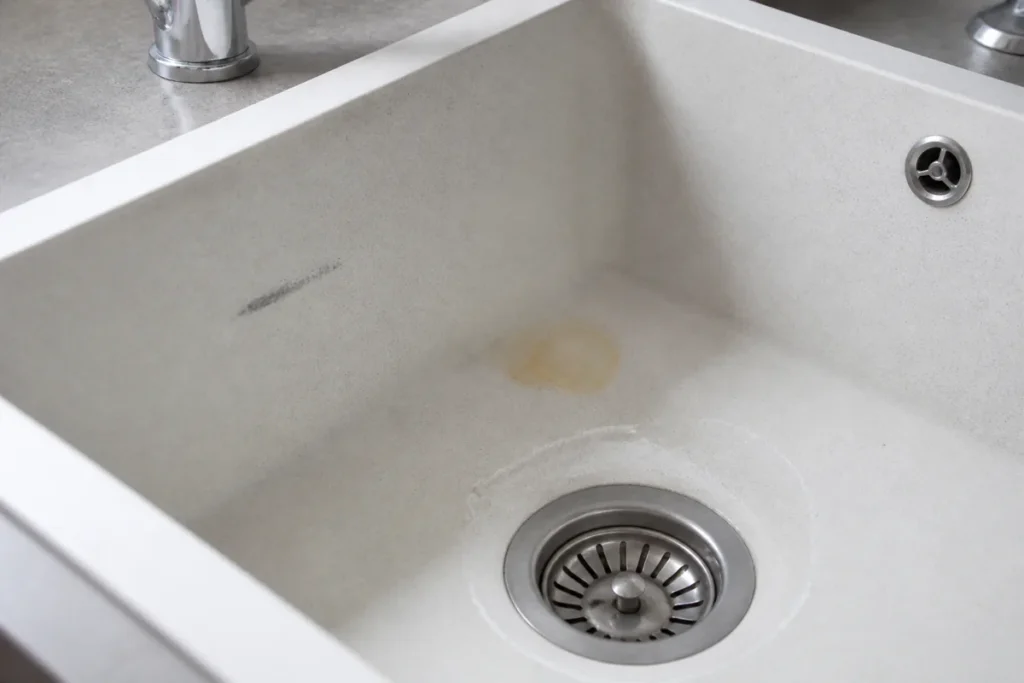
A white sink can make limescale difficult to see until it traps colour. That is why a yellow or grey patch is not proof that the composite itself has stained. Clean away surface soil first, dry the area and inspect it in even daylight before choosing a stronger product.
What products do you need to clean your composite sink?
The best thing to do if you want to get something over with as soon as possible is to prepare in advance. Here’s what you’ll need to clean your white composite sink:
- Baking soda
- White vinegar
- Soft microfibre cloths
- A spray bottle
- A nylon brush
- A pair of gloves
- Soap
- Warm water
That’s it. As you can see, cleaning your sink won’t cost you an arm and a leg. The methods I’m proposing are safe, effective, and eco-friendly. What’s not to like?
Current compatibility note: The list above is the original household toolkit, not permission to use every item on every composite sink. Warm water, a small amount of mild washing-up liquid and a soft cloth form the default routine. Use bicarbonate of soda, vinegar or a nylon brush only when the exact manufacturer’s guide allows that product, strength and tool.
How to clean your white composite sink the right way
Enough talk – let’s get to the actual cleaning. Hopefully, you keep your white composite sink clean most of the time so it doesn’t require a deep clean. Put on your gloves and let’s get started.
Step 1: Run some warm water through your composite sink
Warm water should help loosen any dirt or grime that may have made your sink its new permanent residence. It’s also going to serve as a basis for the rest of our process.
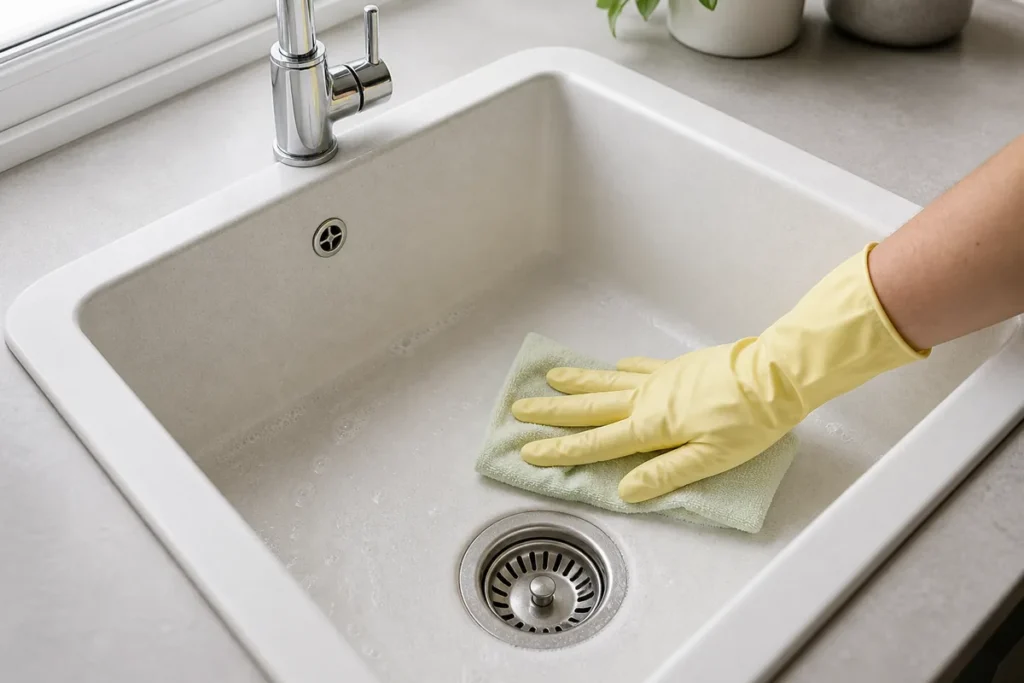
Step 2: Wipe your sink with soapy water
Use a microfibre cloth and wipe your sink with warm soapy water (warm, not hot). This should be enough to deal with any residual grime or oil stains. If it doesn’t help, move on to step 3.
Keep the cloth clean enough that it lifts residue instead of moving it around. Rinse the whole basin with fresh water and dry it before deciding that a mark needs stronger treatment.
Step 3: Apply baking soda paste to the stains
Put some baking soda in a bowl and add some warm water. Make a paste and apply it directly on the stains. Let it do its magic for a few minutes and rinse it with water. Repeat if needed. Use a nylon brush on the stains if they’re particularly stubborn. Dry out your sink with a soft cloth.
Current care limit: Bicarbonate paste and nylon brushing are not universal. Confirm that both are allowed for your sink, patch-test away from the main viewing area and use minimal pressure. Stop if the tested patch becomes smoother, brighter, rougher or duller than the surrounding finish.
Step 4: Use a vinegar/water solution to deal with limescale or water stains
Cleaning can sometimes leave water stains and limescale, especially if you clean your sink often (as you should). No need to fret – it’s an easy problem to deal with. Simply mix a 1/1 solution of white vinegar and water in the spray bottle and use it on the stains. Then wipe it off with the microfibre cloth. Use a nylon brush if the stains are particularly stubborn.
Note: Never use undiluted vinegar in your white composite sink. The vinegar will strip off the coat of the sink and remove its lustre.
Current manufacturer-first correction: The original 1:1 method above must not be transferred automatically to an unknown sink. Current manufacturer guidance varies: some composite sinks permit a 1:1 solution for brief limescale treatment, while other care guides specify one part vinegar to three parts water. Use the ratio and contact time for your exact make, never mix vinegar with bleach or another cleaner, and rinse and dry completely.
You may also enjoy:

Tea, coffee and coloured food residue
Blot or rinse coloured spills promptly. Use the routine soapy-water method first, because the colour may be sitting in a mineral film rather than in the composite. If it remains after rinsing and drying, follow the maker’s stain instruction instead of combining several internet remedies.
Limescale and apparent yellowing
Hard-water minerals can form a rough film that catches tea, coffee and cooking pigments. Treat the deposit according to the manufacturer, rinse, dry and reassess the colour. A longer dwell time or stronger acid is not automatically safer or more effective.
Grey metal-transfer marks
A pot or utensil can leave metal on a harder composite surface. This may look like a pencil line without creating a groove. Use only the maker-approved sink cleaner and pad. If a fingernail catches in the line, treat it as possible surface damage and stop scrubbing.
White composite sink cleaning methods you want to avoid
Many websites recommend using bleach if you want to restore the white colour of your sink. This is a terrible idea – undiluted bleach with ruin your sink. Some manufacturers recommend using a highly diluted solution but it’s difficult to get the dosage right, so I say avoid it if you can. Of course, anything you’re trying at home is at your own risk, so be mindful of the suggested methods.
Current bleach boundary: Manufacturer instructions differ by composite formula. Do not improvise a bleach ratio or leave a chlorine product to soak. If the maker permits a specific diluted treatment, follow its exact dilution, contact time, ventilation, rinsing and glove instructions. Otherwise, do not use it.
Also, make sure you avoid ammonia (especially in combination with citrus cleaners). Using highly abrasive brushes or sponges can also damage your sink, so keep them away. Needless to say, steel wool is an absolute disaster when used on a composite sink.
Finally, avoid harsh cleaning products, such as oven cleaners.
Also keep drain cleaner, paint or solvent products, wet metal cookware and damp cloths from sitting on the composite surface. Do not use a knife, razor or metal scraper to chase a mark. A clean-looking patch is not a success if the surrounding finish has been abraded away.
Maintenance tips
It’s easier to clean a stainless steel sink than a composite one, but the good news is maintenance is about the same. The most important part is to clean your white composite sink daily and dry it after every use. This is the best way to prevent limescale and hard water stains.
If your sink begins to crack or scratch, there are special kits you can buy to fix it. They’re affordable and easy to use so you’ll be able to fill those cracks in no time.
Current repair boundary: Do not assume a generic repair kit will match the resin, colour, food-area requirements or warranty of the sink. Photograph cracks, chips and scratches and ask the manufacturer, supplier or installer which repair route is compatible. A cleaner can remove residue; it cannot restore missing material or a failed finish.
How Samyx Cleaning can help with kitchen cleaning
Routine sink cleaning may be included within an agreed Samyx One-Off Cleaning scope. Tell the office that the sink is composite and describe the mark before the visit. Cleaning does not include repairing cracks, chips, scratches, chemical bleaching, resurfacing or guaranteeing removal of permanent discolouration.
Book a One-Off Deep Clean
Enter your postcode to view our rates and availability in your area.

Frequently asked questions
-
Are white composite sinks hard to keep clean?
They are manageable when spills are removed promptly and the sink is rinsed and dried after use. The difficult part is choosing a treatment for a stubborn mark because composite formulas and finishes vary. Keep the maker’s care guide and begin with warm soapy water and a soft cloth.
-
What is the best cleaner for a white composite sink?
There is no single best cleaner for every composite sink. Mild washing-up liquid and warm water are the routine starting point for many models. For limescale, coloured residue or metal transfer, use the product, dilution, tool and contact time approved by the exact manufacturer.
-
Why is my composite sink turning white or yellow?
A pale, yellow or grey cast may be a mineral film that has trapped food and drink pigments, but it can also be chemical or abrasive damage. Wash, rinse and dry the area first. If the texture or sheen has changed, stop cleaning and seek manufacturer advice.
-
Can I use bleach on a white composite sink?
Do not treat bleach as universally safe. Some manufacturers prohibit concentrated chlorine, while some specify a tightly diluted, time-limited treatment for particular models. Follow only the exact sink instructions, never mix bleach with acids, ammonia or another cleaner, and rinse thoroughly.
Important: Manufacturer care and warranty instructions override general cleaning advice. Patch-test any permitted treatment, use the labelled dilution and contact time, ventilate when required, wear the stated protective equipment and rinse completely. Never mix bleach with vinegar, acids, ammonia or another cleaner. Do not use steel wool, blades, oven cleaner, paint stripper or an unapproved drain or limescale product on the composite surface. Stop if the colour, sheen or texture changes, or if a crack, chip or scratch is present.
Conclusion
While composite white sinks are a great addition to your home, they do need some special care to keep their lustre for longer. The good news is there are many eco-friendly ways you can use to clean your sink without breaking a sweat (or the bank). And, if you ever find yourself in a situation where cleaning seems overwhelming, you can always give us a call.

Author: Atanas Dzhingarov
Hi, I’m Atanas - brand consultant and writer. I’m helping Samyx Cleaning create the best cleaning company blog on the Internet. Join us on our journey and learn how to live a cleaner, healthier, happier life in the process.
Discover more of our cleaning secrets: