
Are Essential Oils Safe for Cleaning Around Children?

Last modified on: 17/08/2026

Are essential oils safe for cleaning around children? A finished cleaning product containing essential oils may be suitable when it is used exactly as labelled. Adding high-strength oils to homemade or shop-bought cleaners is not the safer default for a home with children.
The decision depends on the child’s age and sensitivities, the oil concentration, how it is released, where residue may remain and whether the product has instructions for that surface. A suitable fragrance-free cleaner usually removes an avoidable exposure question without changing the cleaning task.
Use the lowest-exposure option that does the job
- Choose a suitable labelled cleaner without added fragrance when scent adds no cleaning benefit.
- Do not add undiluted essential oils to a cleaner, spray bottle, mop bucket or diffuser as a cleaning shortcut.
- Keep children out of the room during use, ventilate, follow rinse directions and wait until the surface is dry.
- Store oils and cleaning products closed, upright, out of sight and in a locked cupboard.
- After a suspected swallow, eye or skin contact, or breathing reaction, stop exposure and follow NHS poisoning advice.
Key takeaways
- Natural origin does not make a high-strength oil harmless when swallowed, inhaled or left on skin.
- No single list can make every oil suitable for every child, age, exposure route or health condition.
- A finished cleaner’s label is more useful than a homemade dilution rule copied from a recipe.
- Scent does not prove that a surface has been disinfected.
- Storage and emergency planning matter as much as the choice made during cleaning.
Table of Contents
Are essential oils safe for cleaning around children? Use five checks
A product may be acceptable for one task and a poor choice for another. Before using it, check what the child could swallow, touch or breathe and whether the cleaned surface will later contact food, hands or the mouth.
Child-exposure check
If any answer is unclear, use an appropriate fragrance-free product or postpone the task until the manufacturer can clarify the label.
1. Product
Is it a finished cleaner with directions for the task, or an undiluted oil and improvised recipe?
2. Route
Could droplets, vapour or residue reach the mouth, eyes, skin or breathing zone?
3. Surface
Will the child eat from, crawl on, hold or mouth the surface after cleaning?
4. Child
Is the child very young or known to have asthma, eczema, allergies or fragrance sensitivity?
5. Finish
Can the room be ventilated, the surface rinsed when directed, fully dried and checked before the child returns?
The same checks apply when a label uses words such as botanical, plant-based or naturally fragranced. Read the ingredient and hazard information, use the stated amount and keep the original packaging. The wider guide to product labels explains what parents should check before a cleaner enters the routine.
Why dilution alone does not settle the question
A drop count does not describe the whole exposure. Drop size varies, oils have different properties, and water does not distribute oil evenly without a suitable formulation. A bottle shaken at the start may still leave stronger pockets on a cloth, floor or spray nozzle.
Recipes also use different meanings for words such as diluted, gentle and child-safe. None of those words identifies how much residue remains, whether the surface must be rinsed, or whether mist will be breathed during application. Finished-product directions give a clearer basis for a household decision than a universal drops-per-bottle chart.
Do not use a kitchen measuring spoon, drinking cup or food container for a cleaning mixture. If an unlabelled bottle already exists, keep it away from children and do not use it until its contents and compatible disposal route are known.
Discuss Regular Domestic Cleaning
Enter your postcode to view our rates and availability in your area.

Natural does not mean low risk
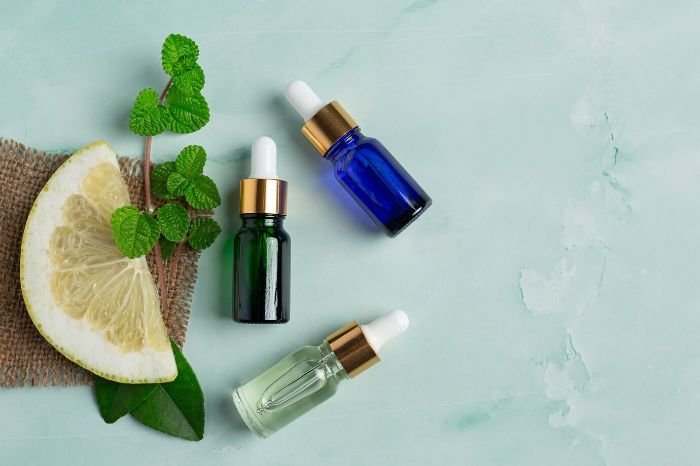
Essential oils are high-strength plant extracts. The Children’s Hospital of Philadelphia warns that oil exposure can cause poisoning after swallowing, can irritate or burn skin, and may irritate the lungs, eyes and skin when dispersed as aerosols.
Cleaning changes the exposure pattern. An oil may be diluted in a bucket, sprayed into the air, left on a floor, transferred from a table to a hand or stored in a small attractive bottle. Each route matters even when the amount used smells mild to an adult.
Why a kid-safe oil list is unreliable
Lists on retailer or recipe sites often treat an oil name as the whole decision. Botanical species, concentration, product formulation, route, room ventilation and the child’s age or sensitivities can change the answer. An unlisted oil is not automatically safer, and a commonly recommended oil is not automatically suitable for a baby or a child with respiratory or skin sensitivity.
A cleaning-company article cannot diagnose an allergy or set a medical age threshold. Parents who have a child with asthma, eczema, allergies or a previous reaction should ask the child’s healthcare professional about exposure concerns and use the simpler fragrance-free route in the meantime.
Cleaning, fragrance and disinfection are different jobs
Cleaning removes soil and residue. Fragrance changes how the room smells. Disinfection is a separate controlled use that depends on a suitable product, the correct surface, the stated contact time and the label directions. A pleasant smell does not confirm that microbes have been reduced to a claimed level.
Do not turn an essential oil into a disinfectant claim because a laboratory study describes activity under controlled conditions. A home recipe has different concentrations, surfaces, contact times and contamination. When disinfection is genuinely needed, use a product labelled for that purpose and follow its directions.
Do not add oils to another cleaner
A shop-bought cleaner has directions based on its supplied formulation. Extra oil can change how it spreads, rinses, contacts skin or affects a finish. Combining it with another cleaning product creates a further unknown. The safety rules for DIY mixtures cover labelling, storage and combinations that should never be made.
If a labelled cleaner contains essential oils
- Check that the label names the intended surface and cleaning task.
- Use only the stated amount. Do not add more oil for a stronger scent.
- Move children away before opening, pouring, wiping or spraying the product.
- Ventilate the space and avoid directing mist towards breathing zones, food or toys.
- Rinse food-contact, toy or mouthing surfaces when the label directs it.
- Let the surface dry and put the closed product away before the child returns.
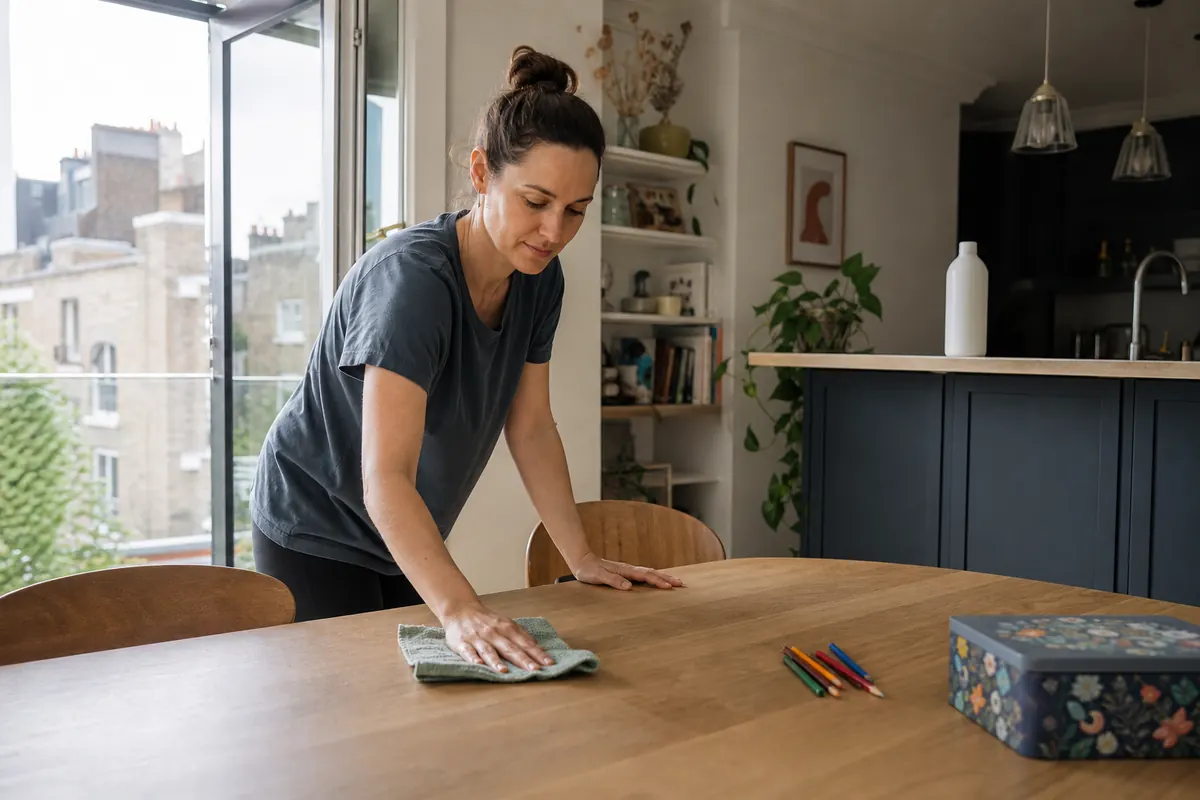
Use a small amount of product on the cloth when the label allows that method. It reduces airborne droplets compared with spraying across the room. A hidden-area patch test still matters on an unknown finish.
Use separate cloths for different tasks. Change a cloth after a spill or when it is visibly loaded. This reduces transfer to toys and food-contact areas.
Choose the lower-exposure route for each surface
| Area | Lower-exposure default | Check before the child returns |
|---|---|---|
| Dining table or high chair | Suitable fragrance-free cleaner used as labelled | Food-contact rinse direction followed and surface dry |
| Floors used for crawling | Compatible low-residue floor product with no added oil | No wet patches, pooled product or accessible bucket |
| Washable toys | Manufacturer-approved cleaning method | Any required rinse completed and small openings dry |
| Bathroom surfaces | Labelled bathroom cleaner with the child out of the room | Room ventilated, residue rinsed where directed and floor dry |
| Bedding and soft toys | Care-label washing method | No homemade pillow drops or scent blend left on fabric |
| Room odour | Remove the source, empty waste, wash textiles and ventilate | Source resolved without adding airborne fragrance |
Product-free methods can solve part of the task. Dry dust capture, vacuuming, laundering and ventilation may remove the soil or odour source before another substance is introduced. Water alone is not suitable for every material, so the surface care instructions still control.
Store every bottle as a poisoning risk
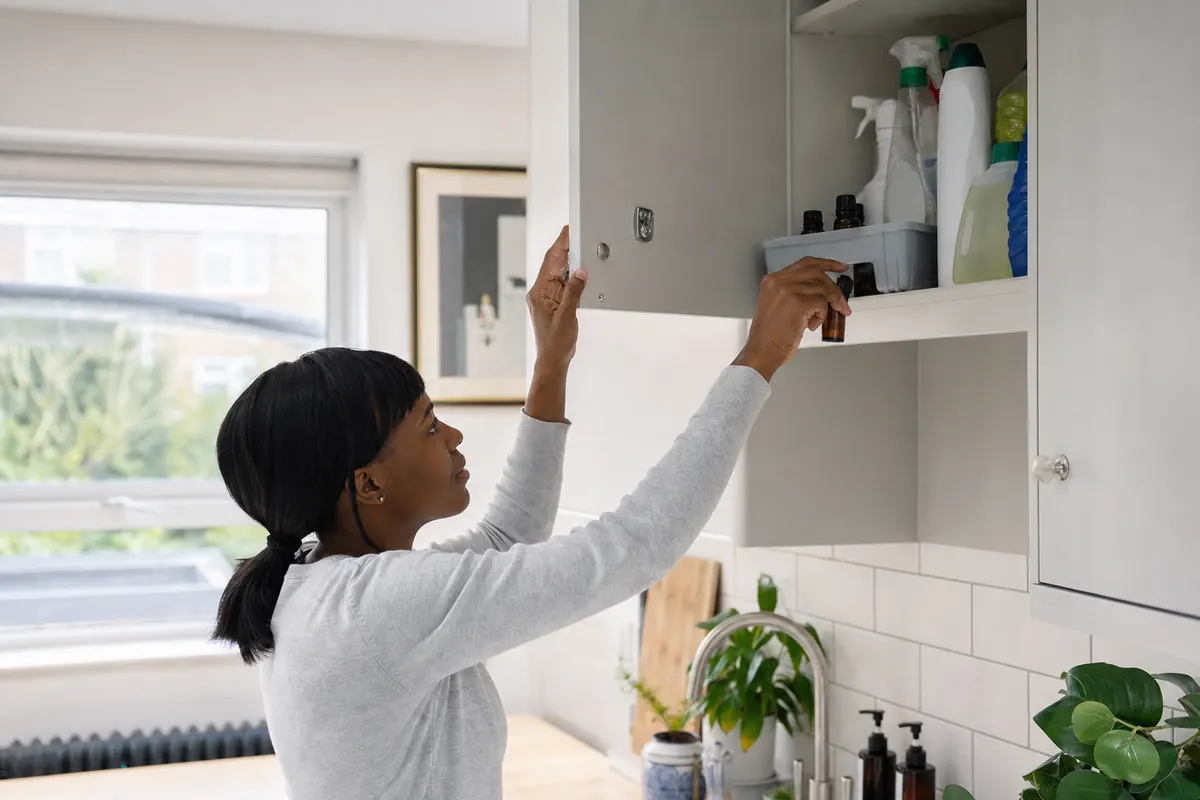
Small dropper bottles can be easy for a child to hold and may smell familiar. Keep them closed, upright and in their original packaging inside a locked high cupboard. Do not store them beside food, medicines, cups or children’s toiletries, and never decant a cleaning blend into a drink bottle.
Poison Control advises locked storage out of children’s sight and reach. Apply the same rule to a finished cleaner that contains essential oils. A high shelf without a lock may still be reachable from a chair or worktop.
Close and store the product during the task
Do not leave an open bottle on the floor, bath edge or low table while moving to another room. Measure or dispense what the label requires, close the cap and return the container to locked storage. Keep used cloths, mop water and disposable wipes out of reach until they are rinsed or discarded.
You may also enjoy:

What to do after accidental exposure
Stop using the product and move away from the source. Keep the bottle or label available so a clinician can identify the substance.
- End contact without putting another person at risk, and move away from vapour or spray if it is safe to do so.
- Check the product label for its first-aid directions and keep the packaging available for clinicians.
- Call 999 or go to A&E if you think the child has swallowed, touched or breathed in something harmful.
- Call NHS 111 if you are not sure whether the substance or exposure is harmful.
- Do not make the child vomit and do not give food or drink while waiting for medical help.
The current poisoning advice covers harmful substances that have been swallowed, touched or breathed in. Follow that emergency guidance and the product label; do not improvise a home remedy.
Build the safety steps into the cleaning routine
- Plan fragranced or spray-product tasks for a time when the child can stay in another room with another adult.
- Bring one labelled product and the required tools into the room. Leave oils and unrelated cleaners in locked storage.
- Open a window or use suitable ventilation before application where the label calls for it.
- Clean from a cloth when permitted, complete any stated contact time, then rinse where directed.
- Close and store the product, deal with used water and cloths, then check that the surface and floor are dry.
- Let the child return only after the room is aired and all products, tools and residues are out of reach.
A routine prevents the interruption that creates many household exposures: an open bottle left on a worktop, a bucket beside a doorway or a wet low surface touched before it dries. Write ventilation and the return-to-room check into the task as required finishing steps.
Keep scent separate from the cleaning plan
A room does not need to smell of lemon, lavender or peppermint to be clean. Removing the source of an odour, emptying waste, washing textiles and ventilating may solve the problem without adding another airborne substance.
Diffusers, pillow drops, bath products and oils used for congestion are aromatherapy or medical-adjacent questions outside a household cleaning routine. The separate guide to room fragrance keeps odour control and child exposure in their proper scope.
When a simpler professional routine may help
Professional cleaning can reduce the number of improvised products and unfinished tasks in a busy household, though it does not remove the need to discuss sensitivities and product restrictions. Share relevant requirements before booking so the office can confirm what can be accommodated.
Samyx Cleaning provides domestic cleaning across London. Choose the hours needed in the booking form and name the rooms and tasks that matter most. Keep children away from the active work area and allow cleaned surfaces to dry before normal use.
Book Regular Domestic Cleaning
Enter your postcode to view our rates and availability in your area.
Frequently asked questions
-
Is lavender oil safe for babies to inhale?
There is no blanket safe-use answer for a baby. Do not treat household cleaning guidance as aromatherapy advice or use it to justify diffusing lavender or adding it to a baby’s pillow, bedding or bath. Ask a qualified healthcare professional about a specific exposure concern.
-
Can essential oils disinfect surfaces?
A scent or an ingredient study does not prove that a home mixture disinfects a real surface. Use a product whose label states the disinfecting purpose, compatible surfaces, contact time and directions when disinfection is required.
-
Are essential oils safe for cleaning baby toys?
The lower-exposure default is a suitable fragrance-free product used according to its label. Check whether rinsing is required, especially for toys or surfaces that may enter a child’s mouth, and wait until the item is fully dry.
-
Can I add essential oil to a shop-bought cleaner?
Do not add essential oil or another ingredient unless the manufacturer explicitly instructs it. The addition changes the supplied formulation and may affect skin exposure, rinsing, surface compatibility and the product directions.
Important: Essential oils are high-strength substances. Follow the finished product label and the surface manufacturer’s care instructions over general guidance. Patch-test where compatibility varies, ventilate the room, wear suitable gloves, rinse when directed and let surfaces dry before children return. Never mix cleaning products or add oils to a supplied cleaner. Stop after coughing, breathing discomfort, eye or skin irritation, discolouration, dulling, etching, coating change or fibre change. Seek medical advice for a child with known respiratory, skin or fragrance sensitivity and use NHS 111 or 999 according to the seriousness of any exposure.
Author: Svetlana Georgieva (Clara)
Hi, I’m Svetlana Georgieva, but you can call me Clara. As the co-founder and heart behind Samyx Cleaning, I’m devoted to sharing the art of a clean space. Let’s journey into a cleaner, more joyful life together with tips from London's cleaning experts.

Discover more of our cleaning secrets: