
Homemade Air Freshener Safe for Children? What to Know

Last modified on: 18/08/2026
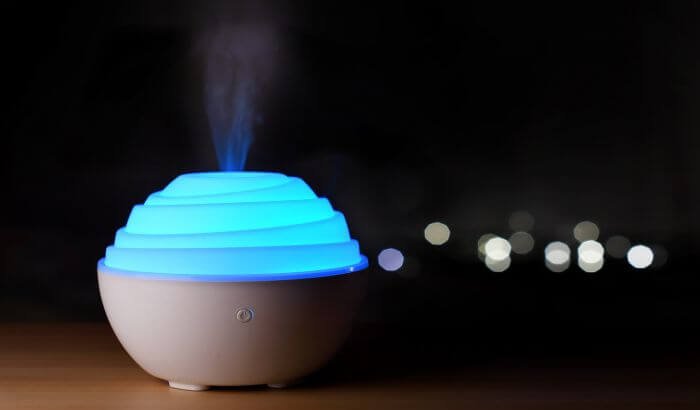
Homemade air freshener safe for children? The words homemade, natural and non-toxic do not prove that a mixture is suitable to inhale, touch or swallow. A room spray can create airborne droplets, an aromatic-oil diffuser holds concentrated liquid, an open jar can be reached, and a simmering pan introduces a burn risk.
The lower-exposure response to an unwanted smell is usually to find the source, remove it, clean or wash the affected material, dry it fully and ventilate when conditions allow. If fragrance is still wanted, assess the exact ingredients, container, placement, child’s age, possible routes of exposure and any medical sensitivities before using it.
Key takeaways
- Homemade and natural are descriptions, not child-safety guarantees.
- Source removal and ventilation should come before adding another scent to the room.
- Concentrated aromatic oils should not be assigned universal child-safe ages or diffuser times.
- Open jars, spray bottles, diffuser reservoirs and hot pans create access, spill, inhalation or burn risks.
- Keep products identifiable and inaccessible, and use NHS guidance immediately after a suspected harmful exposure.
Table of Contents
Homemade air freshener safe for children is not a safety label
A homemade mixture has no automatic advantage simply because its ingredients came from a kitchen cupboard or plant. The same material can behave differently when it is swallowed, put on skin, dispersed into the air or heated. Concentration also matters. A few drops of a fragrant oil in a small room are not equivalent to the plant from which the oil was produced.
Marketing terms need the same caution. Fragrance-free, unscented, green and non-toxic can describe different product features, and none answers every exposure question. Read the full label on a bought product. For a homemade mixture, write down every ingredient and amount before use. If that record would not let a clinician identify the contents after a spill or ingestion, the mixture is not ready to store.
Current RoSPA advice says to keep household products in their original packaging because the label, warnings and child-resistant features help prevent mistakes and help medical professionals identify a swallowed substance. That is another reason never to turn leftover fabric conditioner, disinfectant or cleaning solution into a homemade room spray. The same no-mixing and storage boundary applies to DIY product safety.
You may also enjoy:

Find the smell before choosing a freshener
The UK Air Quality Expert Group says identifying and removing the source of a bad smell, or ventilating by opening windows, is preferable to masking it with other volatile compounds. Its indoor-air report also notes that the absence of a smell does not prove that indoor air contains no pollutants.
| Smell pattern | Check first | First response |
|---|---|---|
| Stale bedroom | Damp laundry, bedding, shoes, closed windows and an overfilled bin | Remove waste, wash compatible fabric, dry it fully and ventilate safely |
| Musty smell | Condensation, a leak, damp material or visible mould | Find the moisture source; do not cover it with fragrance |
| Kitchen odour | Food waste, fridge spills, grease, cloths and the sink area | Remove spoiled material and clean the compatible surface |
| Bathroom odour | Damp towels, poor extraction, drains, seals and grout | Dry textiles, use the extractor and investigate persistent drain or mould problems |
| Burning, gas or solvent smell | Appliance, electrical, fuel or chemical source | Do not mask it; move away and use the appropriate emergency or qualified service route |
A recurring musty smell needs a moisture diagnosis, not a stronger scent. Use the dedicated damp-smell guide to separate ordinary cleaning from ventilation, leak repair and mould work that may need a landlord, contractor or specialist.
Ventilate without creating another hazard
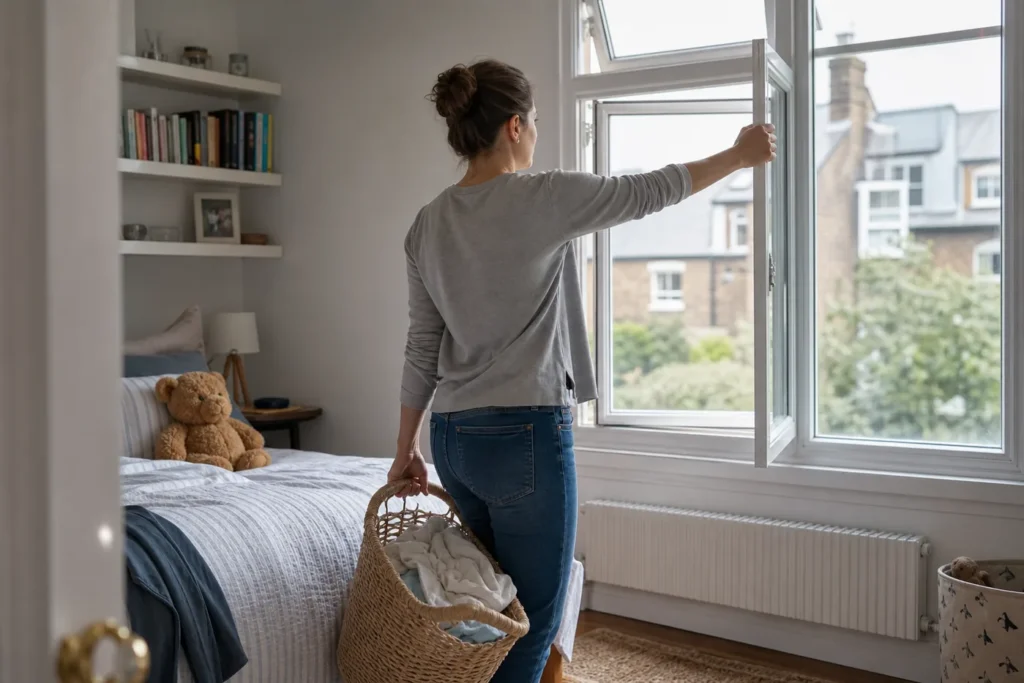
Use an extractor, trickle vent or open window only when it is safe and suitable for the room. Do not leave a young child beside an unrestricted open window, and keep blind cords and furniture that can be climbed away from the opening. Outdoor smoke, high pollution, extreme heat or a building fault can change the ventilation decision. Follow the ventilation-system instructions and use the safer opening or timing available to the household.
Ventilation dilutes and removes some indoor emissions; it does not repair damp, remove contaminated material or make an unsuitable fragrance harmless. Close the room to children during cleaning when the product label requires it, then follow the stated ventilation and re-entry instructions.
Compare common homemade freshener ideas by exposure
The right question is not whether an idea is natural. Ask how the substance can reach a child and what new hazard the method introduces.
| Idea | Main concern around children | Practical decision |
|---|---|---|
| Room spray | Airborne droplets, eye contact, surface residue and an accessible bottle | Do not spray around a child or onto bedding, toys or touch surfaces without product and material guidance |
| Aromatic-oil diffuser | Concentrated reservoir liquid, spill or ingestion, continuous exposure and individual sensitivity | Do not treat it as a default nursery or bedroom product |
| Open bicarbonate jar | Powder access, tipping and any added fragrance oil | An open container is not childproof; keep it inaccessible or do not use it |
| Citrus or herb simmer | Hot hob, steam, scalding liquid and boil-dry risk | Not an unattended room freshener and not a child-accessible activity |
| Candle or incense | Flame, hot wax, smoke and combustion particles | Do not use it as an air-quality solution |
| Source removal | No added fragrance, but cleaning products and windows still need normal precautions | The preferred starting point for most household odours |

Concentrated aromatic oils need an ingredient-specific decision
There is no responsible universal table that makes one oil suitable from six months, another from two years and a broader group from five years. Age is only one factor. The oil, concentration, diffuser design, room size, duration, ventilation, route of exposure and child’s health all change the decision.
Do not use a concentrated aromatic oil because a recipe describes it as calming, antibacterial, purifying or non-toxic. Do not add it to a spray, cleaning mixture or skin product unless the exact use is supported by the manufacturer and suitable professional advice. Check the separate oil-use limits before considering one for a cleaning surface.
Keep oil bottles and filled diffuser reservoirs locked away, not merely on a shelf that a climbing child may reach. Avoid routine fragrance in the room of a child with a known sensitivity or a healthcare plan that identifies airborne triggers. Stop using a fragranced product if symptoms appear and seek appropriate medical advice.
If you still make a scented mixture
- Do not use fabric conditioner, laundry products, disinfectant or leftover cleaner as an air-freshener ingredient.
- Never combine commercial products or assume vinegar, bicarbonate, alcohol and concentrated aromatic oils are compatible with one another or with a surface.
- Make only a small amount for a defined use. Record the ingredients and date on a dedicated label.
- Never use a drinks bottle, food jar or familiar children’s container. Store the mixture locked away immediately after use.
- Do not spray near a child’s face or onto toys, bedding, soft furnishings, food-contact areas or pet items without compatible guidance.
- Discard a water-based mixture if its identity, age, cleanliness or storage history is uncertain. Do not keep topping up an old bottle.
This checklist reduces avoidable mistakes; it does not certify a recipe as safe. A bought product retains its manufacturer instructions and hazard information. A homemade mixture places the responsibility for ingredient choice, labelling, compatibility, hygiene and storage on the person making it.
What to do after a possible exposure
Act on the exposure, not on whether the label says natural. NHS guidance says poisoning can follow swallowing, touching or breathing in a harmful substance. Its poisoning advice says to call 999 or go to A&E for severe difficulty breathing, loss of consciousness, stopped breathing or a seizure. Call NHS 111 if you are unsure whether something swallowed, touched or inhaled is harmful.
Keep the container, packaging or written ingredient record available for the healthcare team. Do not try to make the child sick and do not give food or drink unless a healthcare professional tells you to. Move away from further airborne exposure when it is safe to do so.
How Samyx Cleaning Can Help With Odour Sources
Cleaning can help when an ordinary household smell comes from removable waste, surface soil, washable textiles, kitchen residue or accessible bathroom build-up. It cannot repair a leak, diagnose mould, make an unsafe product suitable for a child or provide medical exposure advice.
A Samyx one-off clean can address agreed household cleaning priorities within the booked scope. Tell the team about children, pets, known sensitivities and products you do not want used before the visit. Unknown chemicals, sewage, extensive mould, pest contamination and building defects need the appropriate specialist route.
Book a Home Reset
Enter your postcode to view our rates and availability in your area.

Frequently asked questions
-
Is a homemade air freshener safe for children?
Not automatically. Homemade and natural do not prove that a mixture is suitable to inhale, touch or swallow. Check every ingredient, concentration, container, placement and route of exposure. Source removal, cleaning, drying and ventilation are the preferred first response to an ordinary household smell.
-
Which aromatic oils are safe to diffuse around children?
There is no universal age list that can certify an oil or diffuser routine for every child. The exact oil, concentration, room, duration, ventilation, possible ingestion and the child’s health all matter. Keep oils and diffuser liquids locked away and seek product-specific and appropriate healthcare advice.
-
Is a bicarbonate air freshener child-safe?
An open jar or dish is not childproof. It can be tipped, handled or swallowed, and added fragrance oil creates another concentrated exposure. Keep any container inaccessible or do not use it. Plain bicarbonate also cannot correct damp, mould, spoiled material or another continuing odour source.
-
What should I do if a child swallows air freshener?
Use current NHS poisoning advice immediately. Call 999 for severe breathing difficulty, loss of consciousness, stopped breathing or a seizure. Call NHS 111 if you are unsure whether the substance is harmful. Keep its packaging or ingredient record and do not induce vomiting or give food or drink unless instructed by a healthcare professional.
Important: This is general household information, not paediatric, toxicology, allergy, asthma, mould-remediation or emergency advice. Natural and homemade do not mean harmless. Follow product labels and healthcare plans, keep substances locked away, never mix products, and use current NHS guidance after any suspected harmful ingestion, inhalation, skin or eye exposure.
Author: Svetlana Georgieva (Clara)
Hi, I’m Svetlana Georgieva, but you can call me Clara. As the co-founder and heart behind Samyx Cleaning, I’m devoted to sharing the art of a clean space. Let’s journey into a cleaner, more joyful life together with tips from London's cleaning experts.

Discover more of our cleaning secrets: