
How to Remove Cat Urine Smell from Carpet

Last modified on: 18/08/2026
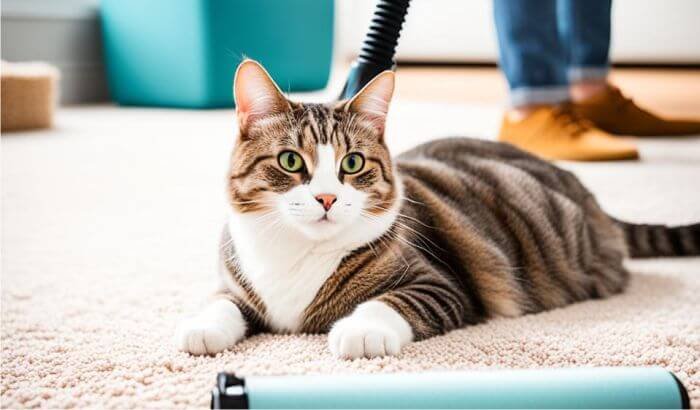
Remove cat urine smell from carpet by absorbing fresh liquid before it spreads, then treating the full affected depth with one compatible pet-urine cleaner and drying every layer completely. A mark at the pile may extend into the backing, underlay or floor, so an odour that returns after cleaning points to a depth problem. More fragrance will not correct it.
Key Takeaways
- Blotting limits spread; scrubbing drives liquid across the pile and can distort fibres.
- Urine odour can remain in the backing, underlay or floor after the visible carpet looks clean.
- A compatible labelled enzyme or microbial cleaner is a more reliable choice than a fragranced household mixture.
- Steam, ammonia-based cleaners and mixed products can make the problem harder or create a separate safety risk.
- Repeated accidents need both material assessment and attention to the cat’s health, stress and litter arrangements.
Table of Contents
Remove cat urine smell from carpet by checking the layer
Start by deciding whether you are dealing with a fresh surface accident, a dried deposit or urine that has passed through the carpet. The treatment area may be wider than the visible edge. A returning smell during warm or humid weather often points to residue below the pile, where moisture in the air makes it noticeable again.
| What you find | Likely depth | First action | Stop point |
|---|---|---|---|
| Fresh damp patch with a clear boundary | Pile, possibly backing | Press with white towels from the edge towards the centre | Stop blotting when pressure no longer transfers liquid |
| Dry mark with a localised smell | Pile and backing | Mark the odour boundary and patch-test a compatible labelled treatment | Do not soak a larger area to chase the smell |
| Odour returns after drying or in humid weather | Backing, underlay or floor may be affected | Inspect accessible layers or arrange an assessment | Repeated surface treatment is unlikely to reach the source |
| Removable rug over a hard floor | Rug pile, backing and floor can all hold residue | Check the care label, backing and floor separately | Stop if dye transfers, backing softens or the floor finish changes |
| Repeated accidents in one fitted-carpet area | Underlay and subfloor are plausible | Record the full area and consider lifting by a competent person | Replacement may be more reliable than repeated wetting |
| Handmade, antique, silk, viscose or unstable-dye rug | Construction risk is high at any depth | Keep the area dry and contact a suitable rug specialist | Do not experiment with household recipes |
Use your nose only to establish a broad boundary, not to judge whether the material is hygienically clean. A UV torch may reveal some old deposits. Optical brighteners, food and previous cleaners can also fluoresce. Treat it as a locating clue, then confirm the area through the history of the accident, visible transfer and inspection of accessible layers.
Fresh cat urine needs pressure, not scrubbing
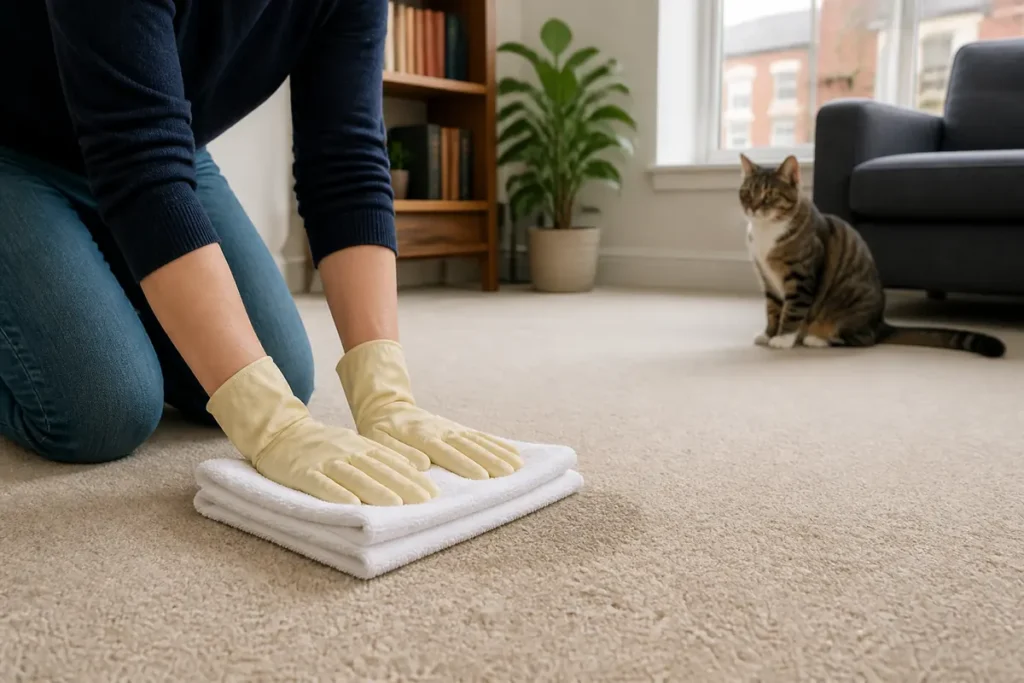
Move the cat away from the work zone and remove nearby objects that could be splashed. Put on any gloves or other protection required by the product label. Place folded white towels over the damp area and press straight down with your hands or body weight. Replace the towels as they pick up moisture.
- Work from the outside towards the centre so pressure does not spread liquid into a wider ring.
- Use white towels to make colour transfer from the carpet easier to spot.
- Lift and press; do not rub back and forth. Rubbing can distort the pile and move contamination sideways.
- Do not add water until you have selected a compatible treatment and read its directions.
- Mark the edge discreetly if the damp boundary will be hard to see once the surface has been blotted.
A wet vacuum or extraction machine is not automatically the first tool. It must be suitable for the carpet, backing and chosen product, and it cannot correct damage already present below the carpet. Domestic machines can also leave more water than they recover when used slowly or repeatedly.
Choose one cleaner that suits the fibre and backing
Read the carpet or rug care information before treating it. Fibre type is only part of the decision: dyes, adhesive, latex, jute, secondary backing and the finish on the floor below may react differently. A method tolerated by a colourfast synthetic fitted carpet may damage a wool rug or leave a ring on a timber floor.
Choose a product whose label names pet urine, the relevant carpet or rug material and the intended application. Enzyme or microbial formulas are designed to act on odour-producing organic residue. The label still controls preparation, coverage, dwell time, temperature, extraction, rinsing and repeat use. Keep children and pets out for the full exclusion and drying period stated by the manufacturer.
Test the complete method in a hidden place. Apply, wait, remove and dry it in the same way planned for the accident area. Check the dry test for dye transfer, lightening, darkening, pile change, tackiness, watermarking and backing movement. A five-minute colour check cannot reveal every problem that appears after drying.
Why common household mixtures can disappoint
Vinegar can alter surface conditions, but it is not a complete urine-removal method for every carpet construction. Adding bicarbonate makes a visible reaction and consumes much of the acidity; powder left in the backing can become another residue to extract. Hydrogen peroxide can remove colour, and washing-up liquid can leave a sticky patch when it is difficult to rinse.
A disinfectant or fragranced product may change the immediate smell without removing urine salts and residue from the affected layer. Zoflora should only be used for a purpose, surface and dilution on its current label; disinfection is not proof that the odour source has gone. Ammonia-based cleaners are a poor choice because the smell may resemble a component of urine. Never combine products, including a commercial pet treatment with a homemade mixture.
The same material-first reasoning applies to broader DIY stain removers. If the maker’s instructions conflict with general online advice, the label and material-care directions take priority.
You may also enjoy:

Dried urine needs a wider search
A dried accident may have travelled along the backing before the pile showed a clear mark. Inspect the skirting edge, furniture feet and seams around the suspected location. Compare the smell at floor level with nearby clean carpet, then mark the broad boundary without saturating it to confirm your guess.
Other spills can create a sour smell, and their treatment is different. A known food accident belongs to the relevant method, such as the approach for milk spills. Do not apply a pet-urine product merely because the room smells unpleasant.
Removable rugs
Check the rug label and construction before lifting it. A small machine-made colourfast rug may permit controlled treatment from both sides; a handmade or unstable rug may not. Place a barrier under a permitted test area so residue does not move into the floor, and never leave a damp rug lying flat on timber, laminate or another carpet.
Inspect the backing and the floor as separate surfaces. Clean the floor only by its own manufacturer’s method. Timber, laminate, stone and resilient flooring have different moisture limits, and urine can enter joints or unsealed edges. Roll or move a valuable rug only after advice on supporting its wet weight and avoiding dye migration.
Fitted carpet and underlay
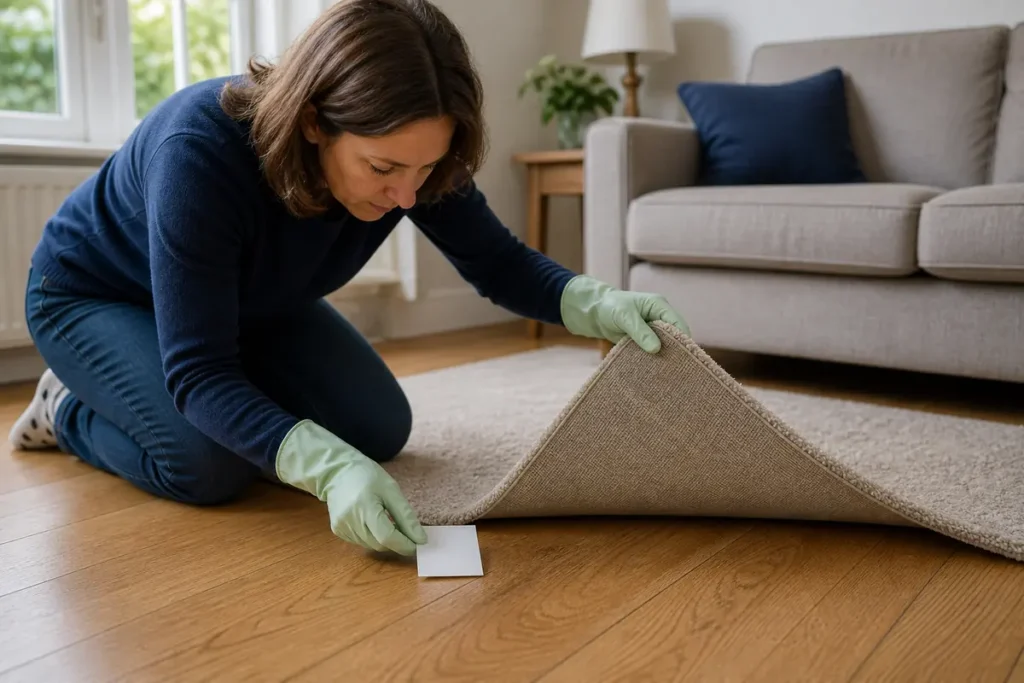
Fitted carpet hides the affected layers. A small fresh accident may stay within the pile and backing, though repeated urination in one place can reach the underlay, gripper edge and subfloor. Lifting carpet without the right tools can stretch it, damage the backing or expose sharp grippers, so this is not a casual inspection step.
Odour that returns after correct surface treatment and full drying is a strong reason to assess below. A contaminated underlay section may need removal and replacement. Porous boards can require a separate remediation decision once exposed. Cleaning the pile again will not reach a source isolated beneath an impermeable backing.
Ask About Carpet Odour
Enter your postcode to view our rates and availability in your area.

Remove residue and dry every treated layer
Follow the product directions after its stated contact period. Some treatments are left to dry and then vacuumed; others require controlled extraction or a clean-water rinse. Adding an unlisted rinse can dilute a treatment too early, and skipping a required rinse can leave residue. Use only the sequence on the current label.
Recover as much permitted moisture as possible without repeated passes that pull water across the backing. Blot the boundary with a fresh white towel to check for product or dye transfer. Raise a removable rug only in a supported way allowed by its care instructions, and protect the floor beneath until both surfaces are dry.
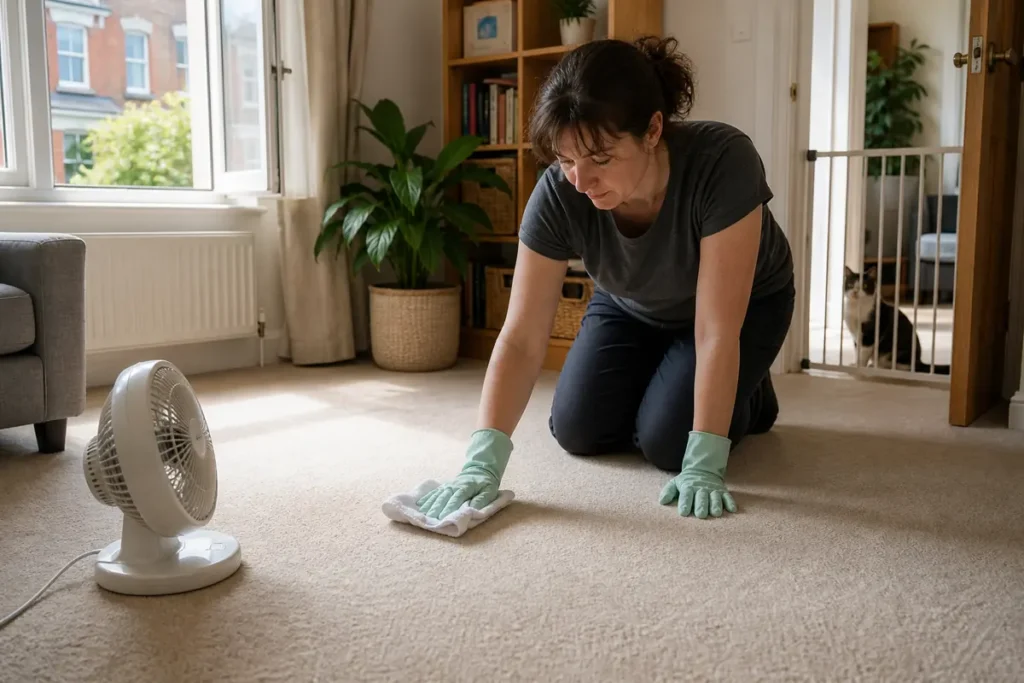
- Open a window when outdoor conditions and security permit, and use steady room ventilation.
- Direct a clean fan across the treated area, never straight down into it.
- Keep the room comfortably warm without applying a heater, hairdryer or steam to the carpet.
- Keep people and animals away until the product’s re-entry conditions are met and every layer is dry.
- Check again after full drying, once cleaner fragrance and dampness have gone.
Another treatment will not solve every odour
Pause before repeating a product. A second application is reasonable only when the label permits it, the first treatment dried fully and the material remains stable. Increasing concentration, extending dwell time or adding a second chemical changes the method and can damage the carpet without reaching a deeper source.
Arrange professional assessment when the smell covers a wide area, accidents have happened repeatedly, the backing has delaminated, dyes transfer, the pile changes, liquid has reached electrical floor fittings or the rug is valuable. Replacement can be the honest answer for contaminated underlay or badly affected porous material. Specialist restoration may be needed for damaged flooring; routine carpet cleaning does not repair it.
Repeated urination also needs a cat-care decision. Changes in frequency, straining, distress, blood, urinating outside the tray or being unable to pass urine warrant veterinary attention. PDSA advises contacting a vet promptly about urine problems; inability to pass urine needs urgent veterinary care. Cleaning the carpet cannot address pain, illness, stress or an unsuitable litter setup.
When professional carpet cleaning fits the problem
Samyx Cleaning can assess a carpet or rug for a compatible professional method when the affected material, access and contamination depth remain within cleaning scope. Depending on the fibre, backing and condition, carpet cleaning may use controlled pre-treatment and hot-water extraction to lift accessible soil and recover moisture more effectively than repeated hand application.
No cleaning process can promise complete odour removal when urine has entered underlay, subfloor, damaged backing or an inaccessible joint. The practical assessment separates treatable carpet contamination from material that needs lifting, replacement, structural drying or restoration. Tell the office where accidents occurred, whether they are fresh or repeated, what treatments have already been used and what lies beneath the carpet or rug.
A clear history helps avoid incompatible chemistry and sets a realistic scope before the visit. The team can clean compatible carpet and rug surfaces; veterinary care, pest treatment, subfloor repair, mould remediation and replacement work remain outside ordinary carpet-cleaning scope. Avoid the recurring carpet mistakes of over-wetting, scrubbing and layering products before help arrives.
Book Carpet Cleaning
Enter your postcode to view our rates and availability in your area.
Frequently asked questions
-
What kills the smell of cat urine in carpet?
A compatible cleaner labelled for pet urine can break down or digest odour-producing residue when it reaches the affected material and is used exactly as directed. Success still depends on depth. Product applied only to the pile cannot remove urine held in underlay or flooring.
-
Will cat urine smell ever come out of carpet?
A fresh, localised accident often responds well when it is blotted quickly, treated with a compatible product and dried fully. Repeated or old urine may have reached the backing, underlay or subfloor. Those layers may need professional treatment, lifting or replacement before the smell stops returning.
-
Can I steam-clean cat urine from carpet?
Do not use steam as the first response. Heat and excess moisture can affect fibres, backing and residue, and a machine may spread contamination or leave the carpet wet. Use only a method permitted by the carpet maker and the chosen pet-urine product, or ask a professional to assess it.
-
Does Zoflora remove cat urine smell from carpet?
Disinfection and urine-odour removal are different jobs. Use Zoflora only where its current label permits the exact surface, purpose and dilution, and never mix it with another cleaner. A fragrance change does not show that urine residue has been removed from the carpet layers.
Important: Product labels and the carpet, rug and flooring manufacturers’ care instructions take priority over general guidance. Patch-test the complete method in a hidden area and check it again when dry. Use the gloves, ventilation, rinsing, extraction and re-entry steps named for the product. Never mix bleach with ammonia, vinegar or another acid, and never combine any two cleaning products. Stop if colour transfers, the pile changes, a coating dulls, backing softens or separates, the floor finish changes or the area remains wet. Seek manufacturer, veterinary or suitable professional advice before treating a delicate, valuable, unfamiliar or damaged material, a repeated accident, suspected underlay or subfloor contamination, or any cat with changed urination or distress.
Author: Svetlana Georgieva (Clara)
Hi, I’m Svetlana Georgieva, but you can call me Clara. As the co-founder and heart behind Samyx Cleaning, I’m devoted to sharing the art of a clean space. Let’s journey into a cleaner, more joyful life together with tips from London's cleaning experts.

Discover more of our cleaning secrets: