
How to Spot Greenwashing in Cleaning Products: Fake Eco Claims

Last modified on: 21/07/2026
How to spot greenwashing in cleaning products is to test the claim, not the colour of the bottle. Ignore the front-label mood first and check what the product says is greener, which part of the product the claim covers, who verifies it, and what limits apply.
Quick answer: check the claim, not the colour of the bottle
A real eco-friendly cleaning product claim should tell you exactly what is greener, compared with what, and how the evidence can be checked. If the label only says “natural”, “green”, “eco-friendly” or “kind to the planet” without proof, treat it as marketing, not evidence.
- Clear claim: says what is greener and compared with what.
- Defined scope: formula, bottle, refill, packaging, transport or whole lifecycle.
- Proof: named certification, test, standard or full ingredient/function detail.
- Limits: explains disposal, dilution, surfaces, fragrance or trade-offs.
- Decision: buy, check further, use with limits, or choose a clearer product.
Table of Contents
How to spot greenwashing in cleaning products quickly
Start with the claim on the front of the bottle, not the feeling created by the packaging. “Plant-based”, “biodegradable”, “refillable”, “cruelty-free”, “non-toxic”, “plastic-free” and “sustainable” can each mean something useful once the brand explains what is being measured and how you can check it.
The UK’s Green Claims Code says environmental claims should be clear, accurate, evidenced, fairly scoped and not hide important information. The ASA also warns that environmental advertising normally needs the basis of the claim explained, with limits made clear and evidence held for comparisons or broad claims. For a shopper, the practical version is simple: if the product cannot show the proof, treat the claim as marketing until you can verify it.
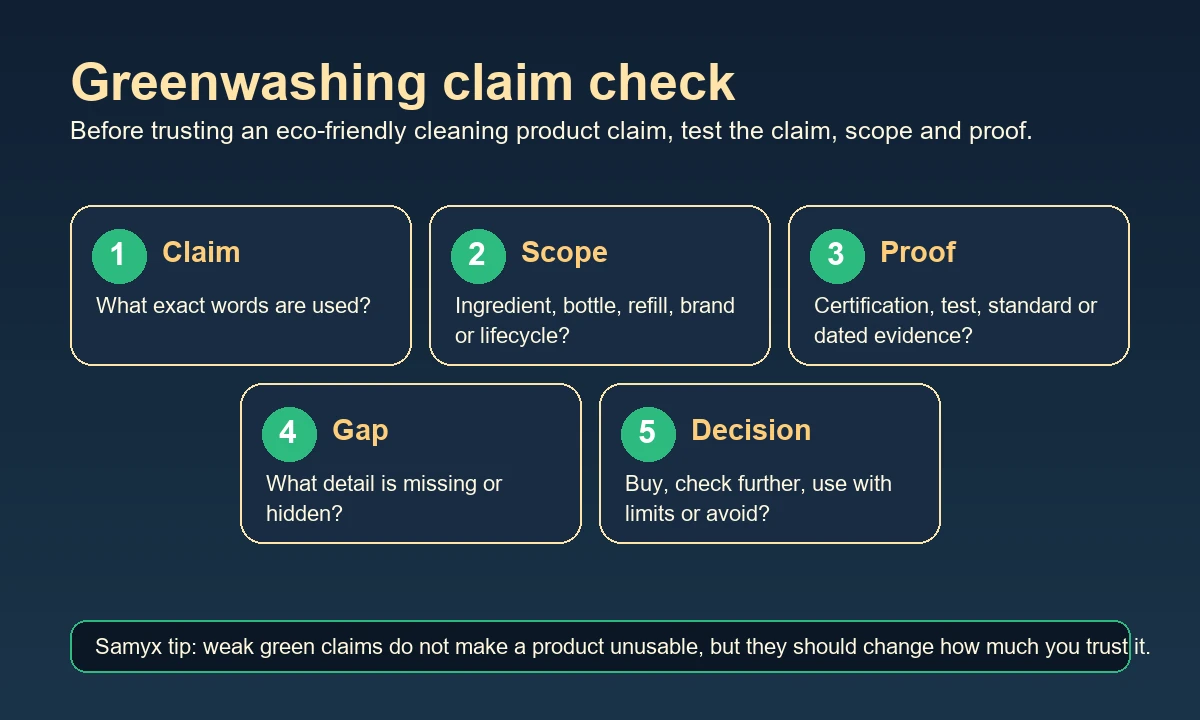
Greenwashing claim worksheet
Use this five-part check before trusting an eco-friendly cleaning product claim.
ClaimWhat exact words are used?“Eco”, “plant-based”, “biodegradable”, “refillable”, “non-toxic”.
ScopeWhich part is greener?Formula, fragrance, bottle, refill, transport, brand or whole lifecycle.
ProofCan you verify it?Independent label, named test, standard, full ingredient function or dated report.
Missing detailWhat is left out?Dilution, disposal, fragrance, surfactants, packaging limits or comparison basis.
DecisionWhat should you do?Buy, check further, use with limits, or choose a clearer product for that job.
Green words that need proof
Some cleaning-product words are useful only when they are tied to something measurable. “Plant-based” may describe one ingredient, most of the formula, or only the fragrance. “Biodegradable” may refer to a surfactant under specific test conditions, not the whole product in your sink. “Refillable” may reduce packaging; the refill pouch, transport and concentration still matter.
Words such as “green”, “eco”, “earth-friendly” and “kind to the planet” are weaker because they sound broad. If the label does not explain what is greener, compared with what, and where the proof sits, the claim is asking for trust before it has earned it. That is the point where greenwashing can begin.
Nature imagery works the same way. A bottle can be beige, green, covered in leaves and sold beside bamboo brushes, with the useful facts sitting on the back label or on a product page. Look for the details behind the design: ingredient functions, hazard information, refill instructions, disposal notes and the limits of any environmental claim.
If a brand uses an unfamiliar badge, check who created it. A self-made icon is not the same as an independent certification. Reliable labels name the standard, the certifier, the product or range covered, and a way to verify the current status. Small logos with no traceable body behind them are decoration, not proof.
You may also enjoy:

Check the scope before you judge the product
Many fake eco-friendly cleaning product claims are not completely false. They are too narrow for the impression they create. A spray might use a recycled bottle even though the formula still contains ingredients you would rather avoid. A concentrated refill can reduce transport and plastic and still need careful dilution, storage and surface testing. Some vegan products also have a weak environmental story elsewhere.
Write down the claim in plain words. Is the brand talking about the liquid, the bottle, the refill system, the fragrance, animal testing, plastic, carbon, water use, aquatic life, palm-derived ingredients, or the whole company? Then ask whether the claim is limited to one product or stretched across the brand.
This is where the Green Claims Code checklist is useful for consumers as well as businesses. It pushes claims back towards accuracy, current evidence, fair comparison, lifecycle thinking and clear caveats. You do not need to become a lawyer to use that logic. You only need to ask whether the bottle tells the whole relevant story or only the flattering part.
For cleaning products, scope is especially important because the same bottle has several jobs. It must clean the surface, be safe to use as directed, avoid damaging materials, be stored correctly, and make any environmental benefit clear enough to compare. The strongest claim in one area does not cancel every trade-off in another.
Labels, certifications and self-made badges
A credible label should make verification easier. It should not make you guess. Look for the name of the certifying body, the standard or scheme, the product covered, and the date or current listing. If the certification applies to the company office, a factory process or one ingredient, it should not be presented as proof that every cleaning product in the range is environmentally preferable.
Third-party labels can still have different scopes. Some focus on ingredients, some on animal testing, some on packaging, some on environmental management systems. That is why the question is not simply “does it have a logo?” The better question is “what does this logo actually verify for this product?”
The ASA’s environmental claims guidance is clear that broad claims need a strong basis, limits need to be made clear, and full-life-cycle impact may matter when a claim sounds general. That helps explain why a product can get into trouble even if one part of the message is true. The claim can still mislead if the total impression is bigger than the evidence.
Be careful with “free from” claims as well. A product may say it is free from a certain ingredient because that ingredient is not normally used in that product type anyway. If the claim presents a basic or legally required feature as an environmental advantage, it may not help you choose between products.
Ingredients, performance and packaging trade-offs
Ingredients deserve more than a quick good-or-bad list. Cleaning products use surfactants, acids, alkalis, solvents, preservatives, fragrance components and disinfecting agents for different reasons. Look for a label or product page that explains their function clearly enough for the job you need.
Plant-derived formulas can still irritate skin or damage a surface if used wrongly. A strong disinfectant can be useful after illness and unnecessary for routine dust and light soil. A vinegar-based cleaner can sound simple and natural, then damage stone, grout, seals and some appliance parts. Read ingredients and labels on cleaning products together with the surface and the task.
Packaging claims need the same treatment. A recycled bottle, refill pouch or concentrated tablet can reduce one type of impact. The claim should still say what changes and what does not. Check whether the bottle is recyclable in your local system, the refill is lighter to transport, the product needs less water, and the disposal route is clear. If the answer is hidden, the claim is incomplete.
Performance also matters. A weaker product that needs repeated applications, hot water, extra rinsing or another specialist product may not be the greener choice in practice. That does not mean the strongest chemical is best. It means environmental claims should be judged alongside dose, method, surface compatibility and the amount of cleaning needed.
For the wider picture, connect the product claim with the environmental impact of cleaning products. Water, packaging, fragrance, aquatic toxicity, transport, concentration and disposal all affect the real footprint. A single front-label phrase rarely covers all of that.
What to do when the claim is weak but the product still works
You do not need to throw out every product with weak marketing. A practical response is better. Keep using safe, suitable products according to the label and stop giving unsupported claims extra weight. Replace them gradually with products that provide clearer evidence, better dilution instructions, less confusing packaging or a stronger refill system.
If the product has a broad claim and cleans well, use it for the jobs where it is appropriate and do not treat it as proof of a fully sustainable routine. If it has poor directions, unclear ingredients, heavy fragrance or no information on surfaces, keep it away from delicate materials and food-contact areas until you can check. Product choice is only one part of safer cleaning.
Do not replace one problem with another. Homemade or “natural” substitutes can also be misused. Vinegar, bicarbonate of soda, lemon juice, fragrance oils and soap-based mixes all have limits. The same evidence habit applies to DIY options, which is why DIY cleaning product safety still matters as you try to avoid greenwashing.
When you finish a bottle, disposal is part of the decision. Rinse or recycle only where the product label and local recycling rules make that suitable. Keep concentrated refills, capsules and chemical residues away from children and pets. If a product is leaking, unlabelled or no longer identifiable, do not keep it for a future job.
For bottles, packaging and leftover supplies, recycling and reusing in the cleaning process gives the topic a more practical home. The best product choice is easier to make when storage, use and disposal are treated as one routine.
How Samyx Cleaning helps without making green claims for you
Samyx Cleaning is not an eco-certifier, and a regular cleaner should not be used as proof that a product brand is sustainable. The useful service connection is more practical: a planned cleaning routine can reduce rushed product choices, repeated scrubbing, overuse of strong chemicals and the habit of buying a new bottle for every small problem.
With regular domestic cleaning in London, households can keep bathrooms, kitchens, floors, dust and high-touch areas under control on a schedule. That makes it easier to use suitable products in the right amount, follow labels, ventilate where needed and avoid mixing different cleaners under pressure.
Need regular home cleaning?
Enter your postcode to view our rates and availability in your area.

If you have product preferences, fragrance sensitivities, surfaces that need mild treatment, or supplies you do not want used, note that before the clean. The cleaner can then work within the agreed service scope and the product directions. That is different from promising a fully green home; it is a clear way to make cleaning choices more deliberate.
The service route is most useful when the issue is not one bad product, but a home routine that keeps slipping into last-minute cleaning. Predictable work makes the product decision easier: fewer emergency sprays, fewer half-used bottles, and more control over what is used on the surfaces you touch every day.
Frequently asked questions
-
What is greenwashing in cleaning products?
Greenwashing in cleaning products is when a product, brand or advert gives a greener impression than the evidence supports. It can happen through broad words, nature imagery, weak badges, selective ingredient claims, hidden trade-offs or broad eco claims with no clear proof.
-
How do I spot fake eco-friendly cleaning product claims?
Check the exact claim, the scope, the evidence and the missing detail. A useful claim should say what is greener, compared with what, which part of the product it applies to, and where current proof can be checked.
-
Are natural cleaning products always better?
No. Natural does not automatically mean safer, suitable for every surface or better for the environment. Read the label, check the ingredients and use directions, and judge the product by evidence, not the word natural alone.
-
Which eco labels should I trust?
Trust labels that name an independent body, explain the standard, show what product or claim is covered and allow current verification. A badge created by the brand itself may still be useful branding; it is not the same as independent proof.
-
Can a professional cleaner choose eco-friendly products for me?
A domestic cleaner can follow agreed product preferences within the service scope and product directions. They should not be treated as an environmental certifier. If a specific claim matters to you, check the product evidence before asking for it to be used.
Safety and claims note: Use this as practical consumer guidance, not legal advice, environmental certification advice or chemical safety advice. Follow the product label and the surface manufacturer’s care instructions first. Do not mix cleaning products, do not assume a natural or eco claim makes a product safe for every surface, and seek specialist help for chemical exposure, allergies, damaged materials, commercial compliance decisions or claims you need to rely on legally.
Author: Svetlana Georgieva (Clara)
Hi, I’m Svetlana Georgieva, but you can call me Clara. As the co-founder and heart behind Samyx Cleaning, I’m devoted to sharing the art of a clean space. Let’s journey into a cleaner, more joyful life together with tips from London's cleaning experts.

Discover more of our cleaning secrets: