
Do Homemade Cleaning Products Really Work?

Last modified on: 03/09/2026
Publish: 2nd Jun 2022
Views:
Category: Cleaning & Health
Tags:
Baking soda, Disinfection, Eco-friendly cleaning, White vinegar

Homemade cleaning products can work well for specific everyday jobs, but the ingredient, soil and surface must match.
Match the cleaner to the job
- Identify the surface and check its care instructions before choosing an ingredient.
- Use warm water and a small amount of washing-up liquid for ordinary removable dirt on compatible washable surfaces.
- Reserve diluted vinegar for acid-compatible mineral deposits and bicarbonate paste for durable surfaces that tolerate mild abrasion.
- Patch-test first, never mix a homemade recipe with another cleaner, rinse when required and stop if the finish changes.
I’ve been riffing about eco-friendly homemade cleaning products for a while now. If you have a look at other articles I’ve written on our blog, you’ll notice I recommend them at every opportunity. So much so, that some of our readers have reached out to me and asked if they really work.
At first, I was mind-boggled at the question. I mean, the easiest way to find out whether homemade cleaning products work or not is to try them out. But then it hit me – many people don’t like trying new things. Heck, I don’t like trying new things and it’s actually a part of my job.
So instead of answering every email individually, I’ve decided to address this question in an article I can easily refer people to in the future.
Key Takeaways
- Choose by soil and surface, not by whether an ingredient is described as natural.
- Use soap or detergent and physical wiping for routine cleaning; do not assume a DIY recipe disinfects.
- Keep acids away from natural stone and other acid-sensitive finishes, and keep abrasive pastes away from scratch-prone surfaces.
- Make small batches, label every container and keep mixtures away from children, pets, food and commercial products.
- Use a labelled commercial product when a verified disinfectant claim, specialist chemistry or manufacturer-approved method is required.
Table of Contents
What are homemade cleaning products?
Before we answer the question of whether homemade cleaning products work, we need to specify what they are. Mixing a storebought concentrate with water at home hardly makes it “homemade”.
When I talk about homemade products, what I mean is making eco-friendly cleaning supplies at home from things you don’t normally use for cleaning, such as white vinegar and baking soda.
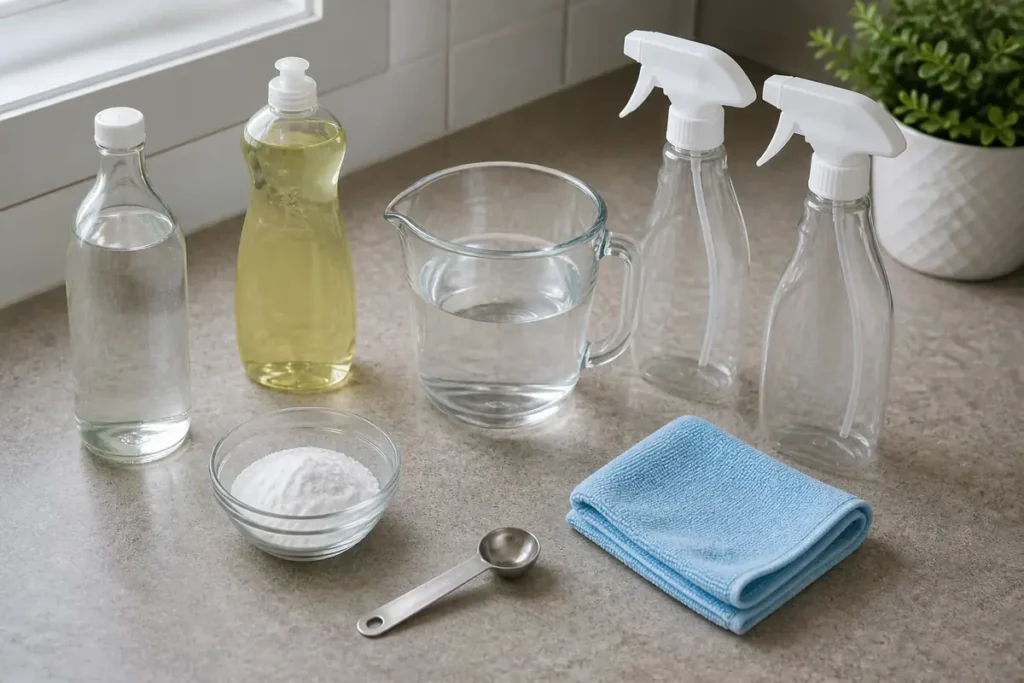
What each homemade cleaning agent actually does
A cupboard ingredient is not a universal cleaner. Its useful action can be narrow, and the same property that helps on one deposit may damage another surface.
| Ingredient | Useful role | Main limit |
|---|---|---|
| Warm water | Loosens many fresh, water-soluble spills and carries away loosened soil | Too much moisture can swell wood, enter seams or affect powered items |
| Washing-up liquid | Surfactants help lift ordinary grease and dirt from compatible washable surfaces | Too much leaves residue and some finishes need a manufacturer-approved product |
| White vinegar | Acidity can help with limescale and some hard-water marks | Acid can etch marble, limestone and other sensitive surfaces and affect some metals or finishes |
| Bicarbonate of soda | A paste can provide mild abrasive action and help with some odours | It can scratch polished, coated, soft or delicate materials and may leave a white residue |
| Lemon juice | Acidity can act on some mineral deposits | It carries the same broad acid risks as vinegar and is not proof of disinfection |
| Fragrance additions | Add scent when suitable for the household and formulation | Fragrance is not cleaning power and may be unsuitable around some children, pets or sensitivities |
Are homemade cleaning supplies effective?
Yes, homemade cleaning products are effective. I wouldn’t vehemently recommend them if they weren’t. However, there are a few caveats.
First off, you need to know what you’re doing. Many people try using vinegar or lemon juice on the wrong stains and then complain about the results.
Vinegar is acidic so it’s perfect for things like mineral deposits and hard water stains. Combined with lemon juice, it’s also a natural disinfectant.
Cleaning is not the same as disinfecting: the linked study tested specific foodborne pathogens under controlled conditions. It does not turn every vinegar-and-lemon household mixture into a validated surface disinfectant. Routine cleaning with soap or detergent removes dirt and many germs; when disinfection is actually needed, use a suitable labelled product exactly as directed. The distinction is explained in current cleaning and disinfecting guidance.
Baking soda, on the other hand, is a base. This means it’s effective against organic stains, such as grease splatter. Trying to use baking soda on hard water stains or white vinegar on grime will result in a disaster.
Another caveat is you need to hit the proper proportions. Baking soda is usually combined with water and made into a paste. Vinegar has strong acidic properties, so it too should be diluted. Too diluted, however, and it won’t be effective.
Finally, eco-friendly cleaning products require a bit more elbow grease. You’ll have to scrub a little harder to get the same result since you’re not treating the surface you want to clean with harsh chemicals. However, that’s a small price to pay in order to stay eco-friendly.
The practical correction is to judge the whole method, not one ingredient. A small amount of washing-up liquid is usually a better starting point for greasy soil because its surfactants help oil and water interact. Bicarbonate contributes mild abrasion rather than behaving like a universal chemical degreaser. Vinegar and bicarbonate also neutralise much of each other’s useful chemistry when combined, so fizzing should not be mistaken for extra cleaning power.
Choose by soil and surface
| Job | Reasonable first choice | Do not improvise when |
|---|---|---|
| Fresh food or everyday dirt on a washable worktop | Warm water, a little washing-up liquid and a clean cloth | The surface is unsealed, porous, speciality-coated or has maker-specific care instructions |
| Limescale on compatible glass or ceramic | A brief, patch-tested diluted vinegar treatment followed by rinsing | The surface contains natural stone, cement-based grout, an unknown finish or acid-sensitive metal |
| Light residue on durable ceramic or uncoated stainless steel | A gentle bicarbonate paste, used without heavy pressure and rinsed away | The surface is polished, coated, soft, decorative or easily scratched |
| Kitchen grease on a sealed washable surface | Warm water and washing-up liquid, followed by a clean-water wipe | The appliance is hot, powered, porous or has openings and sensitive controls |
| Illness, raw-food contamination or a verified disinfection need | Clean first, then use a labelled compatible disinfectant when guidance calls for it | A homemade recipe has no validated claim, concentration or contact time |
| Unknown stain or valuable material | Identify both before treatment and check the manufacturer’s advice | You cannot confirm compatibility in a hidden test area |
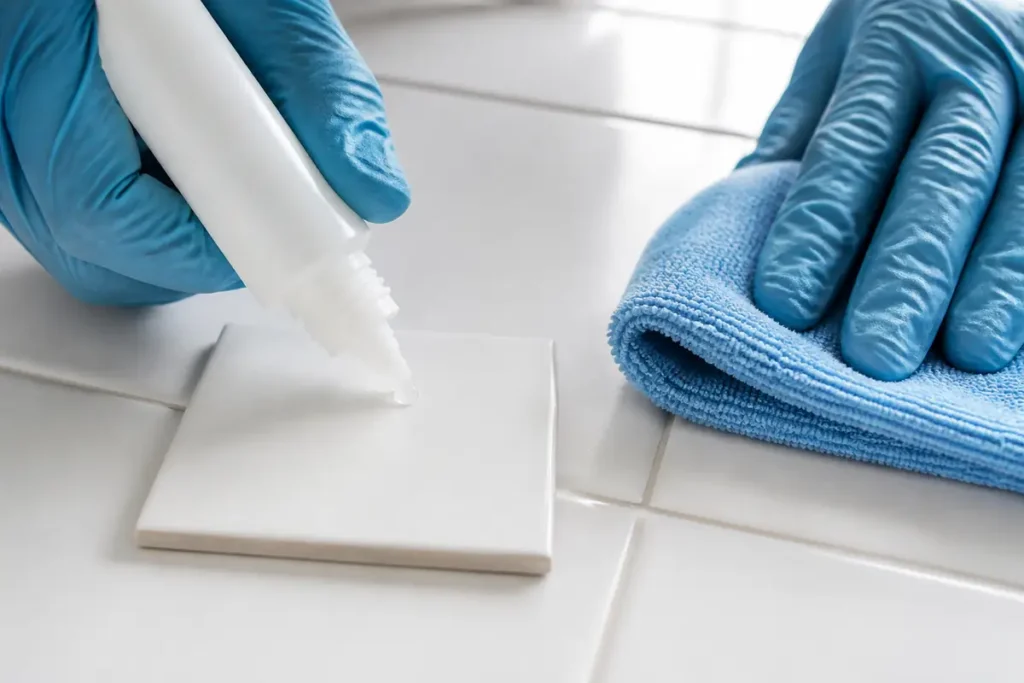
Homemade cleaning products for four everyday jobs
These are small-batch starting points for compatible household surfaces. Check the item’s instructions, wear any protection the task requires and test a hidden spot first. Never add bleach, ammonia, disinfectant or another cleaner.
1. Mild homemade cleaning solution
- Add one teaspoon of mild washing-up liquid to 500 ml of warm water in a bowl.
- Dampen a clean cloth rather than flooding the surface.
- Wipe the compatible washable area, then use a separate clean damp cloth if rinsing is needed.
- Dry the surface and discard the used mixture when the job is finished.
This is the sensible first choice for ordinary removable dirt and light grease. It is not intended for unsealed wood, electronics, absorbent stone or any surface whose instructions rule out water or detergent.
2. Homemade cleaning spray for limescale
- Mix equal parts white vinegar and water in a clearly labelled spray bottle.
- Apply it to a small patch of acid-compatible glass or ceramic, keeping it away from joints and surrounding materials.
- Allow only brief contact, wipe gently, rinse with clean water and dry.
- Stop if the surface dulls, changes colour or the surrounding seal or metal reacts.
Do not use this on marble, limestone, travertine or another acid-sensitive natural stone. Avoid unknown metals, coatings, wood finishes, rubber parts and cement-based grout unless the manufacturer expressly permits an acidic cleaner.
3. Bicarbonate paste for compatible durable surfaces
- Mix three parts bicarbonate of soda with about one part water to form a soft paste.
- Apply a small amount to a patch-tested durable surface with a soft damp cloth.
- Use light pressure, then remove every trace of the paste with clean water.
- Dry and inspect before repeating.
This method relies partly on abrasion. Keep it away from polished stone, lacquer, acrylic, delicate glass, non-stick coatings, plated metal and any finish that scratches or clouds easily.
4. Mild homemade degreaser
- Use the same ratio of one teaspoon of washing-up liquid to 500 ml of warm water.
- Switch off and cool the appliance or work area where relevant.
- Apply the solution with a cloth so liquid cannot enter controls, vents or seams.
- Wipe away loosened grease, rinse if the surface requires it and dry thoroughly.
For baked-on deposits, delicate finishes or an appliance with specific care instructions, stop and use the approved product or method. Stronger chemistry is not automatically safer, but neither is a homemade substitute.
When should you use homemade cleaning products?
You can hardly go more eco-friendly than homemade cleaning products. People use them for many different reasons. There are actually plenty of benefits and very few downsides:
- Saving money – making your own cleaning products is a lot cheaper than buying them from the shop.
- Having small children – many parents don’t like keeping harsh chemicals in a house with small children.
- Avoiding health hazards – mixing certain cleaning products can create a serious health hazard. These hazards can be easily avoided by using eco-friendly products.
- Having health problems – cleaning with asthma can be a serious challenge. Switching to homemade cleaning products makes cleaning-related asthma symptoms less severe.
Sadly, there’s a limit to what you can clean using natural products.
Natural does not mean harmless: homemade mixtures can still irritate skin or airways, damage a surface or become unsafe when stored or mixed incorrectly. Use the smallest suitable amount, ventilate when needed and keep every ingredient and finished mixture out of reach of children and pets.
How to label and store a homemade cleaning spray
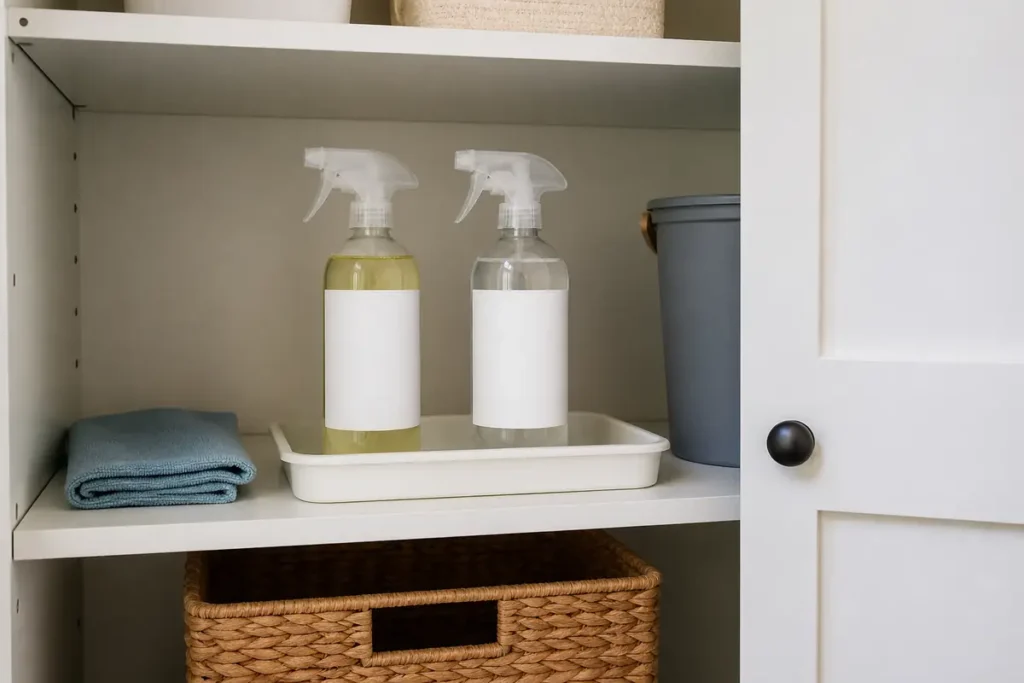
- Use a clean container that is compatible with the ingredients and in good condition.
- Write the full ingredients, dilution, intended surface and preparation date on the label.
- Never use a drinks bottle, food jar or an unmarked container.
- Store the bottle upright, away from food, heat, sunlight, children and pets.
- Do not top up an old mixture, combine leftovers or add a commercial product.
- Make water-based recipes in small quantities and discard them if the appearance, odour or container changes.
A homemade bottle has no commercial product label to supply a tested shelf life, approved surfaces or emergency instructions. The safest routine is to prepare only what you need and keep a written record on the container. For the wider boundaries around storage and incompatible combinations, see our dedicated DIY cleaning safety guide.
You may also enjoy:
When should you use commercial cleaning products?
Sometimes, you need that extra bit of cleaning power you simply cannot get from homemade cleaners. Should the occasion arise, you’d have to use commercial cleaning products. But before you do:
- Make sure you read the label – it’s important to get the dosages and application methods right.
- Don’t mix them with other cleaning products – unless you’re absolutely positive you know what you’re doing, don’t mix cleaning products. Some chemical reactions are violent and can cause serious harm.
- Use protection – use gloves, mask, glasses, any kind of protection you can.
Other than heavy-duty cleaning, natural products should be fine for your everyday needs.
Use a commercial product when you need a verified disinfectant claim and contact time, a manufacturer-approved cleaner, a controlled descaler or degreaser, or specialist treatment for a material or contamination risk. Follow the label rather than adding extra ingredients. UK guidance warns that mixing bleach and ammonia can expose people to toxic gases.
How Samyx Cleaning can help
A clean-smelling home is not created by covering an odour with fragrance. The practical sequence is to remove the source, clean away soil and residue, manage cloths and tools so contamination is not spread, allow damp materials to dry and ventilate where appropriate. Professionals may use commercial products because the label defines the dose, surface, contact time and precautions. Fragrance is optional and never proves that a surface is clean.
If you prefer not to choose, mix and store products yourself, a regular domestic cleaner can handle routine household cleaning with products suited to the agreed surfaces. This does not include specialist decontamination, mould remediation, hazardous spills or restoration of damaged materials.
Book Regular Domestic Cleaning
Enter your postcode to view our rates and availability in your area.

Frequently asked questions
What is the best homemade solution for cleaning?
There is no single best solution for every surface. For ordinary removable dirt on a compatible washable surface, start with warm water and a small amount of washing-up liquid. Use acids only for acid-compatible mineral deposits and mild abrasive pastes only on durable surfaces that tolerate them.
How do I create my own cleaning products?
Identify the soil and surface first, choose one simple compatible formula, measure a small batch and patch-test it. Label the container with the ingredients, dilution, intended use and date. Never add bleach, ammonia, disinfectant or another cleaner, and keep the mixture away from children, pets and food.
What are the five homemade cleaning agents?
Five common options are warm water, washing-up liquid, white vinegar, bicarbonate of soda and lemon juice. They do different jobs: water and detergent handle much routine dirt and grease, acids may help with compatible mineral deposits, and bicarbonate provides mild abrasive action. None is universal.
What do professional house cleaners use to make the house smell so good?
A genuinely fresh result starts with removing the odour source, cleaning soil and residue, using clean tools, drying damp materials and ventilating. Professionals may use labelled commercial products appropriate to each surface. Added fragrance is optional and should not be used to disguise an unresolved odour.
Safety note: use these methods only for ordinary household cleaning. They are not instructions for poisoning treatment, infection-control incidents, hazardous spills or specialist material restoration. Never mix cleaning products. Follow commercial product labels and manufacturer care instructions, ventilate as directed, use the stated protective equipment, keep ingredients and mixtures away from children and pets, and stop if a surface changes colour, texture, gloss or finish. If exposure may have occurred or someone is unwell, seek urgent medical advice.
Conclusion
Natural homemade cleaning products are very effective but you have to use them right. They offer you plenty of benefits at a price point that cannot be beaten.
Even if you use commercial cleaners for heavy-duty cases, cleaning with natural products during your day-to-day still goes a long way toward improving your health and protecting the environment.

Author: Atanas Dzhingarov
Hi, I’m Atanas - brand consultant and writer. I’m helping Samyx Cleaning create the best cleaning company blog on the Internet. Join us on our journey and learn how to live a cleaner, healthier, happier life in the process.
Discover more of our cleaning secrets: