
Are Oven Cleaners Toxic?

Last modified on: 15/09/2026
Publish: 3rd Oct 2022
Views:
Category: Cleaning & Health
Tags:
Eco-friendly cleaning, Kitchen cleaning, Oven cleaning

Is oven cleaner toxic? Many oven cleaners are hazardous when swallowed, splashed into eyes, left on skin or inhaled as spray or mist, but risk depends on the product, exposure and whether its label is followed. “Toxic” is not a useful yes-or-no substitute for safe handling.
Key Takeaways
- Read the hazard label: ingredients and instructions vary substantially between products.
- Control the spray: mist and splashes create avoidable eye, skin and breathing exposure.
- Protect the appliance: some coatings, seals, elements and catalytic liners must not be treated.
- Remove residue: do not heat or cook until the stated wiping, rinsing and airing steps are complete.
- Never mix cleaners: bleach, acids, ammonia and other products can create dangerous reactions.
Table of Contents
How to assess an oven cleaner before use
Label check
What it changes
Hazard pictograms and warnings
Required handling, storage and response if the product contacts skin or eyes
Approved oven surfaces
Whether it can touch enamel, glass, racks, catalytic liners, seals, fans or elements
Application method
Whether spraying is permitted and how to control mist or splashes
Contact time
How long the product may remain before it must be removed
Wiping, rinsing and airing
When the oven is ready to be heated and used for food again
No single ingredient list describes every oven cleaner. Ready-to-use gels, foams, aerosols and professional products may carry different hazards and appliance restrictions. The current container and oven manual therefore govern the method, even if a previous brand was used differently.
The debate about whether oven cleaners are toxic or not never culminates in a clear winner. Opponents talk about hazardous chemicals and dangerous side effects.
Proponents tout the safety of these products as self-evident by virtue of them being on the shelves in supermarkets. So who’s right? Today we aim to find out.
How toxic are oven cleaners?
Debating whether every oven cleaner is simply “toxic” misses the useful question. The real issue is which product you have, what its label says and how someone could be exposed to it.
Most cleaning products base their entire foundation and effectiveness on a few active ingredients. In the case of oven cleaners, those ingredients are effective at dealing with oily and grimy stains. They also happen to be harmful.
If you don’t believe me, take your oven cleaner of choice and read the label. Invariably, there’s going to be a section that tells you what to do if the stuff gets into your eyes or if you ingest it. These scenarios can pose a significant danger to your well-being. I think that answers the question of whether they’re toxic or not.
How hazardous the product is depends on its current formulation. Strong oven cleaners may use corrosive alkalis such as sodium or potassium hydroxide, while other products use different ingredients and carry different precautions. The label on the exact container, not an old generic ingredient list, is the reliable guide.
Strong alkalis are excellent at breaking down oily splatter and grime, but they can also damage skin and eyes. I don’t want to get into more gruesome territory, but you get the gist.
“Wait a minute,” I hear you exclaim. “If these products are so toxic, how come they’re selling them in supermarkets?” Great question, dear reader. And the answer is that thanks to the warning on the label, you’re using these products at your own peril.
Don’t get me wrong, if you take all the necessary precautions, you can clean your oven without a hitch. Precautions like good ventilation where you use these products, wearing glasses, a mask, and gloves will ensure oven cleaning doesn’t cost you your health. But the fact that you need all these measures in the first place settles the toxicity debate, don’t you think?
Can an oven cleaner make you sick?
Can an oven cleaner make you sick? Yes, a hazardous product can cause harm if it is swallowed, splashed, left on skin or breathed in as spray or mist. The route and severity depend on the formulation and exposure.
Not every oven cleaner is highly volatile. Depending on the formulation, the practical breathing risk may come from aerosol, spray mist or poor ventilation rather than rapid evaporation. Follow the exact label and never transfer the product into an unlabelled sprayer.
That’s why it’s essential to ensure proper ventilation while you clean. It’s also ill-advised to use these products if you suffer from asthma or other chronic lung conditions.
Other than toxic fumes, you should also be careful with direct skin contact. These chemicals don’t discriminate between oil stains and your hands.
It goes without saying, but ingesting any oven cleaning products can be potentially life-threatening. Be extra careful when handling any cleaning products.
Finally, be especially mindful about protecting your eyes. Getting toxic chemicals into your eyes is not something you want to deal with, especially if you’re home alone.
Can oven cleaner fumes poison your food?
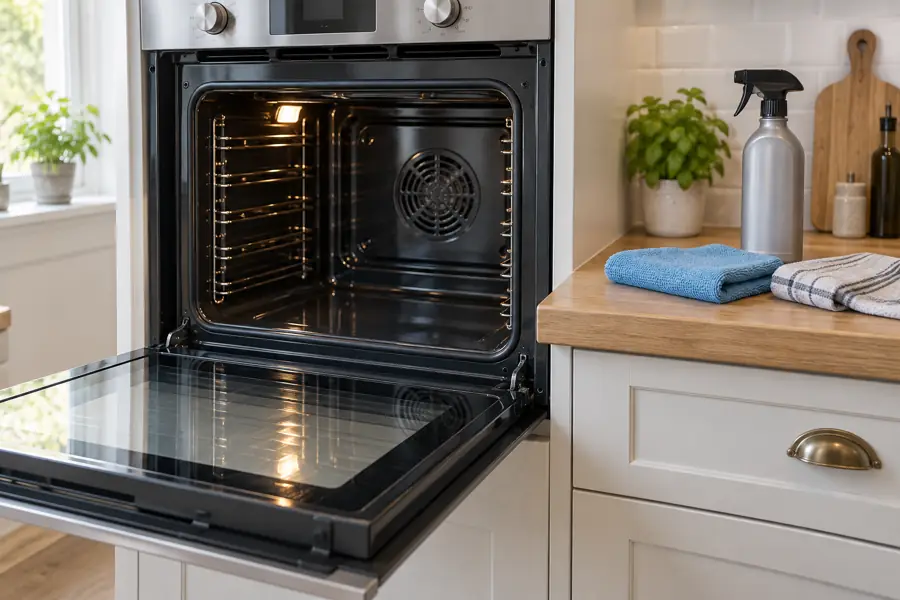
Do not assume residue has disappeared because the product has dried or its smell has faded. Any remaining cleaner can be transferred to food or produce fumes when the oven heats, so the stated removal steps matter.
Remove the product exactly as its label directs. Some instructions specify wiping, repeated rinsing or airing rather than a universal rinse. Do not heat the oven or prepare food while visible cleaner, foam, odour or an incomplete removal step remains.
Oven “self-cleaning” feature
Some ovens come with a so-called “self-cleaning” feature. Whether you should use it depends on that exact model and the manufacturer’s instructions, not on generic advice from the internet.
Some high-temperature programmes heat residue until it turns to ash. Do not start one and then leave the appliance unattended unless the manufacturer explicitly says that is safe. Follow the manual’s ventilation, rack-removal and supervision instructions.
In theory, this makes the remaining ash easier to wipe away. In practice, heavy grease, forgotten food, damaged components or an incorrect setup can create smoke or a fire risk. That is why the preparation instructions matter.
Many people forget food leftovers in the oven before they execute the self-cleaning function. The leftovers catch fire and… well, you can imagine the rest.
The programme may take hours and can produce heat, odour or smoke. Keep children and pets away, ventilate as the manual directs and stop the programme if the appliance shows a fault or unsafe condition.
All in all, use this function only when the manufacturer’s manual provides it and you can follow every preparation and ventilation step. A general article cannot override that model’s safety controls.
Milder oven-cleaning alternatives
As you can see, oven cleaning can be a tricky business. But it does not always require the strongest product on the shelf. A milder method may suit light grease if the appliance manual permits it, and you probably already have the ingredients in your kitchen.
I’m talking about baking soda or diluted white vinegar, depending on the soil and surface. Natural does not mean hazard-free or compatible with every liner, coating or heating system. Do not mix bicarbonate and vinegar in the oven. Choose one manual-compatible method, keep it away from restricted parts and remove all residue before heating. Here’s how you can use baking soda to clean your oven (and your entire kitchen).
If oven cleaner causes an exposure
Stop using the product and follow the emergency instructions on its label. Keep the container available so the substance can be identified. The NHS poisoning guidance says to seek medical advice immediately if someone may have swallowed, touched or breathed in something harmful; call 999 for severe breathing difficulty, collapse or another emergency, and call NHS 111 if you are unsure.
Safety note: The information above supports household product decisions and does not replace poison or medical advice. Follow the exact product label and appliance manual. Never mix oven cleaner with another chemical and never use an unlabelled product.
Conclusion
Are oven cleaners toxic? Some are corrosive or otherwise hazardous, and all should be handled exactly as their labels direct. Make sure your oven is cool and empty before you start cleaning, and never underestimate how easily a simple cleaning can go sideways.
Opt for a milder compatible method when it can do the job. And, of course, if you need professional help, you can always count on us.
Book Professional Oven Cleaning
Enter your postcode to view our rates and availability in your area.


Author: Atanas Dzhingarov
Hi, I’m Atanas - brand consultant and writer. I’m helping Samyx Cleaning create the best cleaning company blog on the Internet. Join us on our journey and learn how to live a cleaner, healthier, happier life in the process.
Discover more of our cleaning secrets: