
White Vinegar for Cleaning: What It Is and How It Works

Last modified on: 13/09/2026

White vinegar for cleaning works because acetic acid reacts with some mineral deposits and alkaline residues, which is why it can help with limescale and certain water marks. That same acidity also creates limits: vinegar is not a universal cleaner, it is not a substitute for a labelled disinfectant, and it can damage acid-sensitive materials.
Use vinegar only when the soil and surface suit an acid
- Check the label strength first. Household white vinegar is often around 5% acetic acid. Cleaning vinegar can be stronger.
- Use acidity for mineral deposits and some alkaline residues, not as a replacement for detergent on heavy grease or general soil.
- Check the material before applying it. Natural stone, damaged finishes and other acid-sensitive surfaces can be etched, dulled or weakened.
- Use one cleaning product at a time. Never combine vinegar with bleach or another cleaner unless the product instructions explicitly direct it.
Key Takeaways
- Match white vinegar to mineral deposits and alkaline residue; do not treat it as an all-purpose cleaner.
- Read the acidity on the bottle because dilution only makes sense when the starting concentration is known.
- Use a labelled disinfectant when disinfection is required; household vinegar does not provide a validated contact-time claim.
- Check the surface care instructions before using an acid, especially on stone, grout, wood finishes and mixed-material fittings.
- Keep vinegar separate from bleach and other cleaning chemicals, and rinse before changing products.
Table of Contents
What White Vinegar Is and Why Acidity Matters
White vinegar is mainly water and acetic acid. Many household food-grade white vinegars are around 5% acetic acid, although the exact strength varies by product. The percentage on the label is more useful than assuming every bottle has the same pH or cleaning strength.
Acetic acid reacts with alkaline mineral deposits. That is why vinegar can loosen calcium-rich limescale around some taps, shower fittings and other compatible hard surfaces. Acidity can also help with certain mineral films left after hard water dries. It is far less useful against jobs dominated by oils, fats or particulate soil, where a detergent or another surface-compatible cleaner is usually the better chemistry.
The wider chemistry is explained in how cleaning products work: the useful product depends on the soil, the surface, contact time and mechanical action. One ingredient cannot cover every cleaning mechanism.
Acidity percentage and pH answer different questions
The percentage on the bottle tells you how much acetic acid is present. Dilution changes that concentration in a predictable way. A one-to-one mix of 5% vinegar and water produces roughly 2.5% acetic acid. The same dilution of a stronger cleaning vinegar leaves a stronger final solution.
pH tells you how acidic the solution is. It does not replace the concentration on the label. Two acidic products can have similar pH readings and still behave differently because concentration, formulation and buffering affect how much acid is available during cleaning. For household decisions, the labelled acidity and the surface instructions are more useful than chasing one quoted pH number.
What White Vinegar Can and Cannot Do
Vinegar earns its place in a cleaning cupboard when the problem is compatible with a mild household acid. The same bottle becomes a poor choice when the job needs surfactants, validated disinfection or a surface-safe specialist product.
Limescale and mineral film
Acetic acid can help dissolve alkaline mineral deposits on compatible surfaces. Stop if the fitting, stone, grout or finish is not acid-safe.
Grease and oily soil
Vinegar is not a surfactant. A suitable detergent normally lifts oily soil more effectively and with less unnecessary acidity.
Routine disinfection
Use a disinfectant labelled for the surface and purpose, then follow its concentration and contact time. Do not substitute household vinegar.
Unknown or delicate finishes
Check the manufacturer care instructions before cleaning. If the finish cannot be identified, start with the least aggressive compatible method.
Surface-specific examples vary enough to need separate treatment. The guide to cleaning with white vinegar maps those practical uses and limits. The decision remains the same: match the acid to the soil and material before applying it.
White Vinegar and Cleaning Vinegar Are Not Always the Same Strength
Household white vinegar and products sold as cleaning vinegar both rely on acetic acid. The concentration and intended use can differ. A stronger cleaning product is not automatically more effective for every job. Higher acidity can increase the chance of damaging finishes, grout, metals or nearby materials.
Food-grade white vinegar is sold for culinary use as well as household tasks. A cleaning vinegar may be sold only as a cleaning product. Treat the label as the authority for concentration, intended use, warnings and whether dilution is required. Do not assume a bottle labelled cleaning vinegar can be used in food or appliances.
Dilution Depends on the Starting Acidity and the Surface
A universal vinegar-to-water ratio is misleading because the same ratio can create very different final strengths. If a 5% vinegar is mixed one-to-one with water, the acetic acid concentration becomes roughly 2.5%. If the starting product is stronger, the final mixture is stronger too.
Use the weakest concentration that can do the job without damaging the material. For a small mineral deposit on an acid-compatible fitting, short controlled contact can be more sensible than flooding the whole area. Rinse afterwards where the surface or product guidance calls for it, then dry the area so loosened mineral residue is removed and not redistributed.
Appliances need their own instructions. Kettles, coffee machines, washing machines and dishwashers contain seals, metals and internal components that may have model-specific descaling guidance. Follow the manufacturer procedure and avoid a generic vinegar ratio.
A controlled vinegar treatment uses less liquid, not more
- Identify the deposit and confirm that an acid is suitable for the surface.
- Read the bottle strength and the material care instructions before deciding whether to dilute.
- Test a hidden area when the finish, coating or previous treatment is uncertain.
- Apply only enough solution to wet the deposit and avoid flooding joints, edges or nearby materials.
- Remove the loosened residue, rinse when required and dry the surface so the remaining minerals are not left behind.
You may also enjoy:
White Vinegar Is Not a Substitute for a Labelled Disinfectant
Cleaning and disinfection are different jobs. Cleaning removes soil and reduces contamination physically. Disinfection depends on a product being suitable for the target organism and surface, applied at the stated concentration and left for the required contact time.
Household vinegar can show antimicrobial activity under some laboratory conditions. That does not give a bottle of vinegar a validated household disinfection claim. Where disinfection is needed, use a suitable labelled product and follow its instructions. The HSE guidance on disinfectants also stresses concentration, contact time and compatibility with the surface.
The distinction matters most on food-preparation areas, toilets, illness clean-up and other jobs where simply removing visible residue is not the whole task. More acidity does not turn vinegar into a validated disinfectant.
Why Vinegar Sometimes Helps with Odours
Some odours come from alkaline residues, so an acid can change the chemistry at the surface and reduce the smell. That does not make vinegar a universal deodoriser. Smoke, mould, spoiled food, pet contamination and liquids absorbed into porous materials can keep producing odour after a surface wipe.
Remove the source first. Clean the contaminated material with a method suited to that material, then ventilate and dry it fully. Adding more vinegar to a persistent smell can mask the decision that matters: whether the odour is sitting on the surface or coming from material underneath it.
Mixing Vinegar with Other Cleaners Can Reduce Performance or Create Risk
Vinegar and bicarbonate of soda produce the familiar fizz because an acid and a base react. The reaction releases carbon dioxide and moves both ingredients towards neutralisation. Bubbling can help disturb loose debris in some situations. A combined mixture is not automatically stronger than using the right ingredient separately.
More detail on the chemistry and practical limits is available in the dedicated baking soda and vinegar article. For household cleaning, a safer rule is to use one product at a time, rinse when changing products and avoid improvised mixtures.
Never mix vinegar or another acidic cleaner with bleach. The Health and Safety Executive warns that hypochlorite bleach can produce toxic gases when mixed with acidic cleaners. Keep cleaning products in their original labelled containers and follow the product directions.
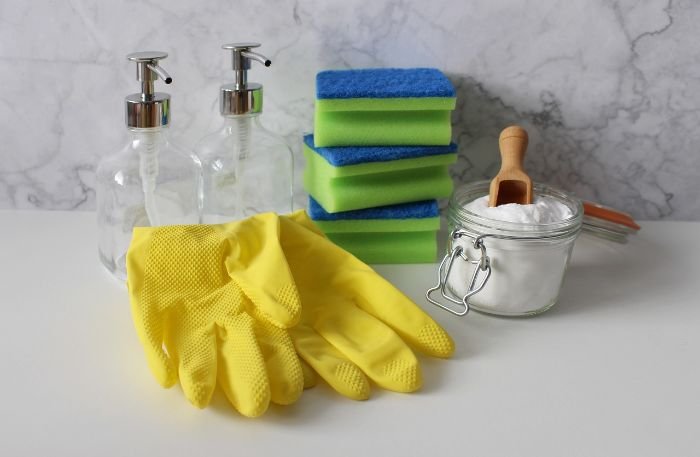
Store Vinegar as a Cleaning Product Once It Enters the Cleaning Cupboard
Keep the original bottle closed and labelled, away from children and pets. If a diluted solution is moved into a separate spray bottle, label the bottle with its contents and concentration and never use a food or drink container. A clear label matters more than a decorative storage bottle because it prevents accidental mixing and mistaken use.
Do not keep homemade mixtures whose composition is uncertain. If a task needs a stronger or more specialised product, return to the labelled product directions and avoid building a stronger DIY blend from several ingredients.
Run a Controlled Test Before Scaling Up
Start by identifying the problem rather than reaching for vinegar because it is familiar. A chalky deposit may respond to a mild acid, while cooking grease usually needs a suitable detergent. If the residue is unknown, remove loose soil first and check the manufacturer’s care instructions before choosing a product.
Test the weakest practical solution on a small, hidden area. Use only enough liquid to wet the mark, keep it away from joints and electrical parts, and watch for colour transfer, dulling, softening or a change in texture. Stop if the surface changes. When the test is satisfactory, treat a manageable area, rinse where the product and material require it, and dry the surface instead of leaving acidic residue behind.
Check the Material Before Using Vinegar
Acid-sensitive materials are the main reason vinegar should never be treated as an all-purpose cleaner. Marble, limestone, travertine and other calcium-rich stone can etch when exposed to acid. Cement-based grout, some metals, unsealed wood and damaged surface coatings can also be affected by repeated or concentrated acidic cleaning.
Mixed-material fittings need extra care. A tap may have acid-tolerant glass nearby, a plated metal finish, silicone seals and cementitious grout in the same splash zone. Cleaning the limescale successfully is not useful if the surrounding finish is dulled or the joint is weakened.
The dedicated list of surfaces to avoid with vinegar covers the material exclusions in more detail. When the care instructions are unclear, test a hidden area or use the manufacturer-recommended cleaner.
Safety note: White vinegar and cleaning vinegar are acidic products. Follow the bottle label and the surface care instructions, ventilate where directed, keep cleaning products out of reach of children and pets, and never mix vinegar with bleach or another cleaner. If accidental exposure occurs, follow the product first-aid information and seek appropriate medical advice when needed.
When a One-Off Clean Makes More Sense Than Another DIY Mixture
Vinegar is useful for a narrow set of compatible mineral-cleaning jobs. It becomes inefficient when a kitchen or bathroom has several soil types at once: grease, dust, soap residue, limescale, food soil and different finishes all need different methods.
Samyx Cleaning’s one-off cleaning service is the practical route when a wider reset is needed across multiple rooms and surfaces. The cleaning team can match the method to the material and soil without applying one household acid everywhere.
Professional help is also sensible when the finish is unknown, the build-up is heavy, several products have already been tried or the property needs more work than one small treatment can solve.
Need a cleaning service?
Enter your postcode to view our rates and availability in your area.

Frequently Asked Questions
-
Does white vinegar remove limescale?
White vinegar can help dissolve alkaline mineral deposits such as limescale on acid-compatible surfaces. Check the material first because natural stone, some grout, finishes and metals can be damaged by acid.
-
What percentage of white vinegar is best for cleaning?
There is no single best percentage for every task. Many household white vinegars are around 5% acetic acid. Cleaning vinegar can be stronger. Follow the product label and the surface care instructions before deciding whether dilution is needed.
-
Is white vinegar a disinfectant?
Do not rely on household white vinegar as a substitute for a labelled disinfectant. When disinfection is required, use a suitable product at the stated concentration and contact time for the surface and purpose.
-
Is cleaning vinegar the same as white vinegar?
Both usually rely on acetic acid. Cleaning vinegar can have a different concentration and may be sold only for cleaning. Check the label strength, intended use and warnings before treating the products as interchangeable.
-
Can you mix white vinegar and bicarbonate of soda for cleaning?
The acid and base react, partly neutralise each other and release carbon dioxide. Fizzing can move loose debris. That reaction does not automatically create a stronger cleaner. Use the right product for the soil and surface, and never mix cleaning chemicals casually.
Author: Svetlana Georgieva (Clara)
Hi, I’m Svetlana Georgieva, but you can call me Clara. As the co-founder and heart behind Samyx Cleaning, I’m devoted to sharing the art of a clean space. Let’s journey into a cleaner, more joyful life together with tips from London's cleaning experts.

Discover more of our cleaning secrets: